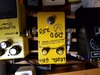
So....Watcha Been Eyeballin'?

I havent been eye-ballin' much except the rising inflation.
I did recently get a DOD 250 pre amp clone from a small builder based in eastern P.A.
I have never tried another, so I cant compare.

Really like it, very different, more transparent than the Klon clones I have, and without the mid hump of the Tubescreamer, Rat, and different EQ than the Boss SD-1, also without as much bass cut filter. I use them all more or less with different guitars , amps and the tone I am seeking (but rarely finding), when using them more as boost / light OD.

The gain gets really and suddenly hard clipped at the last few degrees to max.
It is actually quite useful for very low volume distortion play. With the amp vol still up and the level on the pedal down, it doesn't sound so weak / anemic as the others.

At volume, I dont use it that way, or with the gain up like in the pic; usually around 9-11:00 ish, but I'm always experimenting.

20220207_180909-2.jpg
 
I havent been eye-ballin' much except the rising inflation.
I did recently get a DOD 250 pre amp clone from a small builder based in eastern P.A.
I have never tried another, so I cant compare.

Really like it, very different, more transparent than the Klon clones I have, and without the mid hump of the Tubescreamer, Rat, and different EQ than the Boss SD-1, also without as much bass cut filter. I use them all more or less with different guitars , amps and the tone I am seeking (but rarely finding), when using them more as boost / light OD.

The gain gets really and suddenly hard clipped at the last few degrees to max.
It is actually quite useful for very low volume distortion play. With the amp vol still up and the level on the pedal down, it doesn't sound so weak / anemic as the others.

At volume, I dont use it that way, or with the gain up like in the pic; usually around 9-11:00 ish, but I'm always experimenting.

View attachment 80413
I see they spared no expense on the artwork :pound-hand:
 
We were trained to tune to pitch as step #1.

Then check and adjust relief as step 2.

To check relief, affix a capo at the first fret, push down on the strings at the last fret and your measurement should be taken/evaluated at the 7th fret.

Then adjust bridge height to yield .070" at the 12th unfretted as step 3.

(Fender specifies checking action height at the 17th unfretted with a capo on the first to a specification of 4/64" - Guess what??? This is exactly .070" at the 12th unfretted.)

Re-tune to pitch after above steps are taken.

Then check and adjust the 1st fret height at the nut to .020" to .025" unfretted with .022" being the Blueprint Specification.

Wow. Very interesting!

Fender needs to update their manuals. They don’t specify to use a capo at the first fret when checking the action at the 17th fret. However, immediately prior to discussing action, the manual does say to use a capo when checking relief, so maybe the intention is that you just progress from checking/setting relief to checking/setting action and the idea is that the capo would still be attached? Still, I think they could make that a little clearer.

Anyway, let me ask…what do you do if you set everything and you still encounter some fret buzz? Do you have to make a judgement call on how much buzz is acceptable? Also, what gauge of strings is used? I think my Strat came with 9-42, but I don’t quite recall.
 
I typically buy new from the boutique, hang on for a while, and sell for a profit. The only watch I have kept long-term is one my wife gave me for our 20th Anniversary, which for obvious reasons I can't move on. Honestly, the only reason I talked myself out of it was we had just walked out of brunch and I had a couple of drinks under my belt and I didn't want to impulse-buy something that expensive under those circumstances.

Still thinking about calling the dealer up and having her put it aside for me though.

Haha, the last time I wore a watch was in the 80's
 
Wow. Very interesting!

Fender needs to update their manuals. They don’t specify to use a capo at the first fret when checking the action at the 17th fret. However, immediately prior to discussing action, the manual does say to use a capo when checking relief, so maybe the intention is that you just progress from checking/setting relief to checking/setting action and the idea is that the capo would still be attached?

Anyway, let me ask…what do you do if you set everything and you still encounter some fret buzz? Do you have to make a judgement call on how much buzz is acceptable? Also, what gauge of strings is used? I think my Strat came with 9-42, but I don’t quite recall.

Exactly!!!! The capo at the first fret is used to check relief. The reason fender gives a 17th fret spec is only so you don't have to remove the capo. It's an 'economy of movement' thing only.

I'm setting up 72-85 guitars in a 10 hour day.

(Setup defined: Visual inspection under fluorescent light, Tune to pitch, check/adjust relief, check/adjust action height, check/adjust 1st fret height @ nut, check/adjust pickup height, check electronics function, play scales to ensure no fretting out or buzzing)

So, keep this in mind...

Gibson's spec is .070" at the 12th fret unfretted. It's exactly the same as 4/64" at the 17th with a capo at the first. It doesn't matter which method you use.

(Gretsch specifies checking relief at the 8th fret with a capo on the 1st, then checking action height at the 12th, but it doesn't matter...it's all gonna give you .070" at the 12th, regardless of the method used.)

I also snap the capo on the 3rd fret and check the action at the first fret, even though both fender and Gibson only give a spec for checking the first fret height unfretted.

My Personal Time-Saving Tip:

I also do "overflow" setups for a couple of local Luthiers and I work as an independent (extra help) tech for a couple of factory warranty techs on the "down low."

If you are evaluating a guitar for nut height, then a capo at the 3rd fret will be fastest method. What you want to see is 'perceptible movement" between the string and the first fret. What this will give you is a quick 'snapshot' of whether or not you have minimum 1st fret clearance. It won't tell you how much clearance you have, but when diagnosing problems, you really don't care. You just want to know you have 'adequate' first fret action height and this is the fastest method.

TBTH, when calculating/evaluating action height, the string gauge is meaningless. We are only measuring the height from the bottom of the string to the top of the fret. As long as the string is seated in the nut slot, that's all we care about.

Now, here's where things really started to make sense to me in my training.

IF you have .008" to .012" relief at the 7th fret

IF you have .022"/.025" 1st fret unfretted action

IF you have .070" at the 12th fret unfretted

You will have ZERO issues with buzzing.

Period. End of story.

IF you have buzzing at these specs, you have a hump in the fretboard (which you would have seen during your "rifle sight" neck inspection) or a lifted fret.

Pickup adjustment is another thing. Even though we are given a 'spec' for pole piece to string adjustment, most people will alter this, not realizing that the spec is really a product of scientific research by engineers. On a Fender single coil, 3/32" is the minimum spec on both sides and this is specifically to prevent/reduce "wolftones" or the "Stratitus" harmonic oscillation brought on by magnetic pull. I tend to shhot for 4?32" on just about everything to increase speed and productivity.

I even paint colored marks on my Stewie-Mac rulers so I don't have to "look for the spec."

If the pickup’s magnet pulls on a vibrating string, it can actually affect both intonation and sustain, because the pull of the magnetic field deadens/impedes the string's vibration. (I'm sure you all now this fact) This is less of a problem with humbuckers, but many people still move them too close - or too far away - for optimum performance. The engineering documents even show a shaded magnetic field around the pole pieces/bobbins and describe how far into this field the string should intrude for both maximum output an sustain, both of which are effectively "juggled" by the specification.

Back in the day, with the old vintage, low-output pickups, players would move their pickups very high in order to push an amp to overdrive. My friend, Fil Oliveri, of 'Solo Dallas' fame, confirmed this when he inspected many of Angus Young's older guitars. On some of those old SG's the strings actually wore grooves in the pickups.

That’s one of the reasons aftermarket pickups began being offered in hotter and hotter versions. The thing to remember is that the hotter variations, don't need to be quite so close to the strings and older, lower output versions still shouldn't be too far from the strings for maximum efficiency.

This is one variable that we leave to the end user. But there really is science involved in finding the right spot.

Here's my personal specs for doing setups for private clients based on trial and error:

  • Don’t set humbuckers closer than 4/64” (1.6mm)
  • Don’t set Fender Single Coil pickups closer than 6/64” (2.4mm)
  • Don’t set P-Bass closer than 6/64”(2.4mm) and J-Bass closer than 5/64” (2mm)
  • EMG's and other actives should be as close to the strings as possible. I set them to about 2/64" with strings fretted at the last fret
  • Other pickups will probably be somewhere around these figures, although it’s worth noting that hotter pickups can have very powerful magnets and will often need to be a lot lower.

For Fender Singe Coils with Magnetic Pole Pieces, this is the factory spec.
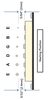
Pickup Height Adjustment.jpg

(On private client's guitars, I set Single Coils to 8/64" (4/32" or 1/8" same measurement) on both sides of the bobbin evenly.

Now, when older, low output pickups are mentioned, Gibson always comes to mind, so I thought referencing the Gibson service publications would be worthwhile...

Gibson's current service documentation recommends 1/16" (1.6 mm) for the bridge pickup and 3/32" (2.4 mm) for the neck for all humbuckers on all Gibson models. Now, I personally feel this is too close for pickups like the 498T and 500T, but thus far, Gibson hasn't published a revision for the higher output pickups.

My 2021 Gibson 50's Standard has not been touched since it left the factory. Fretting all strings at the last fret, The bride pickup is 8/64's on both sides and the neck is 6/64" on the bass side and 4/64" on the treble side, just for reference. This is with factory installed BB3 bridge and BB1 Neck Pickup-to-pickup balance is dead-nuts straight out of the case.

The ONLY adjustment that I performed on my Les Paul was to adjust the induvial pole pieces for accurate and even string-to-string balance. This is 'SOP' on all guitars that I setup for private clients and has been for several years. Some will poo-poo on this, but the VU meter doesn't lie.
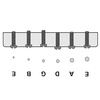
Pole Piece height.jpg

Setup really is fascinating to be honest and it's steeped in well spun mythology and personal preferences being sold as absolute facts.

Every time I have a complaint about buzzing or other anomalies, the guitar is always out of spec.

Yesterday, I was given a Kirk Hammet ESP (purple metal flake!) that fretted out in some spots and had intonation problems.

Sure as could be, it was totally out of spec. Clearly personal preference was afoot here.

1. 12th fret action at .035"

2. Neck relief at .025"

3. Pickups almost touching the strings

4. Tremolo bridge (Floyd) adjusted like a "stink bug"

It took me 7 minutes to bring everything into "Fender specs" and it played like a dream. The guy was just elated and admitted he had been trying adjustments that he "read on some discussion forums," which wasn't at all surprising to me, because I re-live this exact scenario over and over again.
 
Last edited:
I should add that when setting up a Floyd Rose, they (Floyd Rose) specify setting the fine tuners to an "approximation of string radius," meaning a gentle arc. Again guys will poo-poo on this, but it really does work. Once I install strings (or when I receive a new unit) I stretch the strings ONLY in the direction that the strings move when being played. I do not recommend pulling up on them, because it subjects the molecules in the string to deformation in a direction they will not "see" when being used. (This is my personal preference and it is not rooted in fact.)

Now, what I really dislike is the Jackson headstocks without string retainer bars. With Jackson's, the strings ALWAYS pitch up and down oppositely in pairs. For example, the low 'E' will go flat when clamped and the 'A' wil go sharp, so you have to "split" the two by 10-15 cents so that they both "swing" into spec when clamped.

I've gotten to where this is now auto-pilot for me, but it threw me when I first started...
 
Thanks much, Robert!

That is very informative.

Hope it helps!!!!

For those who come carrying virtual torches and pitchforks' for most of what I post, (that is contrary to their beliefs) I will say this:

Yes, you can set your own guitar anywhere you like. I see guy's who have their guitars set up to something they read on a forum/were advised to do and they have operational issues because of their chosen setup, However, they substantiate the problems with things like, "Ya, I can't play fast passages unless I have sub-.040" action height" or some other nonsense based on guitar mythology. Statements like this are common and they are funny to me because when you actually get to lay hands on one of Yngwie's stage guitars and you see 5.5mm action height at the 12th unfretted, it further drives the mythology out of the village.

My goal is to recommend industry accepted specs that are based in science and fact. I will Always disclaim my personal opinions, rather than trying to pass them off as fact... :)
 
If the pickup’s magnet pulls on a vibrating string, it can actually affect both intonation and sustain, because the pull of the magnetic field deadens/impedes the string's vibration. (I'm sure you all now this fact) This is less of a problem with humbuckers, but many people still move them too close - or too far away - for optimum performance.

Yes, when I first started messing around with setups, I noticed that pickups too close to the string can affect intonation. Very interesting to observe.

But, you mention too far away. Aside from the obvious decrease in output, what another issues can result from backing your pickups off?
 
Yes, when I first started messing around with setups, I noticed that pickups too close to the string can affect intonation. Very interesting to observe.

But, you mention too far away. Aside from the obvious decrease in output, what another issues can result from backing your pickups off?

Too far away certainly won't hurt intonation, but it introduces other problems. Most prolific is a lack of output along with a lack of 'ambience,' because you are operating the pickup at much less than peak efficiency. Typically, it creates a thinner tone that needs to be "boosted" or "EQ'd" to compensate. This doesn't have the same negative effects of being too high, but it creates another set of problems that must be overcome with more tweaking.

I can almost always spot the guys who like very low pickup settings - they are constantly on their tone and volume knobs, turning around to tweak the amp, etc. I had a top L.A. producer tell me that when everything is set up for 'maximum efficiency,' you don't "hear" the need to change it and you can just focus on playing.

However, I've learned that a lot of players actually live for the constant tweaking and it makes them feel like they have this certain 'something.' What I've been told by sound engineers is that some players have conditioned themselves to hear what they are listening for, even though it likely exists only in their heads.

In the world that I work in, I don't encounter those types of players because they would have an extremely short career lifespan, but I do see them in the clubs.

Last weekend, my wife and I watched a band in Yucaipa. They had a very good guitarist, but he was constantly fiddling with knobs and turning around to tweak settings on his amp, or bending down to adjust his FX. Buck Owen's was the man who told me, "Son, you don't ever turn your back to a crowd and you don't be fussin' with stuff on stage. The stage is where you perform. Ain't none of that fussin' gonna make a difference, but making the crowd remember that you were connected to them will..." (about the best as I can recall it anyways.)

I feel fortunate to be working with and for guys who not only do it for a living, but go very deep into the art. I'm always hungry to learn. These guys who specialize in live pro-sound will take things to an extreme, even ringing out the room in a relatively small club. Some of the most interesting things I have learned came from working with these guys on very large, outdoor performances.

I also recall reading something to this effect in an article about live sound. I think these quotes were from Brian Pomp:

"If you had a great sound-check and everything sounds good together, don’t think that you should be moving faders and changing EQ's. Most people are constantly 'on the lookout' for odd things that need fixing here and there during the songs, and they just don't exist anywhere other than in their heads. Live mixing and studio mixing aren’t as different from each other as they once were. It wasn’t always that way, but the gap has really closed up with the advent of new technology..."

It's really hard to argue a contrary point when you see these guys proving it right in front of you.

Now, if guys love twisting knobs and all that, then that's great, but this is just an observation that I made one night when a sound engineer was pointing out things about certain players and I found it very interesting.
 
Last edited:
Here's one for you, Robert.

Years ago, I remember you fighting the Wolftones battle. What ever did you arrive at being the cause and the corresponding remedy for this?

The cure for wolftones is to lower the pickups...this reduces the magnetic "pull" against the string.

On my YelloStrat, I found a stacked single coil made by Artec that is madeike a humbucker with individually adjustable pole pieces.

You can raise these to almost touching the strings without wolftones.
 
Last edited:
I can almost always spot the guys who like very low pickup settings - they are constantly on their tone and volume knobs, turning around to tweak the amp, etc.

Now, that is a very interesting observation!

I would add that this can sometimes be due to parts of the rig. Before I got my Rivera and was using a DSL-5C, I messed with my tone knobs a lot while playing. I felt like I was always trying to dial out this excessive top end thing, especially with the Strat.

The Rivera is voiced so much differently that I don’t even really use my EQ pedal much anymore. Thing is, I really WANTED to use that little Marshall! It took a bit of introspection to admit that it wasn’t gonna cut it for me. The other issue with the little DSL-5C is that it shares the EQ section between channels. So, I could get my EQ dialed in for cleans, but it would be too dark for the overdrive channel - so much so that I’d disappear in the mix. So, I was fighting that, too. Since my Rivera has an EQ section for each channel, I can pretty much get things EQ’d well and not try to compensate with the guitar.

But, the pickup observation is something I hadn’t thought about.

That’s interesting.
 
"If you had a great sound-check and everything sounds good together, don’t think that you should be moving faders and changing EQ's. Most people are constantly 'on the lookout' for odd things that need fixing here and there during the songs, and they just don't exist anywhere other than in their heads. Live mixing and studio mixing aren’t as different from each other as they once were. It wasn’t always that way, but the gap has really closed up with the advent of new technology..."

It's really hard to argue a contrary point when you see these guys proving it right in front of you.

Now, if guys love twisting knobs and all that, then that's great, but this is just an observation that I made one night when a sound engineer was pointing out things about certain players and I found it very interesting.

I'm calling BS on that one, sorry. Every room sounds different with people in it vs. when it was empty during a soundcheck. If this person is mixing live sound with this attitude (as in, I shouldn't have to actually do my job during your set) stay as far away from them as possible. Those opening bands aren't there just to get the crowd worked up - they're also there to make sure the headliner is going to sound as good as possible when they take the stage and the only way to do that is to EQ to the crowd.

As for knobs, well, show me a guy that doesn't use the volume and tone on his axe and I'll show you a guy with zero dynamics.
 
Last edited:
I'm calling BS on that one, sorry. Every room sounds different with people in it vs. when it was empty during a soundcheck. If this person is mixing live sound with this attitude (as in, I shouldn't have to actually do my job during your set) stay as far away from them as possible. Those opening bands aren't there just to get the crowd worked up - they're also there to make sure the headliner is going to sound as good as possible when they take the stage and the only way to do that is to EQ to the crowd.

As for knobs, well, show me a guy that doesn't use the volume and tone on his axe and I'll show you a guy with zero dynamics.

I'm totally neutral, but I've heard this many times in the industry before from producers and engineers.

I just listen and watch...I'm just a hired hand.
 
Last edited:
Compared to you guys I pretty much have zero experience in this. My time on a stage was in church for about 10 years. And then only about every 4-6 weeks for my turn to roll around. But to these untrained ears… I’d have to say that our sound in the auditorium changed once we filled it with 300 or so warm bodies.
 
I also recall reading something to this effect in an article about live sound. I think these quotes were from Brian Pomp:
"If you had a great sound-check and everything sounds good together, don’t think that you should be moving faders and changing EQ's. Most people are constantly 'on the lookout' for odd things that need fixing here and there during the songs, and they just don't exist anywhere other than in their heads. Live mixing and studio mixing aren’t as different from each other as they once were. It wasn’t always that way, but the gap has really closed up with the advent of new technology..."
I'm calling BS on that one, sorry. Every room sounds different with people in it vs. when it was empty during a soundcheck. If this person is mixing live sound with this attitude (as in, I shouldn't have to actually do my job during your set) stay as far away from them as possible. Those opening bands aren't there just to get the crowd worked up - they're also there to make sure the headliner is going to sound as good as possible when they take the stage and the only way to do that is to EQ to the crowd.

As for knobs, well, show me a guy that doesn't use the volume and tone on his axe and I'll show you a guy with zero dynamics.
I'm totally neutral, but I've heard this many times in the industry before from producers and engineers.

I just listen and watch...I'm just a hired hand.

There‘s gotta be more to Brian Pomp’s thinking than just that one quote.

Here he is in Point Blank Music School:

“Listen to the room and the lead vocal, and find the appropriate overall EQ and volume for the space.Listen carefully to the environment you will be mixing in and understand the ambience created naturally by its shape and construction. Pay attention to any nodes and frequencies that stand out and might prove to be problematic for keeping your lead vocal at the level you want it to be. The lead vocal is the most important channel in your mix — make absolutely sure it isn’t going to take off and start ringing uncontrollably during the show. The person holding that mic is signing your paychecks! Follow the standard room equalization protocols using a frequency analyzer like Smaart, and level the room to your liking.”

So, I take from this, especially from his warning about the vocalist ringing during a show, that he isn’t necessarily advocating a hands-off approach once the sound check is done. He’s definitely advocating doing a serious leveling of the room for a performance.

Here he is on fmuser.net talking about some audio engineering myths:

“MYTH: Mixing live and in the studio are totally different.

That assumption is just wrong. They obviously have some differences, but you’re trying to accomplish the same thing — giving the listener something palatable and enjoyable to listen to. Creating that experience. Room acoustics are really the biggest difference. Trying to balance a PA system is totally different than sitting in a nicely treated studio with a pair of good nearfields.”

Again, he advocates the need to balance the PA with the room acoustics.

My guess is that Brian Pomp is making the point that major or continuous fiddling (hence, his statement, “constantly ‘on the lookout’”) shouldn’t be necessary if you’ve done your pre-event setup correctly. I could be wrong as I am unable to talk to him for clarification, but I don’t think he’s necessarily making the point that some minor adjustments are never necessary or appropriate.


There‘s gotta be more to Brian Pomp’s thinking than just that one quote.

Here he is in Point Blank Music School:

“Listen to the room and the lead vocal, and find the appropriate overall EQ and volume for the space.Listen carefully to the environment you will be mixing in and understand the ambience created naturally by its shape and construction. Pay attention to any nodes and frequencies that stand out and might prove to be problematic for keeping your lead vocal at the level you want it to be. The lead vocal is the most important channel in your mix — make absolutely sure it isn’t going to take off and start ringing uncontrollably during the show. The person holding that mic is signing your paychecks! Follow the standard room equalization protocols using a frequency analyzer like Smaart, and level the room to your liking.”

So, I take from this, especially from his warning about the vocalist ringing during a show, that he isn’t necessarily advocating a hands-off approach once the sound check is done. He’s definitely advocating doing a serious leveling of the room for a performance.

Here he is on fmuser.net talking about some audio engineering myths:

“MYTH: Mixing live and in the studio are totally different.

That assumption is just wrong. They obviously have some differences, but you’re trying to accomplish the same thing — giving the listener something palatable and enjoyable to listen to. Creating that experience. Room acoustics are really the biggest difference. Trying to balance a PA system is totally different than sitting in a nicely treated studio with a pair of good nearfields.”

Again, he advocates the need to balance the PA with the room acoustics.

My guess is that Brian Pomp is making the point that major or continuous fiddling (i.e., ”constantly on the lookout”) shouldn’t be necessary if you’ve done your pre-event setup correctly. I could be wrong as I am unable to talk to him for clarification, but I don’t think he’s necessarily making the point that some minor adjustments are never necessary or appropriate.


Could be. I'm not sure, but I've watched live sound engineers at huge venues running the board (sitting with them) and I've asked alot of questions, and their responses were very consistent that volume levels are dictated by the size of the club, but the EQ's are seldom, if ever altered from aoundcheck. (Brooks and Dunn and Dwight Yoakham were two such experiences)

I've seen bands that started out sounding great, and by the time they messed with their tone during the event, it was a muddy mess.

I mean, when I'm playing with my band, I want/expect a certain sound and i don't want it changed during the event where you cannot hear things clearly as you can during soundcheck.

But, you should feel free to do anything you like. I've got no axe to grind and no dog in this fight, just stating my observations...and once guys start dicking with everything, the entire performance sounds like you've thrown a wet blanket over the amps and PA's....bit, since your hearing is compromised in about event, you'll hear exactly what you think you're hearing.
 
Could be. I'm not sure, but I've watched live sound engineers at huge venues running the board (sitting with them) and I've asked alot of questions, and their responses were very consistent that volume levels are dictated by the size of the club, but the EQ's are seldom, if ever altered from aoundcheck.

I've seen bands that started out sounding great, and by the time they messed with their tone during the event, it was a muddy mess.

I mean, when I'm playing with my band, I want/expect a certain sound and i don't want it changed during the event where you cannot hear things clearly as you can during soundcheck.

But, you should feel free to do anything you like. I've got no axe to grind and no dog in this fight, just stating my observations...and once guys start dicking with everything, the entire performance sounds like you've thrown a wet blanket over the amps and PA's....bit, since your hearing is compromised in about event, you'll hear exactly what you think you're hearing.

Interesting. Do they ever adjust relative volume levels of different performers once the show starts?

But, I’m not gonna be doing anything! I don’t run the mix!
 
Back
Top