So....Watcha Been Eyeballin'?

For me, functionality is king. Theories are meaningless and my instrument needs to deliver consistent performance.

When it comes to first fret action, .022" to .025" - which just happens to be Gibson/Fender factory specs - allows me to bend the strings at the first 3 frets easily.

Think the Joe Walsh intro to 'Already Gone' which is a full step bend on the 'G' at the second fret or the second fret bend on 'Interstate Love Song.' You can't get those bends with really low first fret action.

.070" at the 12th with .008"/.010" neck relief (how I've been setting up for years and these are also Gibson/Fender published specs) allows me to hit the strings really hard and not get buzzing or false harmonics from being to close to the frets.

Gibson specs .070" @ the 12th unfretted, bit Fender specifies 4/64" @ the 17th with a capo on the first fret.

Guess what???

Both measurements are exactly the same.

Pickup adjustment.

I've tried every setting imaginable by ear and then balanced the pairs or trios with a VU meter.

Guess what???

I'm always right around the factory specs even by ear.

Gibson's published specs for humbuckers is 1/16" (1.6 mm) for the bridge pickup and 3/32" (2.4 mm) for the neck.

Fender single coil specs are 4/32" from pole piece to bottom of string fretted at the last fret. Fender's spec is scientifically designed to reduce the tendency for the single coils to produce wolftone-esque oscillations.

Now, on really, really hot pickups, I'll sometimes set them to 8/64" - super 3 or super distortions, or Carvin M22SD's would be relevant examples.

The farther you move the pickup away from the string, the mellower the tone becomes with a reduction in output.

Jazz players tend to run their pickups very low.

But, again, the engineers have this figured out and the factory settings are scientifically designed to give you the best overall playing experience with the least amount of problems, like pickup vume imbalance, wolftones and fret buzz or "chime" from having the strings vibration path too close to the fretwire.
 
I have been following this with interest, especially around setup and relief.

What kind of clearances do you guys suggest for the nut slot depth? How much above the first fret should the string be when fretted at the third fret? I have a 2019 Gibson Les Paul Standard AFD Slash that was very high. Unfortunately I got overzealous with the nut files and F’d up. I cut the slots too low now and have to replace the nut. Before I do so, I am seeking some guidance as to how much clearance I need to shoot for.
 
I have been following this with interest, especially around setup and relief.

What kind of clearances do you guys suggest for the nut slot depth? How much above the first fret should the string be when fretted at the third fret? I have a 2019 Gibson Les Paul Standard AFD Slash that was very high. Unfortunately I got overzealous with the nut files and F’d up. I cut the slots too low now and have to replace the nut. Before I do so, I am seeking some guidance as to how much clearance I need to shoot for.

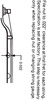
Quick Evaluation Method:

Push down at the 3rd fret, then push the strings down (one at a time) at the first fret.

If you see movement between string at first fret, you generally have adequate clearance, meaning you have material to remove to reach your target speciation.

Now measure from 1st fret to bottom of the strings unfretted.

The spec is .020" to .025" with .022" being the target.

upload_2017-7-4_23-22-45.jpg
 
The reason a lot of techs like to go by "feel" is it allows them to crank out sloppy work and hide behind mysterious bullshit..

I paid a highly regarded guitar tech (with an 'A' list of clients) $200 to setup the nut on my Stratocaster.

(This event would be my catalyst to learn to do nuts myself)

It felt funny on some phrasing and I measured the 1st fret height. I couldn't 'grab' the strings like I could before the visit to the tech.

I found the low 'E' at .027", the 'A' at .017", the 'D' at .020" the "G" at a jangly .010" and the 'b' and 'e' around .015" respectively.

I was getting false harmonics off the lowest strings.

I phoned the tech and he said, "It doesn't matter as long as the strings don't touch the first fret."

When I respectfully asked the 1st fret be set to the spec of .022" he said, "Bring it in and I'll fill the slots with super glue and baking soda..."

That was the day I started doing my own nuts.

These "guitar techs to the stars" will setup a pro player's guitar beautifully, but will give John Q. Average :poo: quality.

Seen it.

Paid for the experience.

When guys ask me about setups, I give factory specs.

I don't give personal bull:poo: or theories, I stick to the facts - and some guys hate me for that because they can't base their advice on any factual or scientific data.

It's your guitar. Set it up how you want it, but you cannot go wrong with the factory spec as a starting point.

But, when people do hate me for being blunt, I strangely feel as though I have fulfilled some divine purpose to uncloak all the theories, mythology and bullshit.
 
Last edited:
Thank you for that Robert. I wasn’t clear on the 0.022” clearance until I saw the photo.

One question though, how would String gauge affect this? Assuming the string sits completely at the bottom of the slot, the bottom of the string is always at the same height, regardless of gauge. Am I missing something here?
 
Thank you for that Robert. I wasn’t clear on the 0.022” clearance until I saw the photo.

One question though, how would String gauge affect this? Assuming the string sits completely at the bottom of the slot, the bottom of the string is always at the same height, regardless of gauge. Am I missing something here?

Typically, the spec calls for all wound strings to be at least 1/2 the string's diameter below the top of the nut surface, and all plain strings to be "even with the nut surface, or no more than the string diameter below the nut surface, but under no circumstances proud of the nut surface.."

(QUOTE from Gibson Service Publication)

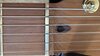
Here's a brass nut I made as an example, bit the nut on my 2021 Gibson Les Paul 50's Standard is set to this spec.

20210906_082413.jpg

Notice how my slots are "funnel shaped" towards the tuner. This is because - on a Fender non-locking tremolo - the low 'E' and the 'G' string unwind from the tuner post when the bar is depressed. This causes the strings to move laterally in the nut.

Try it the next time you push your non-locking tremolo arm down...watch the low 'E' and 'G' strings unwind and move laterally. They will unwind and move laterally even with locking tuners.

Here's a video I made of how the stock Fender 6 screw, non-locking tremolo can divebomb 11 semitones, then allow you to pull down on the slack strings (with non-locking vintage tuners) and come back to perfect pitch everytime..

Locking tuners are a myth. They help only if you cannot install strings properly.

Here's my string install on Grover Vintage Tuners with an extra long Grover on the low 'E' to reduce string tension across the nut.

Also, string trees are unnecessary. EVH proved that on his black/white non-locking Frankenstein.

20210810_162532.jpg

When people tell me all the bull:poo: about locking tuners being a requirement for keeping a Fender in tune, I just send them this video...


Ok,

Back to your question...

You need to decide on string gauge first.

On a Les Paul, I tend to favor .046/.036/.026/.017/.013/.010 and these are the factory-installed gauge on my 2021 Gibson Les Paul 50's Standard.

Your nut slots should be +.004" above string gauge, based on Gibson's pre-2015 revision spec.

So, a .046" string would get a .050" slot and a .010" string would get a .014" slot.

Another critical - and overlooked - aspect of Gibson nut fitting (more critical on Gibson because of the nut width, but still used on Fender 1/8" nuts) is the "fall away" of the string slot on the tuner side.

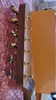
The string only contacts the first 2/3rds of the nut floor, then the floor 'falls away' from the string as they travel to the tuners.

Here's a photo - and yes - Gibson has published drawings of this method.

20210520_074550.jpg

Hint:

Number one reason Les Paul's have a reputation for tuning instability is a flat nut floor with too much string contact over a large surface area.

Hope this helps!!!!
 
Last edited:
One more question.
Am I correct in saying that I really have to start the whole setup process by adjusting neck relief first? As far as I can tell from what I have read thus far, every adjustment (action, bridge height, nut slot depth, etc) is dependent on all the others.
What I mean here is that, for instance, the 0.022” first fret clearance (unfretted) is totally dependant on the action. The action if checked unfretted is dependent on bridge height AND nut slot depth. The only thing that should be independent of all other adjustments is the neck relief if checked at the 12th fret while fretting at the the first and last frets. Everything else would then go off of this starting point.
Have I got all of this correct or am I still missing something somewhere along the way?
 
One more question.
Am I correct in saying that I really have to start the whole setup process by adjusting neck relief first? As far as I can tell from what I have read thus far, every adjustment (action, bridge height, nut slot depth, etc) is dependent on all the others.
What I mean here is that, for instance, the 0.022” first fret clearance (unfretted) is totally dependant on the action. The action if checked unfretted is dependent on bridge height AND nut slot depth. The only thing that should be independent of all other adjustments is the neck relief if checked at the 12th fret while fretting at the the first and last frets. Everything else would then go off of this starting point.
Have I got all of this correct or am I still missing something somewhere along the way?

We were trained to tune to pitch as step #1.

Then check and adjust relief as step 2.

To check relief, affix a capo at the first fret, push down on the strings at the last fret and your measurement should be taken/evaluated at the 7th fret.

Then adjust bridge height to yield .070" at the 12th unfretted as step 3.

(Fender specifies checking action height at the 17th unfretted with a capo on the first to a specification of 4/64" - Guess what??? This is exactly .070" at the 12th unfretted.)

Re-tune to pitch after above steps are taken.

Then check and adjust the 1st fret height at the nut to .020" to .025" unfretted with .022" being the Blueprint Specification.
 
Last edited:
String guage will affect action hight to.I do like Robert says.String guage you want to use,tune to pitch ur going to play in.Set neck relief then go from there were you like the action or by factory specs.I do both sometimes and this is another argument no one ever agrees apon.Specs or feel ? Dont matter to me just play ur geetar.
 
I have been following this with interest, especially around setup and relief.

What kind of clearances do you guys suggest for the nut slot depth? How much above the first fret should the string be when fretted at the third fret? I have a 2019 Gibson Les Paul Standard AFD Slash that was very high. Unfortunately I got overzealous with the nut files and F’d up. I cut the slots too low now and have to replace the nut. Before I do so, I am seeking some guidance as to how much clearance I need to shoot for.
You can temporarily pull the nut and shim it with a sliver of paper / layers of slivers, or business card. You could use this to get a feel for what the right height should feel and look like for when you replace it. If the current nut fits snugly in the slot you probably wont need to glue the temporary fix in either.

I dont glue mine in until I'm sure.
Sometimes I forget and it moves or falls out at the next string change.
 
Back
Top