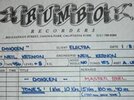
"Dream Warriors" by Dokken
From the album, Back for the Attack (1987 Elektra)
Produced by: Neil Kernon
Engineered [Assistant]: Andy Udoff
Recorded at: Rumbo Recorders (Canoga Park, CA)
Available in the JAMMIT “80’s Rock Vol. 2” application
The place: Rumbo Recorders in Canoga Park, CA.
The producer: Neil Kernon, who is most famous for producing Hall and Oats’ big albums.
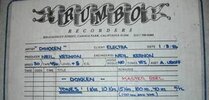
With Mike Clink wrestling Appetite for Destruction into fruition down the hall, Kernon kept Dokken’s volatile ingredients as separated as the 36 analog tracks that were used to capture “Dream Warriors.” Penned by Lynch and bassist Jeff Pilson, this song is quintessential Dokken but with the romantic-but-still-tough lyrics directed toward a scissor-fingered villain instead of a Sunset Stripper. What better place to wallow in the self-pity of those “lonely nights” and one’s thermal propensity to “feel the fire”
game.
Andy Udoff must have had his hands full. Credited as assistant engineer on two high profile records being recorded simultaneously under the same roof may account for some of the errors in the documentation for this song. Assuming he was responsible for labeling these things (as assistants typically were), the track sheets and the tape boxes were erroneously dated January of ’86 when it should have been for the following year. Apparently sleep deprivation can cause an over-worked engineer to consistently misspell “warriors” as well. It’s not unusual to have discrepancies in documentation with older tapes and in a lot of cases finding the corresponding track sheets can be a victory in itself. So all mislabeling aside, let’s spool-up the 2” machine and hear what went down on Saticoy Street.
Exhuming the Boom
The unprocessed drums sound remarkably good. Not only did Mick Brown deliver a solid performance, but the separation and fidelity far exceeded that of previous Dokken albums. Like many other rock bands back then, Dokken was on the cusp of a technology and sonic growth that saw significant improvement throughout the 80’s. This was most obvious in the drum sounds of the time.
There were kick and snare room samples on the master tape to supplement the live drum performance. At that time, engineers would most likely have printed a pre-trigger by flipping the tape around to play backwards which allowed them to bounce the particular drum track to an available track through a delay unit. When the tape was played forward, that track would be gated and appropriately delayed in time to trigger the sample loaded in an AMS DMX 1580 unit. This would have been a significant step up from having to get that overblown sound entirely from the natural drum kit.
Mr. Scary’s Sweet Revenge
George Lynch’s guitar tracks on “Dream Warriors” were a pleasure to hear in their raw state. His signature chunky eighth note chugs and unconventional chord inversions are the elements responsible for propelling this song into a fist-raising rock anthem. The main rhythm guitars were tracked in stereo from a single performance—either using two separate amps or just different cabinets. The stereo imaging of this pair is superb with nice width in the higher frequencies tapering to the center for the lower midrange. The phase relationship of these waveforms is impeccable and this explains why the guitars sound so full and aggressive in this song. These rhythm tracks are supported with a single mono guitar double. The clean arpeggiated guitars—which are another Lynch trademark—are layered with a thin, metallic-sounding DI acoustic guitar track.
I distinctly remember the “Dream Warriors” music video that showed Lynch’s wrecking ball impersonation as he literally tore through a wall wielding his skeleton guitar—all to the initial bewilderment and eventual delight of an adolescent Patricia Arquette. Defiance by way of a ridiculous guitar solo entrance may come off as comical now, but this solo is no joke. Being able to isolate the actual track dry and audition these nuances in their rawest form was a privilege worthy of more than Arquette’s painted-on admiration. I can almost taste the disdain for Don emanating from those precarious bends and the disorienting mélange of well-articulated notes cascading down like Plinko discs on The Price is Right. Lynch’s tone is bold and never loses focus, plowing indiscriminately through the minor string rattles and pick-noise imperfections that get masked in the final mix. The boost used in the front end of the amp was an original square-buttoned Ibanez TS-808 overdrive pedal aided by the use of a BOSS GE-7 equalizer pedal with an accent on the mids being pushed above the zero point. This solo track is supplemented with a harmony lead that highlights and heightens this original performance. There was additional outro soloing other than what made it to the final mix, but Kernon extracted all the good stuff from this track and flew it into just the right spot to close out the song.
Unsung Hero
Don’s lead vocal was well recorded. Like the drums and guitars, the track was full of presence and tonal character that didn’t make it into the final, sloshy, ’80s-centric mixdown that we’ve all grown accustomed to hearing. While Don may be the front man after which the band is named, Jeff Pilson may be the unsung hero of this song. Jeff sang the guide chorus vocals on a scratch track that was used to build the 18-voice harmony layers constructed later on the tape. These were combined, consolidated to four tracks and were then placed into each chorus of the slave reel. Judging by that and a verse harmony track labeled as “Jeff” on the track sheet, I suspect that he may have sung most of these background vocals. Incidentally, his scratch bass take (that was most likely recorded live when the drums were done) was very well thought out and note-for-note pretty much what ended up on the master bass take.
The Bitter End
While Captain and Tennille may have professed that “Love Will Keep Us Together,” sadly, such was not the case with Dokken. “Dream Warriors” represents a career peak that was really just the beginning of the end for the band. Incarnations with different members and reunion attempts failed to recapture the magic of Dokken in their prime. Is it true that all good things must come to an end? Eventually, the significantly more popular Guns n’ Roses crumbled apart due to similar internal band problems and, as mentioned earlier, the very walls holding up what was once the infamous Rumbo Recorders recording studios are now absorbing endless refrains of “The Chicken Dance” and “Hava Nagila.”
Despite the traditional music industry’s decline and the seemingly irresolvable feuds of so many bands, the recorded music of groups like Dokken will outlive all the egos and attitudes that broke them apart in the first place. Evidence of their significance isn’t just immortalized in the mixes that we’ve come to know, the (nowdigitized) individual tracks of these master tapes tell a backstory of their creation that will outlive the bands themselves, and the fading memories of those who were involved in their creation.
Meet Frank!!!!!
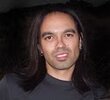
Frank Gryner is a multi-platinum engineer whose credits include bands like A Perfect Circle, Matrix Soundtracks, Rob Zombie, and Tommy Lee. Frank’s technical expertise in audio system design has been applied to location studios for the likes of Filter, Perry Farrell and John Paul Jones.
Additional gear info provided by guitar tech and leading Lynchistorian Gerry Ganaden
@chilipeppermaniac


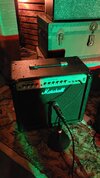


 ,oh & i'm a die hard Gibbons fan.
 .
.

 ) , such as on one of their "Old Grey Whistle Test" performances in the UK he said he found an old Radio in the Studio & used that for his Guitar sound
  .
.