New Borrowed Mesa Fillmore 50 Day!!!!

For those of you who have heard the Fillmore video on Facebook Messenger, would you care to share your thoughts???
 
Taking a break....

The Mesa really is a very different amp in terms of how the EQ works.

With the Ivanberg Modded ORI50, I can crank the bass and knock pics off the wall without it ever becoming muddy, yet still dial in enough mids to cut through the mix.

The Mesa doesn't really respond to high bass settings...the bass control is very, very subtle, even all the way up. The Mesa Fillmore Manual recommends "reducing bass as gain is increased to avoid a loose, unfocused tone."

The mid controls are also subtle, even turned up all the way. Their effect is very gradual.

Treble is the most dramatic tone control in terms of sensitivity and its effect on tone.

Gain a close second to tone in sensitivity and it's effect on tone.

Very tricky to get it dialed in.

Marshall seems to have a much more pronounced upper-mid range "grind" and more bass response that I can't seem to dial into with the Mesa (no flame, just an observation) and that "blow pictures off the wall" resonance is apparently not an attribute of the Fillmore 50...which isn't a bad thing.

The Fillmore definitely cuts through a mix and is more than loud enough to handle a loud drummer with ease. Playing it yesterday in a live band setting was very satisfying.

I ended up cranking the lows on my primary EQ and still didn't have as much "chunk" as I wanted, but I never lost clarity, even with the bass frequency boosted.

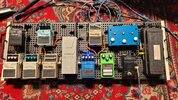
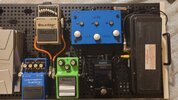
Look at this pic of my primary EQ settings with the Mesa from yesterday.

20211211_120139.jpg

Compare this to the primary EQ settings with my Marshall Origin 50H from a few days ago:

20211115_231909.jpg

When I'm playing my Ivanberg Modded ORI50 through my 2x12 cabinet, my wife says it feels and sounds like a bass player is playing along on my palm muted chords...that's how much punch it has, but it still has enough mid range to cut through.

The Fillmore is more balanced I think. Lows, mids and highs are all very similar in how they are projected. Highs are ample, even with high frequencies pulled back on the EQ pedal.

When I switched off the primary EQ, the other guitarist asked, "What did you just do??? Your tone suddenly got really thin."

I'm certainly not disappointed with the Fillmore, but I feel the need to head over to Primo Rehearsal Studios in Riverside and A/B the Mesa and Marshall Origin for 3 or 4 hours at stage volume levels before I can really say that one is better than the other.

Can the Mesa players interject???
 
Taking a break....

The Mesa really is a very different amp in terms of how the EQ works.

With the Ivanberg Modded ORI50, I can crank the bass and knock pics off the wall without it ever becoming muddy, yet still dial in enough mids to cut through the mix.

The Mesa doesn't really respond to high bass settings...the bass control is very, very subtle, even all the way up. The Mesa Fillmore Manual recommends "reducing bass as gain is increased to avoid a loose, unfocused tone."

The mid controls are also subtle, even turned up all the way. Their effect is very gradual.

Treble is the most dramatic tone control in terms of sensitivity and its effect on tone.

Gain a close second to tone in sensitivity and it's effect on tone.

Very tricky to get it dialed in.

Marshall seems to have a much more pronounced upper-mid range "grind" and more bass response that I can't seem to dial into with the Mesa (no flame, just an observation) and that "blow pictures off the wall" resonance is apparently not an attribute of the Fillmore 50...which isn't a bad thing.

The Fillmore definitely cuts through a mix and is more than loud enough to handle a loud drummer with ease. Playing it yesterday in a live band setting was very satisfying.

I ended up cranking the lows on my primary EQ and still didn't have as much "chunk" as I wanted, but I never lost clarity, even with the bass frequency boosted.

Look at this pic of my primary EQ settings with the Mesa from yesterday.

View attachment 76799

Compare this to the primary EQ settings with my Marshall Origin 50H from a few days ago:

View attachment 76800

When I'm playing my Ivanberg Modded ORI50 through my 2x12 cabinet, my wife says it feels and sounds like a bass player is playing along on my palm muted chords...that's how much punch it has, but it still has enough mid range to cut through.

The Fillmore is more balanced I think. Lows, mids and highs are all very similar in how they are projected. Highs are ample, even with high frequencies pulled back on the EQ pedal.

When I switched off the primary EQ, the other guitarist asked, "What did you just do??? Your tone suddenly got really thin."

I'm certainly not disappointed with the Fillmore, but I feel the need to head over to Primo Rehearsal Studios in Riverside and A/B the Mesa and Marshall Origin for 3 or 4 hours at stage volume levels before I can really say that one is better than the other.

Can the Mesa players interject???
Marshall's greatest attribute has always been its mids-heavy focus. Probably moreso than any other amp manufacturer to date really when you look at it. Lots of manufacturers began trying to copy that design but strayed in the key areas and thus, never got the Marshall sound: the mid range crunch.

Mesa pioneered a heavy bottom end/high end sound, almost scooped to some extent, nearly no mid range. That was what propelled them into fame during the 1980s with metal guitarists. It is a fine amplifier and can bring the thunder, but it sits on polar ends of Marshall in it's entire structure. Not saying one is better than the other,just apples to oranges
 
Marshall's greatest attribute has always been its mids-heavy focus. Probably moreso than any other amp manufacturer to date really when you look at it. Lots of manufacturers began trying to copy that design but strayed in the key areas and thus, never got the Marshall sound: the mid range crunch.

Mesa pioneered a heavy bottom end/high end sound, almost scooped to some extent, nearly no mid range. That was what propelled them into fame during the 1980s with metal guitarists. It is a fine amplifier and can bring the thunder, but it sits on polar ends of Marshall in it's entire structure. Not saying one is better than the other,just apples to oranges

Everything you say makes perfect sense except the comment about bottom end.

Even rolled up all the way this amp doesn't really seem to boost the bottom end.

Cuts through the mix fabulously and, TBTH, nobody probably needs the kind of bottom end resonance that I favor, but it was unusual that when low frequency was dimed, the amp really didn't respond...

However, as I started reading a 115 page post over on TGP about the Fillmore 50, I kept seeing statements like "as you increase gain, bass is automatically pulled down to keep things tight and focused."

This does make sense to me in terms of how the amp behaves.
 
Last edited:
Everything you say makes perfect sense except the comment about bottom end.

Even rolled up all the way this amp doesn't really seem to boost the bottom end.

Cuts through the mix fabulously and, TBTH, nobody probably needs the kind of bottom end resonance that I favor, but it was unusual that when low frequency was dimed, the amp really didn't respond...
To be honest, im not familiar with the Fillmore at all other than what ive read and that its apparently heavily inspired by old 60s era Fender Amps with a bit more gain. If that's indeed the case? Its ironic that this one would lack the bottom end, as Twin Reverbs were pretty well known for the lows lol

Most of the Mesas Ive seen or heard usually had the graphic EQ and so i suppose getting the bottom end up was easy to do. Even the Dual Rectifiers had a lot right off the bat, leaving a lot of users having to boost the mids and trebles as well as using like a TubeScreamer to tighten up the loose bottom end.

This one seems a bit of an anomaly in the usual Mesa sound
 
To be honest, im not familiar with the Fillmore at all other than what ive read and that its apparently heavily inspired by old 60s era Fender Amps with a bit more gain. If that's indeed the case? Its ironic that this one would lack the bottom end, as Twin Reverbs were pretty well known for the lows lol

Most of the Mesas Ive seen or heard usually had the graphic EQ and so i suppose getting the bottom end up was easy to do. Even the Dual Rectifiers had a lot right off the bat, leaving a lot of users having to boost the mids and trebles as well as using like a TubeScreamer to tighten up the loose bottom end.

This one seems a bit of an anomaly in the usual Mesa sound

It's not a deal breaker at all really, it was just very surprising.

Tuesday I'll be in the rehearsal studio all day long shooting out the Fillmore and the Ivanberg.

Let me say this about my signature tone.

Imagine an amp that produces so much resonance that every stroke on a palm muted F# strikes you with a concussive sound wave, yet remains tight and focused.

Then imagine that this tone has this incredibly boosted mid range 'overtone' that sounds like a second amplifier rising up and above this resonance, yet both tones are coming out of a simple 2x12 cabinet.

It's probably silly to try and duplicate that on my Fillmore, but I naturally try to dial in a "big" sound on the bottom end on everything that I play through.
 
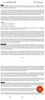
@Clockworkmike - Dig the description from the Fillmore 50 Manual under the heading 'BASS.'

View attachment 76816
So if im seeing this right, the higher the gain, the lower the bass?? That's pretty odd lol that by virtue, seems to make this amp more geared towards a non-hi gain sound. Nothing wrong with that but its odd it adjusts itself internally the more you push the gain.
 
So if im seeing this right, the higher the gain, the lower the bass?? That's pretty odd lol that by virtue, seems to make this amp more geared towards a non-hi gain sound. Nothing wrong with that but its odd it adjusts itself internally the more you push the gain.

That's kinda what I thought too, but you'll be surprised at how much gain I'm running in the video.
 
Good Morning, Audiophiles...

Taking a short break from my daily practice routine for coffee.

Perhaps I put too much thought into these things????

For 2 years, 5 nights a week, I was able to move all my gear around in my Mustang or in the F250 when the weather was good.

The 65 pound DSL40C got to be quite a chore to pick up, flip and lay into my trunk.

20211211_095802.jpg

Weight reduction was the #1 reason that I moved away from a DSL40C. I had a pair of them that served me without fail for 2 years gigging nightly and playing them in the studio.

In 2003, while serving on the SWAT Team, I suffered a L1/L2 compression facture (which healed and eventually grew together) and a rotated SI Joint. I have an amazingly great life and suffer only the occasional pain/stiffness, which I have learned how to adjust out myself. I have learned which movements have the potential to cause me problems and I try to avoid those situations.

Lifting, twisting, bending - as required when I lay these amps flat on their back in my trunk - are movements that I really have to be careful with.

The switch to the Origin 50H and custom 2x12 was all about weight reduction. The finger-joint mahogany cabinet with (2) Celestion 70/80's weighs only 32 pounds. The Origin head is easily stood up (vertical) in my passenger's front seat and simply seat belted in place.

The rear seats fold down to accommodate several guitars and a large pedalboard.

20211211_095832.jpg

I've transported my DoubleNeck (on the bottom) along with (2) Les Pauls and a Stratocaster (cased and stood up) and still had room for the pedalboard.

Up front, I have a backpack containing cables, power supplies, spare tubes, strings and other stage necessities. Guitar stands stack easily in the front floor.

My stage monitor fits in the space behind the guitars and at the edge of the speaker cabinet/amp in the trunk.

20211211_095842.jpg

While this certainly works, I sometimes think of how to reduce my overall load out while retaining the sound quality that I'm hearing in my head.

I've played through small amps, like the Vox, JC-40, etc., and I've arrived at the conclusion that the voicing of a 10" speaker just isn't working for me.

12" is the absolute minimum with 2x12's being more desirable.

The Mesa ticks the boxes for having a 12" speaker, small case, good power, no digital banks and weighing only 44 pounds.

Unfortunately, the build quality of a Mesa doesn't come cheap and they retail for around $1,700.00 USD. I suppose my frugal upbringing still finds those price tags daunting for some reason.

Thus far, in its very first outing, the Mesa - while having a needlessly complicated tone stack - held its own sonically against a 100 watt Carvin All-Tube Full Stack, Line 6 240 Combos and a 100 watt Boss Katana. A Christmas party is coming up December 18th, which will give me another great evaluation opportunity.

At this point, I have to say that the Mesa really has surprised me. It has tons of power/volume and the tone from it is amazingly full for a single 12" combo.

The Ivanberg Modded ORI50 and 2x12 cabinet are also easy to load and move around. I actually like the head/cabinet arrangement for their lighter weight.

But, I'm also thinking outloud here...is it possible for me to further reduce my load out/footprint and still retain a tone that I find pleasing???

When I was visiting @DonO recently, he was kind enough to let me play through his music store-esque collection of amps. One amp simply blew my mind. When I plugged into it - without any effect pedals whatsoever - the tone just absolutely floored me.

Onboard gain production was simply unbelievable. Even 'dimed' the low end remained tight and focused. The amount of gain the amp produced (by itself) exceeds the amount produced by the formidable Ivanberg Modded ORI50 (im talking boost engaged, gain full up and master volume on '7' with loudness controlled with a Boss FV30L in the FX loop) and a TS-9 by a significant margin. Impressive!@!@!

The onboard chorus was every bit as rich, articulate and wide as a JC-120 and can be dialed in on the clean and drive channels independently. The spring reverb was also very rich and infinitely adjustable. The clean tones are easily on part with a Fender Blackface or Fender Ultra Chorus.

The tone stack is simple (traditional perhaps) and knob movements bring rapid and substantial alterations to the tone immediately and in abundance. There are also several switches that color the channel's tone.

The FX loop (an absolute necessity for me) has a level/mix control which allows for a lot of sonic blending.

The amp has 2x12" speakers and is dimensionally the same height as both the Mesa Fillmore 50 and the DSL40C.

At 48 pounds, it is on the edge of my "less than 50 pounds" weight limit.

Whether you like them or not, that amp is a 80watt, 1998 Marshall Valvestate 8280 Bi-Chorus 2x12 Combo, Made in England.

So, as I was playing through it, the wheels were turning in my head....

48 pounds...the Marshall Gold Backs weigh 16.8 pounds/pair. Replacing these with 250 watt Celestion Neodymium Copper Backs, or a pair of Neodymium Jensen Stealth 80 Watters, would reduce the amp's total weight to only 38 pounds - 37.3lbs to be exact.

That's 27 pounds lighter than my DSL40C, 6 pounds lighter than the Mesa, and only 8 pounds heavier than my custom 2x12 mahogany speaker cabinet.

Hmmmm....

Next up, my thoughts turned to the pedalboard.

The Valvestate's gain production means the TS-9 can be pulled off the board, along with the CE5 Chorus and the RV6 Reverb. The 'Contour' control in the tone stack, along with 'Pesence' and 'Tone Shift,' would eliminate the primary EQ pedal.

That's effectively eliminating (4) FX pedals, shrinking the board from 34" to only 24" overall.

The problem is, these relics are (obviously) no longer produced, so not only do you need to find one that hasn't been hacked, the question of reliability and availability of replacement parts becomes a wild card.

I had a 1997 Marshall Valvestate VS265 that I gigged with for 20 years without any problems, but I purchased it brand new and took great care of it. Power wise, the 65 watt hybrid had no trouble alongside my bsndmate's JCM800 2204.

The 8280 2x12 Combo has a twin bother in the 8200 Bi-Chorus Head. These are even more scarce than the 8280 Combos and again, reliability/parts becomes a big question when playing live without a backup.

I considered a newer Valvestate, like the AVT150H, but again, it's only a slightly newer relic, most have been abused/poorly repaired, they are known for problems under the best conditions and I am absolutely against digital/storeable/programmable FX banks.

I'm equally against going with Chinese or Vietnamese manufacturing.

I'm probably over-thinking all of this in a quest to reduce weight/payload, when everything I currently have here is working just fine, but that's how my mind works, in general anyways.
 
It’s been said, necessity is the mother of invention. I have on occasion transported a guitar, my small pedal board and tote bag of goodies to worship team practice (or Sunday church) in my 77 Vette.

Edit: since I primarily played acoustic I didn’t need to haul an amp. Plugged thru a DI box into the house.
 
Back
Top