
You are using an out of date browser. It may not display this or other websites correctly.
You should upgrade or use an alternative browser.
You should upgrade or use an alternative browser.
TTR tube amp gurus: please help!
- Thread starter jtcnj
- Start date


Robert, google Bridge Rectifier. There's a lot of simple examples of how 4 diodes and a filter cap convert the AC sine wave into a DC voltage.So, a question for you knowledgeable folks. When you plug in an amp to 110AC, is it the transformer that converts to the power to DC???

Robert, google Bridge Rectifier. There's a lot of simple examples of how 4 diodes and a filter cap convert the AC sine wave into a DC voltage.
Interesting!!!!

ivan H
Ambassador of Tubes & Grooves

All transformers are operating with "AC only",,, put simply, AC in on the primary side, AC out on the secondary side. It is the rectifier circuit that converts the AC to DC. Also generalising, if the power transformer has a centre tapped HT secondary winding we use a full wave rectifier. If the HT secondary winding does not have a centre tapped we use a bridge rectifier. However, the rectifier "diodes" alone do not give us pure DC voltage, rather, an unbroken chain of voltage "pulses" as seen in the bridge rectifier diodes diagram hereSo, a question for you knowledgeable folks. When you plug in an amp to 110AC, is it the transformer that converts to the power to DC???
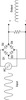
The main filter capacitor is needed to complete the process of rectification by filtering out the "ripple" to give us a steady stream of pure DC. As such, the main filter capacitor is an integral part of the rectifier "circuit." Cheers
Last edited:
All transformers are AC only,,, put simply, AC in on the primary side, AC out on the secondary side. It is the rectifier circuit that converts the AC to DC. Also generalising, if the power transformer has a centre tapped HT secondary winding we use a full wave rectifier. If the HT secondary winding does not have a centre tapped we use a bridge rectifier. However, the rectifier "diodes" alone do not give us pure DC voltage, rather, an unbroken chain of voltage "pulses" as seen in the bridge rectifier diodes diagram hereView attachment 72735
The main filter capacitor is needed to complete the process of rectification by filtering out the "ripple" to give us a steady stream of pure DC. As such, the main filter capacitor is an integral part of the rectifier "circuit." Cheers
Wow, that's amazing!!!!

Amp Mad Scientist
Ambassador of Heresy
You need to re-design it because if the input jack is switched, it's going to pick up a lot of noise.I am trying to avoid making another faceplate if the switch is feasible.
Noise is a possible deal killer.
It is a switch, not looking to add a footswitch and relay. I can add the switch to the front of the amp.
If I want to add the 2nd input jack, I will have to move the existing jack to reposition the holes.
I am not on the power side of the coupling caps.
the Hi and Lo at SW1 are arrows to indicate switch position, not connections, with the input from the tip of the jack at the common.
View attachment 72730
It's going to POP when you switch it...
If the input is connected close to the plate output (on the same switch), it may cause some wild oscillations. The switch is not shielded...
This is why you won't see the input jacks switched on amplifiers...unless you see some special shielding design that gets the noise under control.
Last edited:
ivan H
Ambassador of Tubes & Grooves
I've never had a problem with oscillations when using relays, opto fet's etc to switch stages in or out. If you think about it, he's only switching that one (1st) stage in or out.
Think of how close together the control grid & plate pins are on the 9 pin valve & the pin connectors/solder tags on the valve base. The valve base will likely have greater capacitive coupling between the grid & plate pins/tags than the switch. Lotta surface area on those valve base pins/tags & the control grid & plate pins are right next to each other.
Yes, it will pop some when switching, but that may be unavoidable due to his being limited to a mechanical type switching device. Cheers
Think of how close together the control grid & plate pins are on the 9 pin valve & the pin connectors/solder tags on the valve base. The valve base will likely have greater capacitive coupling between the grid & plate pins/tags than the switch. Lotta surface area on those valve base pins/tags & the control grid & plate pins are right next to each other.
Yes, it will pop some when switching, but that may be unavoidable due to his being limited to a mechanical type switching device. Cheers
OP

jtcnj
Ambassador of the Crossroad
So, I am trying a few things.
I temporarily clip leaded a 1MA pot across the 2 12au7 grids to try the Type3 PPIMV. It works well as far as a reasonable sweep on the pot and reduced volume. I didnt notice much change in the overdrive tone at all, just a little less treble as it is turned down.
That treble attenuation may be due to the pot itself.
I lifted the NFB.
I'm off the switched Hi/Lo input for now.
Instead I'm considering a switched JCM / SLP mode.
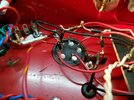
I lifted the lead to the v2a cold clipper grid and clip leaded it to ground. I then put a clip lead as shown in the pic below marked "1".
The cranked tone was much lower gain, but also much lower volume. Then I realized I was passing the signal through 2 470kΩ attenuators before hitting the next triode.
Moved the jumper to position "2" in the pic.
Much better, but working back on the pre-amp volume, still missing that power tube crunch. I know its not the same as big bottles.
Remembering the PPIMV didnt change the OD much, I clip leaded 330k (didnt have 470k on hand) resistors across the 12au7 470k grid stop resistors / portion of the voltage divider, to increase the grid signal to the power tube triodes.
WOW. Best this has sounded by far.
I reconnected the cold clipper and the JCM circuit sound much grindier / crunchier too - especially backing off the pre-PI MV a little. I think the PI is being over-over driven and making some of the mud at full throttle.
I will experiment with the NFB.
I also found when cranking both the pre-amp vol and the MV ( I didnt have the PPIMV pot clipped on) - there is a very noticeable metallic clang. I think the PI output signal is now causing way too much excursion at the 12au7 grids.
So, I will have to experiment with the resistor values at the grid stop / voltage divider, NFB, and PPIMV.
Any input is appreciated.
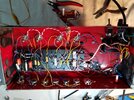
Here are some visuals.
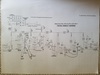
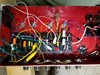
I temporarily clip leaded a 1MA pot across the 2 12au7 grids to try the Type3 PPIMV. It works well as far as a reasonable sweep on the pot and reduced volume. I didnt notice much change in the overdrive tone at all, just a little less treble as it is turned down.
That treble attenuation may be due to the pot itself.
I lifted the NFB.
I'm off the switched Hi/Lo input for now.
Instead I'm considering a switched JCM / SLP mode.
I lifted the lead to the v2a cold clipper grid and clip leaded it to ground. I then put a clip lead as shown in the pic below marked "1".
The cranked tone was much lower gain, but also much lower volume. Then I realized I was passing the signal through 2 470kΩ attenuators before hitting the next triode.
Moved the jumper to position "2" in the pic.
Much better, but working back on the pre-amp volume, still missing that power tube crunch. I know its not the same as big bottles.
Remembering the PPIMV didnt change the OD much, I clip leaded 330k (didnt have 470k on hand) resistors across the 12au7 470k grid stop resistors / portion of the voltage divider, to increase the grid signal to the power tube triodes.
WOW. Best this has sounded by far.
I reconnected the cold clipper and the JCM circuit sound much grindier / crunchier too - especially backing off the pre-PI MV a little. I think the PI is being over-over driven and making some of the mud at full throttle.
I will experiment with the NFB.
I also found when cranking both the pre-amp vol and the MV ( I didnt have the PPIMV pot clipped on) - there is a very noticeable metallic clang. I think the PI output signal is now causing way too much excursion at the 12au7 grids.
So, I will have to experiment with the resistor values at the grid stop / voltage divider, NFB, and PPIMV.
Any input is appreciated.
Here are some visuals.
Amp Mad Scientist
Ambassador of Heresy
Maybe you should try bypassing the 330K grid resistors with a 250pf-500pf cap across each resistor? This might get more crunch into the output...So, I am trying a few things.
I temporarily clip leaded a 1MA pot across the 2 12au7 grids to try the Type3 PPIMV. It works well as far as a reasonable sweep on the pot and reduced volume. I didnt notice much change in the overdrive tone at all, just a little less treble as it is turned down.
That treble attenuation may be due to the pot itself.
I lifted the NFB.
I'm off the switched Hi/Lo input for now.
Instead I'm considering a switched JCM / SLP mode.
I lifted the lead to the v2a cold clipper grid and clip leaded it to ground. I then put a clip lead as shown in the pic below marked "1".
The cranked tone was much lower gain, but also much lower volume. Then I realized I was passing the signal through 2 470kΩ attenuators before hitting the next triode.
Moved the jumper to position "2" in the pic.
Much better, but working back on the pre-amp volume, still missing that power tube crunch. I know its not the same as big bottles.
Remembering the PPIMV didnt change the OD much, I clip leaded 330k (didnt have 470k on hand) resistors across the 12au7 470k grid stop resistors / portion of the voltage divider, to increase the grid signal to the power tube triodes.
WOW. Best this has sounded by far.
I reconnected the cold clipper and the JCM circuit sound much grindier / crunchier too - especially backing off the pre-PI MV a little. I think the PI is being over-over driven and making some of the mud at full throttle.
I will experiment with the NFB.
I also found when cranking both the pre-amp vol and the MV ( I didnt have the PPIMV pot clipped on) - there is a very noticeable metallic clang. I think the PI output signal is now causing way too much excursion at the 12au7 grids.
So, I will have to experiment with the resistor values at the grid stop / voltage divider, NFB, and PPIMV.
Any input is appreciated.
Here are some visuals.
View attachment 73632View attachment 73633
You could try bypassing the output tubes cathode resistor, to increase the output sensitivity...I might try 1-5 uF. This will also increase some low frequency.
It's something that needs experimentation and tweaking...


OP
jtcnj
Ambassador of the Crossroad
I was not aware of that.
I am curious as to what the clang is but I figure the root cause is the amplitude of the incoming grid signal increased by too much, especially with the NFB lifted.
To Quote Ozzy: "He said "Son, son, you've gone too far...""
I'm still planning to lower the node voltages some, so I wont finalize any changes until all the cards are on the table.
I am curious as to what the clang is but I figure the root cause is the amplitude of the incoming grid signal increased by too much, especially with the NFB lifted.
To Quote Ozzy: "He said "Son, son, you've gone too far...""
I'm still planning to lower the node voltages some, so I wont finalize any changes until all the cards are on the table.
Amp Mad Scientist
Ambassador of Heresy
Turn the volume way up and tap on your preamp tubes one at a time.I was not aware of that.
I am curious as to what the clang is but I figure the root cause is the amplitude of the incoming grid signal increased by too much, especially with the NFB lifted.
To Quote Ozzy: "He said "Son, son, you've gone too far...""
I'm still planning to lower the node voltages some, so I wont finalize any changes until all the cards are on the table.
You may find the microphonic tube.
The most sensitive tube is the preamp closest to the input jack.
Just because a tube is "new," or "tested" this does not mean that the tube will work right.
At least 60% of the possible problems with any tube: are not detected by a normal tube tester.
The tube needs to be tested in the actual circuit.
This is the only test which really tells you for certain.
Sometimes it is necessary to try different preamp tubes in the V1 position (tube closest to the input jack), and find a preamp tube which is lower microphonic.
Less ringing, feedback squealing, mechanical clanging noises.
There is ways in the layout of the wires to decrease ringing or squealing or buzzing or hum...
But what it comes down to is the layout of the parts on the circuit board.
This radically effects the sound of the overall amplifier.
One part can pick up sound from another part which is located close to the first. Sound (or even noise) is traveling all the time between parts on the circuit board, because of the location of the parts alone.
If two parts are not connected together, sound (or noise hum buzz hiss) can easily pass between the two parts just because of location alone, nothing else.
Many people will tell you the above is not true.
But I'm trying to teach you that it is true, and confirmed many times.
This is a very important part of tube amps:
The schematic is not the whole circuit.
There is another circuit caused by the layout of the parts and wiring, which is not shown on the schematic.
When there is 2 capacitors side by side:
this forms another capacitor in between the 2. There is a 3rd capacitor formed (in the air space between the parts) when 2 capacitors are located side by side.
Last edited:
OP
jtcnj
Ambassador of the Crossroad
I have experienced microphonic tubes before and had tap-tested these earlier.
Maybe something changed; I'll check them again.
This clank only occurred at full crank on both pre-amp and pre-PI MV. It subsided when I backed off the MV a little - from 10 to about 8.5 - 9.
Right now I'm not coming at this as "there is something wrong / this should be working".
I am experimenting with some values and may have exceeded what should be a working design.
This amp is working I just have not been impressed with the tones.
I am also trying to broaden my understanding; I have started back at learning about tube spec. sheets and load lines, etc.
I have pursued getting an oscilloscope several times but just cant justify the $$.
There are some under $300 units such as Rigol or Hantek I have read good reviews on, and probably some decent used Tektronix or what have you.
I dont know if the cheapy $60. or so portable units are usable for tube amp work or junk.
I have been reluctant to take my chances.
Maybe something changed; I'll check them again.
This clank only occurred at full crank on both pre-amp and pre-PI MV. It subsided when I backed off the MV a little - from 10 to about 8.5 - 9.
Right now I'm not coming at this as "there is something wrong / this should be working".
I am experimenting with some values and may have exceeded what should be a working design.
This amp is working I just have not been impressed with the tones.
I am also trying to broaden my understanding; I have started back at learning about tube spec. sheets and load lines, etc.
I have pursued getting an oscilloscope several times but just cant justify the $$.
There are some under $300 units such as Rigol or Hantek I have read good reviews on, and probably some decent used Tektronix or what have you.
I dont know if the cheapy $60. or so portable units are usable for tube amp work or junk.
I have been reluctant to take my chances.
Amp Mad Scientist
Ambassador of Heresy
I have experienced microphonic tubes before and had tap-tested these earlier.
Maybe something changed; I'll check them again.
This clank only occurred at full crank on both pre-amp and pre-PI MV. It subsided when I backed off the MV a little - from 10 to about 8.5 - 9.
Right now I'm not coming at this as "there is something wrong / this should be working".
I am experimenting with some values and may have exceeded what should be a working design.
This amp is working I just have not been impressed with the tones.
I am also trying to broaden my understanding; I have started back at learning about tube spec. sheets and load lines, etc.
I have pursued getting an oscilloscope several times but just cant justify the $$.
There are some under $300 units such as Rigol or Hantek I have read good reviews on, and probably some decent used Tektronix or what have you.
I dont know if the cheapy $60. or so portable units are usable for tube amp work or junk.
I have been reluctant to take my chances.
Like This:
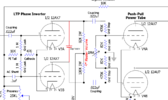
OP
jtcnj
Ambassador of the Crossroad
moved this from the build thread.
I shelved this for a while but got back to it recently.
I realize the "right" solution is probably to get a lower voltage PT, but I'll work with what I have.
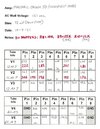
I added a series of 10v zener diodes after the first filter cap and now have @330v on the power tube plates.
with either the 1k or series 1k + 250Ω cathode resistor, the plate dissipation was @81% and 75% .
I was not surprised it sounded horrible.
I am now at 106% with 470 + 250 = actual 710Ω, but at a much lower plate voltage.
It sounds pretty good, best so far, but only played it for an hour or so last night.
I have a parts cart started at Tube Depot and will try 750 and 820Ω.
I will try the cathode bypass cap and the snubber cap across the PI plates soon too.
I skipped the SLP / JCM mode switch for now.
I shelved this for a while but got back to it recently.
I realize the "right" solution is probably to get a lower voltage PT, but I'll work with what I have.
I added a series of 10v zener diodes after the first filter cap and now have @330v on the power tube plates.
with either the 1k or series 1k + 250Ω cathode resistor, the plate dissipation was @81% and 75% .
I was not surprised it sounded horrible.
I am now at 106% with 470 + 250 = actual 710Ω, but at a much lower plate voltage.
It sounds pretty good, best so far, but only played it for an hour or so last night.
I have a parts cart started at Tube Depot and will try 750 and 820Ω.
I will try the cathode bypass cap and the snubber cap across the PI plates soon too.
I skipped the SLP / JCM mode switch for now.
moved this from the build thread.
I shelved this for a while but got back to it recently.
I realize the "right" solution is probably to get a lower voltage PT, but I'll work with what I have.
I added a series of 10v zener diodes after the first filter cap and now have @330v on the power tube plates.
with either the 1k or series 1k + 250Ω cathode resistor, the plate dissipation was @81% and 75% .
I was not surprised it sounded horrible.
I am now at 106% with 470 + 250 = actual 710Ω, but at a much lower plate voltage.
It sounds pretty good, best so far, but only played it for an hour or so last night.
I have a parts cart started at Tube Depot and will try 750 and 820Ω.
I will try the cathode bypass cap and the snubber cap across the PI plates soon too.
I skipped the SLP / JCM mode switch for now.
View attachment 78214View attachment 78215
Sounds like you are on the right track!!!!
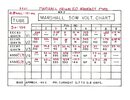
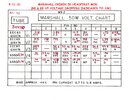
On my Origin 50H (I know your amp is different) @syscokid used a 15k dropper to bring the V2 voltages down from a whopping 385 to 306, where the 330V rating of the Genelex B759 wouldn't be exceeded, but IIRC, our power tube voltages were way higher than your 330V readings!!!!
I need to go back and read previous posts!!!!!