
You are using an out of date browser. It may not display this or other websites correctly.
You should upgrade or use an alternative browser.
You should upgrade or use an alternative browser.
New Blade for the Wife...
- Thread starter Sp8ctre
- Start date


eclecticsynergy
Ambassador of Electric Synergy

That's gorgeous.
Every kitchen needs a good santoku.
Mine sees more use than my big knives.
Every kitchen needs a good santoku.
Mine sees more use than my big knives.

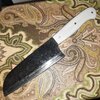
What's up with the crazy pattern on the blade?...she has been asking why I make knives and she hasn't received one. So I made her this one for the kitchen. Hand Ground from a 144 layer Damascus billet. White Micarta handle Scales with Brass pins. Super Sharp!
View attachment 73536


...she has been asking why I make knives and she hasn't received one. So I made her this one for the kitchen. Hand Ground from a 144 layer Damascus billet. White Micarta handle Scales with Brass pins. Super Sharp!
View attachment 73536
Damascus!!!!!

SIx String Chef
Ambassador of Taste

That is one beautiful blade, Sp8ctre! Amazing workmanship. One day I will get one of that level for my kitchen!
SIx String Chef
Ambassador of Taste
That's the damascus pattern!What's up with the crazy pattern on the blade?
eclecticsynergy
Ambassador of Electric Synergy
Damascus blades use alternating layers of hard and softer steel.What's up with the crazy pattern on the blade?
Hard steel gives a razor edge that keeps its sharpness, but it's brittle and will chip easily or even shatter under stress.
Softer steel is more forgiving - flexible and resilient - but it can easily be dented or bent and it doesn't take a good edge or stay sharp.
Layering them together you get the best of both: a sharp, durable blade that holds its edge and will bend without breaking.
The layering is done by welding the two steels together under heat, and hammering the result until thin enough to fold.
That composite is folded over, heated & hammered out thin once more.
The process is repeated again and again until there are many, many superthin layers.
The result is often called watered steel because of the rippled patterns that are visible.
The patterns are as individual as a fingerprint, no two are ever the same.
This is also how the impossibly sharp and flexible Samurai katanas were made in medieval Japan.
The technique is called the Damascus process because swordsmiths in Syria practiced it in the Middle Ages.
It soon became widely known that the best blades in Europe came from Damascus.
However, these legendary ancient blades contain a type of cottage industry steel from India which hasn't been produced since the 1800s, and were made using techniques that were lost when the traditional smiths died off without passing on their secrets.
Despite many attempts, no one in modern times has been able to reproduce the unusual combination of rare impurities in the steel and the long-lost secrets of the forging and tempering methods. Modern blades simply cannot equal the ancient ones.
Even so, today many of the best blades continue to be made in the layered Damascus style, only using modern steel and usually forged with mechanical assistance.
There are still master swordsmiths in Japan using hand hammering and manual tempering. Even though the ancient steel is no longer available, some of these smiths have family tradtitions dating back to the days of the Samurai.
Of course, as with just about anything you can think of, Chinese factories are now mass-producing low-cost fakes.
These are usually cheap stamped blades with patterns etched into the blades to look like watered steel.
However, there are also makers in China producing real layered blades of decent quality, mostly for the Japanese market.

POOP KNIFE
Well-Known Member
Hey baby... You come around here often? I'll bet you can really cut some rug!
Last edited by a moderator:

POOP KNIFE
Well-Known Member
Now that is one sexy knife!
POOP KNIFE
Well-Known Member
I think I'm falling blade over tang in love

syscokid
Ambassador of War & Peace
Cool info...Damascus blades use alternating layers of hard and softer steel.
Hard steel gives a razor edge that keeps its sharpness, but it's brittle and will chip easily or even shatter under stress.
Softer steel is more forgiving - flexible and resilient - but it can easily be dented or bent and it doesn't take a good edge or stay sharp.
Layering them together you get the best of both: a sharp, durable blade that holds its edge and will bend without breaking.
The layering is done by welding the two steels together under heat, and hammering the result until thin enough to fold.
That composite is folded over, heated & hammered out thin once more.
The process is repeated again and again until there are many, many superthin layers.
The result is often called watered steel because of the rippled patterns that are visible.
The patterns are as individual as a fingerprint, no two are ever the same.
This is also how the impossibly sharp and flexible Samurai katanas were made in medieval Japan.
The technique is called the Damascus process because swordsmiths in Syria practiced it in the Middle Ages.
It soon became widely known that the best blades in Europe came from Damascus.
However, these legendary ancient blades contain a type of cottage industry steel from India which hasn't been produced since the 1800s, and were made using techniques that were lost when the traditional smiths died off without passing on their secrets.
Despite many attempts, no one in modern times has been able to reproduce the unusual combination of rare impurities in the steel and the long-lost secrets of the forging and tempering methods. Modern blades simply cannot equal the ancient ones.
Even so, today many of the best blades continue to be made in the layered Damascus style, only using modern steel and usually forged with mechanical assistance.
There are still master swordsmiths in Japan using hand hammering and manual tempering. Even though the ancient steel is no longer available, some of these smiths have family tradtitions dating back to the days of the Samurai.
Of course, as with just about anything you can think of, Chinese factories are now mass-producing low-cost fakes.
These are usually cheap stamped blades with patterns etched into the blades to look like watered steel.
However, there are also makers in China producing real layered blades of decent quality, mostly for the Japanese market.

OP

Sp8ctre
Ambassador of Steel
Damascus blades use alternating layers of hard and softer steel.
Hard steel gives a razor edge that keeps its sharpness, but it's brittle and will chip easily or even shatter under stress.
Softer steel is more forgiving - flexible and resilient - but it can easily be dented or bent and it doesn't take a good edge or stay sharp.
Layering them together you get the best of both: a sharp, durable blade that holds its edge and will bend without breaking.
The layering is done by welding the two steels together under heat, and hammering the result until thin enough to fold.
That composite is folded over, heated & hammered out thin once more.
The process is repeated again and again until there are many, many super thin layers.
The result is often called watered steel because of the rippled patterns that are visible.
The patterns are as individual as a fingerprint, no two are ever the same.
This is also how the impossibly sharp and flexible Samurai katanas were made in medieval Japan.
The technique is called the Damascus process because swordsmiths in Syria practiced it in the Middle Ages.
It soon became widely known that the best blades in Europe came from Damascus.
However, these legendary ancient blades contain a type of cottage industry steel from India which hasn't been produced since the 1800s, and were made using techniques that were lost when the traditional smiths died off without passing on their secrets.
Despite many attempts, no one in modern times has been able to reproduce the unusual combination of rare impurities in the steel and the long-lost secrets of the forging and tempering methods. Modern blades simply cannot equal the ancient ones.
Even so, today many of the best blades continue to be made in the layered Damascus style, only using modern steel and usually forged with mechanical assistance.
There are still master swordsmiths in Japan using hand hammering and manual tempering. Even though the ancient steel is no longer available, some of these smiths have family traditions dating back to the days of the Samurai.
Of course, as with just about anything you can think of, Chinese factories are now mass-producing low-cost fakes.
These are usually cheap stamped blades with patterns etched into the blades to look like watered steel.
However, there are also makers in China producing real layered blades of decent quality, mostly for the Japanese market.
Thanks for the great explanation and saving me a lot of typing!
OP
Sp8ctre
Ambassador of Steel
I love Santoku blades! That's almost all I use in the kitchen. I didn't know you could buy Damascus billets. That's cool.
You can find some on eBay and there are a few makers that sell on the knife forums...