How about this one...
Ahh, so THAT’S how you strip a guitar sound of its native character!
Got it. I was wondering how to do that!

How about this one...

I owned a Engl Fireball for a short while, while it had great saturation it was so over compressed it couldn't cut through the band making it virtually useless for what I wanted it do.I'm listening to this and I am convinced they've never played through an Engl Fireball.
Nothing in that video was high gain...

I owned a Engl Fireball for a short while, while it had great saturation it was so over compressed it couldn't cut through the band making it virtually useless for what I wanted it do.
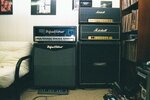
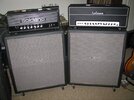
This is the combination I used for a couple years...... The TriAmp was killer with the Marshall.
View attachment 70942
The Soldano and Splawn were very good too.
View attachment 70945

Pretty much any high gain amp set to massive amounts of overdrive or distortion will neutralize a guitar's native character. Or in other words, for that crushing hardcore metal sound, it's more about the amp than it is the guitar.Ahh, so THAT’S how you strip a guitar sound of its native character!
Got it. I was wondering how to do that!
Pretty much any high gain amp set to massive amounts of overdrive or distortion will neutralize a guitar's native character. Or in other words, for that crushing hardcore metal sound, it's more about the amp than it is the guitar.

Too true.Pretty much any high gain amp set to massive amounts of overdrive or distortion will neutralize a guitar's native character. Or in other words, for that crushing hardcore metal sound, it's more about the amp than it is the guitar.

Pretty much any high gain amp set to massive amounts of overdrive or distortion will neutralize a guitar's native character. Or in other words, for that crushing hardcore metal sound, it's more about the amp than it is the guitar.
Even with the wide variety of stuff that I'm playing now (as an instructor) i doubt you would never hear the guitar even if there is zero gain. I'm running chorus 100% of the time as a signature aspect of my tone, plus a compressor and reverb. There's more coloring there than you might imagine.
I use chorus quite a bit, as well as delay and reverb, but my overdrive and distortion are usually not set too aggressive. True, they do color the tone. That’s why I use them! But, I can tell the difference between the sound of different guitars pretty readily even with those effects, and other people can, too. Then again, I don’t overdo them, either.
I agree that any effects will color and mask a guitar‘s tone, and the more you use the more the guitar‘s sound is affected. But, under normal circumstances, heavy distortion has the most singular impact on a guitar’s native character. This is simple physics. As a waveform is overdriven and saturated in the tubes (or transistor stages or clipping diodes) greater and greater portions of the waveform are clipped off, leaving less information of the original signal.
Of course, this is assuming relatively mild and normal use of the other effects! If you use something rather extreme like a ring modulator or a Moogerfooger, all bets are off! The same is true if you cascade a lot of effects and keep them on.
So, I don’t disagree with your comment, as you’ve worded it. I’m only making the point that heavy distortion will more immediately affect the character of your guitar’s sound than other effects, depending on how you’re using them.
I don't hear much difference in my humbucker guitars. My EMG81TW sounds almost identical to my custom DiMarzio Neanderthal 16.5k passive AlNico9. They sound the same played clean too.
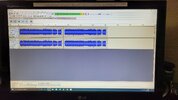
Here's the two waveforms, Schecter EMG81TW on the left and DiMarzio Neanderthal 16.5k passive on the right.
View attachment 70964
In general, I like to have a tremolo for some songs, like 'Cult Of Personality,' or 'Out In The Fields,' but for lots of string bending, like in 'Hotel California,' or 'All Along The Watchtower,' I prefer a fixed bridge.
The main reason I use two guitars is because I am so rough on them, but when I switch, because of a broken string, etc., I don't want to be forced to readjust my rig...

I agree that any effects will color and mask a guitar‘s tone, and the more you use the more the guitar‘s sound is affected. But, under normal circumstances, heavy distortion has the most singular impact on a guitar’s native character.
I agree. I wouldn’t expect you’d hear much difference between those. I know I don’t when I’ve listened to them in sound tests. But, that’s just YouTube!
By the way, the waveforms in Audacity aren’t very useful for really examining frequency response, especially zoomed way out. A tighter resolution would be more useful, but, even then, a display from a spectrum analyzer would be more beneficial. The waveforms in Audacity don’t show harmonic content.
Just a minor point to ponder, as if you don’t have enough to think about already!
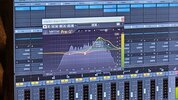
Totally agree! They only tell amplitude really…and all zoomed out….well…the waveforms in Audacity aren’t very useful for really examining frequency response,


Actually, the amps are high sensitivity, not high gain.
The gain is limited by the power supply voltage which doesn't really change no matter which amp....
All the power supplies are under 500 volt...
The term "high gain" is a misnomer.
So let's start by understanding what this really is.
"High gain" amplification has it's origins in tube phonograph amplifiers.
The design was copied and applied to guitar amps.
The first high gain guitar amp was envisioned by Marshall / Dudley Craven.
The design was adapted from the fender bassman....which was boosted up beyond the original.
Later (much later) the same design was copied by Mesa Boogie.
They claimed they invented "high gain," but that is an outright lie.
Yes that can be proven from the schematics !
The design of mesa boogie is just another copy of a marshall and a fender basman....same circuit, same tone stack, same power amp and on and on.
I know I'm late to this, but seeing as the tread title is "real high gain", I think we should clarify just what gain is.I guess the point is:
there is no "high gain." The gain remains the same because of the limit of the power supply.
There is only high sensitivity, or lower sensitivity.
 .
.
I know I'm late to this, but seeing as the tread title is "real high gain", I think we should clarify just what gain is.
Gain is an expression of the "voltage amplification" factor of (either) a single pre-amp stage (or of a pre-amp as a whole). This "voltage gain" is usually expressed in "db", which is a ratio, not a measure.
For a really in-depth explanation of "gain", head over to the Marshall forum, "the workbench" sub-forum & there, 2nd thread title "what is gain" will spell it all out for you properly & without bull
So is there such a thing as "high gain" & "low gain" pre-amps"??? Of course there is, but I don't think most here need me to tell them that.
Can gain be also called sensitivity, yes, but it's still an expression of voltage gain, not voltage sensitivity.
The triode voltage amplifier, which is what inhabits our tube pre-amp sections, was the very first form of amplification ever developed & definitely pre-dates the phonograph by quite some time.
I won't comment on the rest. Cheers
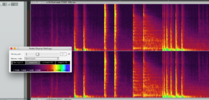
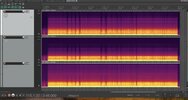
Don't know what's going on here, but it sure looks pretty!“Spectrogram” mode…good stuff.

IS that English?I know I'm late to this, but seeing as the tread title is "real high gain", I think we should clarify just what gain is.
Gain is an expression of the "voltage amplification" factor of (either) a single pre-amp stage (or of a pre-amp as a whole). This "voltage gain" is usually expressed in "db", which is a ratio, not a measure.
For a really in-depth explanation of "gain", head over to the Marshall forum, "the workbench" sub-forum & there, 2nd thread title "what is gain" will spell it all out for you properly & without bull
So is there such a thing as "high gain" & "low gain" pre-amps"??? Of course there is, but I don't think most here need me to tell them that.
Can gain be also called sensitivity, yes, but it's still an expression of voltage gain, not voltage sensitivity.
The triode voltage amplifier, which is what inhabits our tube pre-amp sections, was the very first form of amplification ever developed & definitely pre-dates the phonograph by quite some time.
I won't comment on the rest. Cheers