
OP


Sand the nut down a bit. And try a round bottom rather than a funnel at some point and see which works best for you
Ok, here's where things get tricky...I'm using multiple angles here, making small changes and then dive bombing 10-15 times while watching my tuner to see if improvements were noted.
The nut floors were all cut square with a Stewie-Mac saw to string size.
The floors were then profiled with a round needle file.
The front (bridge side) of the nut is totally squared at the bottom, as this is our intonation point. There is no funnel shape here at the bottom, only on the sides or walls of the slots.
The floor of the nut has string contact along about 2/3rds of its length. After that, the floor "falls away" from the string to the point that a slight space can be seen below each string when viewed from the tuning key side.
The rear (tuning key exit) walls of the nut are bell shaped here too, but the actual trough in the floor of the nut is not.
So, the slot walls on the low 'E' looks like this ) ( when viewed from above, but if you pull out the string, the nut floor looks like this | | so this profile is what lows the string to shift laterally when the bar is depressed.
Here's why I found this important.
The low 'E' is NOT in alignment with its nut slot. As the 'E' leaves the nut, it shifts towards the centerline of the neck slightly. This is visible and consistent on all Fenders and my Jackson.
Look at this shot:
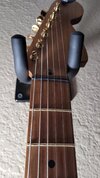
When I was watching the behavior of the low 'E' under magnification, I noticed that the string began to lift out of the front (bridge side) of the nut as it slipped towards the keys...and at the same time, the string also moved away from the centerline of the neck. This is where I was getting hung up.
By adding the ) ( profile to the nut walls, I was able to reduce the strings contact points as it rose up from its "bed" and moved laterally.
The relatively high nut walls seem to keep the strings in place, even when an open 'E' is raked backwards (upwards) without string trees.
I know this isn't textbook, but its turned this guitar into a functional piece.


