When Stratocaster Nuts Drive You Nuts - Keeping The 6-Screw Fender Tremolo In Tune:

Sand the nut down a bit. And try a round bottom rather than a funnel at some point and see which works best for you

Ok, here's where things get tricky...I'm using multiple angles here, making small changes and then dive bombing 10-15 times while watching my tuner to see if improvements were noted.

The nut floors were all cut square with a Stewie-Mac saw to string size.

The floors were then profiled with a round needle file.

The front (bridge side) of the nut is totally squared at the bottom, as this is our intonation point. There is no funnel shape here at the bottom, only on the sides or walls of the slots.

The floor of the nut has string contact along about 2/3rds of its length. After that, the floor "falls away" from the string to the point that a slight space can be seen below each string when viewed from the tuning key side.

The rear (tuning key exit) walls of the nut are bell shaped here too, but the actual trough in the floor of the nut is not.

So, the slot walls on the low 'E' looks like this ) ( when viewed from above, but if you pull out the string, the nut floor looks like this | | so this profile is what lows the string to shift laterally when the bar is depressed.

Here's why I found this important.

The low 'E' is NOT in alignment with its nut slot. As the 'E' leaves the nut, it shifts towards the centerline of the neck slightly. This is visible and consistent on all Fenders and my Jackson.

Look at this shot:
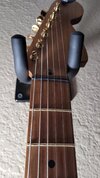
20210309_054444.jpg

When I was watching the behavior of the low 'E' under magnification, I noticed that the string began to lift out of the front (bridge side) of the nut as it slipped towards the keys...and at the same time, the string also moved away from the centerline of the neck. This is where I was getting hung up.

By adding the ) ( profile to the nut walls, I was able to reduce the strings contact points as it rose up from its "bed" and moved laterally.

The relatively high nut walls seem to keep the strings in place, even when an open 'E' is raked backwards (upwards) without string trees.

I know this isn't textbook, but its turned this guitar into a functional piece.
 
Ok, here's where things get tricky...I'm using multiple angles here, making small changes and then dive bombing 10-15 times while watching my tuner to see if improvements were noted.

The nut floors were all cut square with a Stewie-Mac saw to string size.

The floors were then profiled with a round needle file.

The front (bridge side) of the nut is totally squared at the bottom, as this is our intonation point. There is no funnel shape here at the bottom, only on the sides or walls of the slots.

The floor of the nut has string contact along about 2/3rds of its length. After that, the floor "falls away" from the string to the point that a slight space can be seen below each string when viewed from the tuning key side.

The rear (tuning key exit) walls of the nut are bell shaped here too, but the actual trough in the floor of the nut is not.

So, the slot walls on the low 'E' looks like this ) ( when viewed from above, but if you pull out the string, the nut floor looks like this | | so this profile is what lows the string to shift laterally when the bar is depressed.

Here's why I found this important.

The low 'E' is NOT in alignment with its nut slot. As the 'E' leaves the nut, it shifts towards the centerline of the neck slightly. This is visible and consistent on all Fenders and my Jackson.

Look at this shot:

View attachment 60906

When I was watching the behavior of the low 'E' under magnification, I noticed that the string began to lift out of the front (bridge side) of the nut as it slipped towards the keys...and at the same time, the string also moved away from the centerline of the neck. This is where I was getting hung up.

By adding the ) ( profile to the nut walls, I was able to reduce the strings contact points as it rose up from its "bed" and moved laterally.

The relatively high nut walls seem to keep the strings in place, even when an open 'E' is raked backwards (upwards) without string trees.

I know this isn't textbook, but its turned this guitar into a functional piece.
The great thing about nuts is that, even though crucially important, they are rather cheap. This is especially true if you get bone blanks. You may enjoy getting some bone blanks and developing your own ideal specs. You will also need this ruler to do it right


I can recommend some other tools if you are interested.
 
The nut slots still need to be right, whatever the guitar (bass, mandolin...) or strings you use.

Agreed, but was thinking perhaps when my slots were. 047" a drop to .038" would have yielded a difference of .010" which might have been enough room without all the surgery and frustration???
 
Agreed, but was thinking perhaps when my slots were. 047" a drop to .038" would have yielded a difference of .010" which might have been enough room without all the surgery and frustration???

Maybe, but the angle comes into it too. I usually spend more time fettling the nut than setting up the rest of the guitar, unless I'm doing fretwork.
 
The great thing about nuts is that, even though crucially important, they are rather cheap. This is especially true if you get bone blanks. You may enjoy getting some bone blanks and developing your own ideal specs. You will also need this ruler to do it right


I can recommend some other tools if you are interested.

I'd welcome any and all recommendations!!!

I want a brass nut that will work with my 1-3/4" board with a 10" radius. That's my future mod. This Graph Tech Tusq XL doesn't look like it's gonna last too long. It's super soft material...
 
Here's an example...

Most of the "bite" in this recording comes from how hard I am hitting the strings. I've broken Fender mediums playing this song live and you can't get that "snarl" without really hitting it hard.


Listen to Fantasy - Aldo Nova Cover - 11-06-2019 Re-Master by Von Herndon on #SoundCloud
 
a few years ago somebody said a non floyd trem couldnt be set up to stay in tune, or something along those lines.
so made this vid.
since i learned about frudua ive used his methods of strat setups and have had great results. i also use some stuff calls burts bees lip balm to lube all points of string contact. any lube will work, thats just what i had lying around the first time i used lube on a guitar.
 
a few years ago somebody said a non floyd trem couldnt be set up to stay in tune, or something along those lines.
so made this vid.
since i learned about frudua ive used his methods of strat setups and have had great results. i also use some stuff calls burts bees lip balm to lube all points of string contact. any lube will work, thats just what i had lying around the first time i used lube on a guitar.
OK, that nearly kills me every time I see it. I can't stop laughing ...
 
I'd welcome any and all recommendations!!!

I want a brass nut that will work with my 1-3/4" board with a 10" radius. That's my future mod. This Graph Tech Tusq XL doesn't look like it's gonna last too long. It's super soft material...
Metal work is a whole new game that I am not familiar with.

However, for bone, in addition to the ruler I linked before, get these starter files. They help you nail down the original slot in the right place


The next step is the fine files, which you may already have. You do not need a full set if you know precisely what strings you will be using, but you work on other people's guitars, so you may want to invest


Finish the job with Mitchell's abrasive cord for a smooth ride

 
HOLY SHIP a lot happened while I slept.

I read the first couple sentences, Saw the first pic of the head and Tusq nut as it arrived. Minimal groove for Low E string. then saw this pic HUGE looking groove I saw yesterday. Kind of was suspecting a groove issue which is why I think I made a comment about string swaps, maybe even mentioned using a E from a set of 11's in there. OR just thought it and held off my theory. I will hold off on commenting further till I read the rest.
 
Last edited by a moderator:
Back
Top