OP

Clockworkmike
Ambassador of STACKS in WV SHACKS

Ok, thats a start!1000 ohm is good enough for regular EL34.
Adjust the bias on pin 5 to - 48 VDC.

Ok, thats a start!1000 ohm is good enough for regular EL34.
Adjust the bias on pin 5 to - 48 VDC.

You still need to find out why the cathode is reading 14 ohms to ground.Ok, thats a start!
If the bias is 6 volts off, that would draw a lot of current.Ok, thats a start!
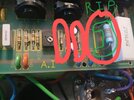
Dominay Dominay Dayoos...What about the DEAD R30 that leads to the plates of the phase inverter tube?View attachment 58990
And so, another evening passes in West by God..........Ok, thats a start!
So would the r30 being smoked, likely destroying the phase inverter tube in the process, play a role in the screwed up cathode resistance?Dominay Dominay Dayoos...
The phase inverter tube is blown to poop.
R30 22K 1 watt is probably blown because of a shorted phase inverter tube.So would the r30 being smoked, likely destroying the phase inverter tube in the process, play a role in the screwed up cathode resistance?
Yeah compared to the other 3, it looks discolored, like the silver is dissipated badly, i can see a faint line across it and it looks milkier in the glass below, inside the components looks darker . Looks off to meR30 22K 1 watt is probably blown because of a shorted phase inverter tube.
The plate resistor of the PI also overheated.
and so you need to replace 2 resistors and a PI tube.
Also check the rest of the resistors in the PI circuit.
Looks like the tube shorted out.
Is the PI tube black / burned on the insides?
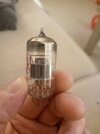
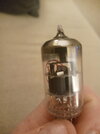
Look at the silver inside the tube. Is it discolored?

I have used a wrench, and a hammer to jump the starter on a Ford .
Replace the PI tube and don't use that tube again.Yeah compared to the other 3, it looks discolored, like the silver is dissipated badly, i can see a faint line across it and it looks milkier in the glass below, inside the components looks darker . Looks off to me
Tube from v1 View attachment 59003
PI tube View attachment 59001
I like the later fords, with EZ pull start.I have used a wrench, and a hammer to jump the starter on a Ford .
Thanks
No.So would the r30 being smoked, likely destroying the phase inverter tube in the process, play a role in the screwed up cathode resistance?
Man, i cant thank you enough for your time and input on all of this. Sincerely mean that. I will change the messed up resistors,replace the PI tube and check further on this cathode wiring before actually putting everything back together.No.
The cathode track pin 1 and 8 would fry from an output tube drawing too much current.
The 500 ma fuse is supposed to blow...
but maybe somebody put an oversize fuse in there at some point in the distant past...and that would fry the cathode wire path leading to ground.
So if the wire is bad whatever you need to fix that.

The PI coupling caps. Sometimes (in 900 amps) these 2 caps are rated 250 volt, and they should be 500 volt or higher.
I will...

Definitely good advice! Ill replace all the messed up and inaccurate pieces and give it a good walk thru before hopefully, putting the tubes back in and fingers crossed: it working lolThe white PI coupling caps on the amp's board are rated for 400v.
I have already have suggested to not use the current V4/PI tube. Also, replace the dead R30. Replace R28 & R29 with stock schematic values. BTW, R28 looks brutalized!
Definitely check the value of the HT fuse and make sure it's no more than .5A.
Then check voltages with no tubes installed.
I really hope that the amp's problems aren't and deeper than this...
Did you look at the voltage rating of PI coupling caps?Man, i cant thank you enough for your time and input on all of this. Sincerely mean that. I will change the messed up resistors,replace the PI tube and check further on this cathode wiring before actually putting everything back together.
As far as the PI capacitors and the delicate soldering: Yeah i learned a lesson years ago on the JCM2000 about fragility, replacing its BR and damaging the traces during soldering, so ill tread cautiously there and if replacing becomes necessary, take that one to the tech. I can solder fairly decently but i know my limits when it comes to precision soldering now lol
Did you look at the voltage rating of PI coupling caps?
These caps will be connected to pins 1 and 6 of the PI.
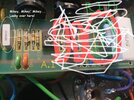
Yeah, following the schematic, i figured these where were i needed to be looking? C9 and c10, which both come off of V4 to each of the EL34 sockets. Says they're 22n 400v rated on the schematic and board. I guess im onto the right path? Lol
A Ha! I see the problem!! It's a JJ made preamp tube. I hate JJ preamp tubes. YMMV...