New amp build finally started. JTM45 with KT66.

Why not ground to a stud??? If the transformer is mounted to the chassis, the entire chassis is grounded, No???
I have heard the same regarding the transformer stud as ground, not sure why.
Yeah, I don't know why, either. All I remember is because German amp guru, Larry aka Novsibir, said so. Maybe somebody else here would know why?
 
Why not ground to a stud??? If the transformer is mounted to the chassis, the entire chassis is grounded, No???

Asking for educational purposes, not being a dick.
We don't want to ground to a PT mounting bolt so as to avoid inducing ground hum problems (different from "ground loop" hum. This is due to how the transformer "works" (magnetics).
If we break the transformer down, we have a ferric laminate core with the primary & a few secondary's wound onto it.
When we apply AC voltage to the primary it causes magnetic fluctuations in the laminate core at 50 or 60 cycles a second (north/south/north/south etc).
The (also ferric) mounting bolts pass through the laminate core & the chassis to secure the two together.
Think of how the pole pieces of a pickup focus a magnetic field. The mounting bolts do the same thing, so it is best not to use them as a ground tie point in the interest of a quiet amp.

The lightbulb limiter is a great idea if you don't have access to a variac.
If you do have access to a variac, hopefully it features an ampmeter as well as voltmeter on the output. If not we should use an ampmeter in the AC "active" lead to the amplifier. We need to monitor the current that the amplifier is drawing to ensure all is OK (same reason we use the lightbulb current limiter if we don't have the other gear, it "lights up" rather than glows a bit if the amplifier is drawing excessive current).

The Mojotone JTM45 layout differs from the originals in a few ways, not sure why they would do that. The layout that I posted earlier in this thread is more like the original amps.

Good catch on the HT voltage droppers Sysco.
Cheers
 
Last edited:
:H5: Ivan, you da MAN!!
Thanks for providing continued enlightenment!

I grounded some leads to a xformer stud on my first build - 5f1. It has a little hum, and for SE builds that is not unusual.
I will add it to the list of things I cant get to to move the ground to see if it reduces the hum.
Purely as an exercise; the amp is not objectionably noisy (unless I am playing).
 
We don't want to ground to a PT mounting bolt so as to avoid inducing ground hum problems (different from "ground loop" hum. This is due to how the transformer "works" (magnetics).
If we break the transformer down, we have a ferric laminate core with the primary & a few secondary's wound onto it.
When we apply AC voltage to the primary it causes magnetic fluctuations in the laminate core at 50 or 60 cycles a second (north/south/north/south etc).
The (also ferric) mounting bolts pass through the laminate core & the chassis to secure the two together.
Think of how the pole pieces of a pickup focus a magnetic field. The mounting bolts do the same thing, so it is best not to use them as a ground tie point in the interest of a quiet amp.
That sounds pretty good to me... :cheers:
 
Just wondering how the amp is going SG John, hopefully it's up & running healthily. Cheers


Thanks Ivan. I replace the 68K plate resistor with an 82K, put the diode in the correct position, and repositioned the trimpot and 56K resistor. Then, I pulled the 10K dropping resistor from the 16/16uF cap. After doing that, I had no voltage to the phase inverter at pins 1 and 6. Was also missing voltage at at the plate resistors. Found that there were more changes I needed to make to get everything to match the drawing you posted. The choke needed to be wired at the other end of 8.2K resistor, a wire needed to be added between the junction of the 82K and 100K resistors and the 8.2K resistor.

Got all the changes done last night. I've been lacking sleep since my wife's hip surgery last week. Now she no longer needs to wear the anti-blood clot air compressors on her legs at night, so I finally got a good night's sleep. Tonight, I'll see if I have voltage in all the correct places.
 
Hope the wife is recovering well; dote on her the amp will wait for you.....

I have been. I think I’ve heard her say “I love you” more in the past week than in the entire time we’ve been together. Took her out for a walk around the neighborhood last night. It did more for her recuperation than just walking around the house has.
 
Hope your wife has a speedy recovery John. Great to hear you've making such an effort taking care of her.

I really don't understand why Mojotone would deviate so much from the original layout. Good job getting it reconfigured, which is harder than getting it right the first time 'round.

Hope all the voltage tests go well.
Remember to make sure the negative bias voltage is present at pins 5 of both power tube sockets during your voltage checks (no power tubes fitted). You should also check this bias voltages min/max range (trimpot fully counterclockwise to fully clockwise).

To read this "negative" bias voltage with a "digital" type multimeter, you can put the black meter probe to ground like normal, & use the red probe to read the voltage, in which case your digital meter will show it is reading a negative voltage by placing a - symbol before the readout.
If you have an "analogue" type meter (meter type display), you will need to place the red meter probe to ground & read the negative bias voltage with the black probe. You then know that the reading is a "negative" voltage as the probes are reversed from normal.
You can also use a digital meter in this "probes reversed" fashion & get a normal readout (no - symbol preceding readout).
Maximum (negative) bias voltage should be around -45V, maybe a tad more.
Only when you are absolutely sure the bias circuit is functioning properly & present at pins 5 of both sockets, & the min/max adjustment is in the correct range & the negative bias voltage is set to its maximum can you safely install power tubes. Hope this all helps. Cheers
Edit:
With the bias adjustment trimpot set fully clockwise ("maximum" negative bias voltage) you should be reading somewhere around -45V or maybe a tad more. BE SURE THIS ADJUSTMENT IS SET TO MAXIMUM BEFORE FITTING POWER TUBES. Cheers
 
Last edited:
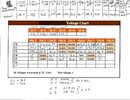
Did a general check of the voltages with no power tubes. I'll play with the bias pot to see what I get tomorrow night. As for now, pin 5 of V4 and V5 get -46.6 volts. Everything else looks like it's close enough to the range of what the Mojo sheet says for voltages. I scribbled those at the top. Also need to try a few different tubes in V3 to get that 7.2 volts between pins 1 and 6.

Hope to go to Cambridge on Saturday and be able to have Scott and maybe Tim around when I try it for real.

Tube Chart 10212020_9PM.jpg
 
Last edited:
Are the Mojotone's suggested voltages done without tubes too?

You should also document the wall voltage and the date too.

I have no clue if it's done without. I'll print a few different schematics before Saturday to bring to Cambridge. I'll also try to look them over prior, maybe I'll find something.

I do save day and time on the scan. And of course, after I posted it I realized that I forgot to check wall voltage. But then my house has been pretty consistent at 120 lately.
 
:H5: Ivan, you da MAN!!
Thanks for providing continued enlightenment!

I grounded some leads to a xformer stud on my first build - 5f1. It has a little hum, and for SE builds that is not unusual.
I will add it to the list of things I cant get to to move the ground to see if it reduces the hum.
Purely as an exercise; the amp is not objectionably noisy (unless I am playing).

I peed on an electric fence once.
 
I asked cuz your amp's voltages will drop a bit when the tubes go in.

I'm also looking at the 197v of the pin-8 cathode of V2. Most 12AX7's cathodes are rated at 180vdc. A few are rated for 200vdc.


Weird. The Mojo sheet says 209 volts from C6 to the Cathode. Metro says 150 volts. My 209 volt value is 196. If it drops 10%, I'll be at 177. I'll look over everything again tonight when I get home.
 
Last edited:
I peed on an electric fence once.


An engineer I once worked with had a neighbor who's dog would pee on his Rhododendron bush all the time. He was pissed the neighbor would not keep the dog leashed. One day, he sat down with a spool of 20 gauge wire, and stripped all the insulation off of it. When he got home, he wrapped it around the bush like he was hanging X-mess lights, then connected each end to a truck battery. He said when the dog pissed on the bush, he started running and yelping and hasn't stopped.
 
Did a general check of the voltages with no power tubes. I'll play with the bias pot to see what I get tomorrow night. As for now, pin 5 of V4 and V5 get -46.6 volts. Everything else looks like it's close enough to the range of what the Mojo sheet says for voltages. I scribbled those at the top. Also need to try a few different tubes in V3 to get that 7.2 volts between pins 1 and 6.

Hope to go to Cambridge on Saturday and be able to have Scott and maybe Tim around when I try it for real.

View attachment 50743
The voltages at each pre amp tube pin vary a little depending on the particular 12AX7's installed, plate & cathode resistor tolerances etc, & the HT voltage overall will vary a bit depending on the PT spec. For example a "Metroamp" spec 1202-55 PT will give a B+ of about 400V, wheras a "Marstran" or "Merren" 1202-55 will give a B+ of 450V (which is about correct for an original). A "Classictone" PT (apparently) gives a bit higher B+. Not sure about a Mojotone spec (Heyboer) PT, but you get the idea.
You can expect voltages to drop about 10% with the power tubes installed & biased. So long as your voltages are ballpark it's all good. We must remember that the original Marshall spec called for a -/+ 10% tolerance in regard to voltages.
Regarding the 7.2V ~ 7.3V difference between PI plates, when you have the power tubes installed & biased, plug a few different 12AX7's in the V3 position to find one that gets you closest to this (they can vary a LOT). We have to remember, Marshall (or really any amp manufactures) never worried about this type thing, they plugged a 12AX7 in & you got what you got. Even now, very few give a means of adjustment here (or for pre amp tubes). It's only really high end stuff like Dumble where you'll see adjustment features, or the high end tuners who bother with it.
We'll get to maybe adjusting things like this to "spot on" once you have it all up & running.
When you get to biasing the power tubes, please, no 'scope method.
I recommend using this method
50 Watt biasing technique (from Marstran technical info) & I hope I linked it properly (digitally challenged). Remember, the figures given are examples, you'll have to take readings from your amp & apply to this method. If you aren't sure of anything at all regarding the procedure, just ask. Make sure you are totally clear on how to accomplish the bias setting before attempting. Cheers
Edit:
Practically all biasing tutorials will tell us to bias to 70% of maximum plate dissipation & this is ok, but we can do better. The 70% figure for class AB1 gives good power output along with reasonable tube service life. We can bias hotter than 70% & still be in class AB1 operation, but at the expense of tube life. Alternately, we can bias cooler than 70% (down towards 50%) & still be in class AB1 operation.
What I like to do is to bias to where the power tubes sound & respond the best, which can only be done by actually playing through the amp at volume.
To do this, I first bias to 70%, then take a reading of the negative bias voltage & write it down as my "maximum" bias parameter (I take the reading at the junction of the bias splitter resistors).
Next I bias to about 60% (or a little lower) & again, take a reading of the negative bias voltage & write it down as my "minimum" bias parameter.
By playing through the amp while experimenting with the bias setting, keeping the negative bias voltage within those minimum & maximum parameters, I find where I like it best.
It takes some time, but in the interest of tone, I find it worthwhile. Cheers
 
Last edited:
The voltages at each pre amp tube pin vary a little depending on the particular 12AX7's installed, plate & cathode resistor tolerances etc, & the HT voltage overall will vary a bit depending on the PT spec. For example a "Metroamp" spec 1202-55 PT will give a B+ of about 400V, wheras a "Marstran" or "Merren" 1202-55 will give a B+ of 450V (which is about correct for an original). A "Classictone" PT (apparently) gives a bit higher B+. Not sure about a Mojotone spec (Heyboer) PT, but you get the idea.
You can expect voltages to drop about 10% with the power tubes installed & biased. So long as your voltages are ballpark it's all good. We must remember that the original Marshall spec called for a -/+ 10% tolerance in regard to voltages.
Regarding the 7.2V ~ 7.3V difference between PI plates, when you have the power tubes installed & biased, plug a few different 12AX7's in the V3 position to find one that gets you closest to this (they can vary a LOT). We have to remember, Marshall (or really any amp manufactures) never worried about this type thing, they plugged a 12AX7 in & you got what you got. Even now, very few give a means of adjustment here (or for pre amp tubes). It's only really high end stuff like Dumble where you'll see adjustment features, or the high end tuners who bother with it.
We'll get to maybe adjusting things like this to "spot on" once you have it all up & running.
When you get to biasing the power tubes, please, no 'scope method.
I recommend using this method
50 Watt biasing technique (from Marstran technical info) & I hope I linked it properly (digitally challenged). Remember, the figures given are examples, you'll have to take readings from your amp & apply to this method. If you aren't sure of anything at all regarding the procedure, just ask. Make sure you are totally clear on how to accomplish the bias setting before attempting. Cheers
Edit:
Practically all biasing tutorials will tell us to bias to 70% of maximum plate dissipation & this is ok, but we can do better. The 70% figure for class AB1 gives good power output along with reasonable tube service life. We can bias hotter than 70% & still be in class AB1 operation, but at the expense of tube life. Alternately, we can bias cooler than 70% (down towards 50%) & still be in class AB1 operation.
What I like to do is to bias to where the power tubes sound & respond the best, which can only be done by actually playing through the amp at volume.
To do this, I first bias to 70%, then take a reading of the negative bias voltage & write it down as my "maximum" bias parameter (I take the reading at the junction of the bias splitter resistors).
Next I bias to about 60% (or a little lower) & again, take a reading of the negative bias voltage & write it down as my "minimum" bias parameter.
By playing through the amp while experimenting with the bias setting, keeping the negative bias voltage within those minimum & maximum parameters, I find where I like it best.
It takes some time, but in the interest of tone, I find it worthwhile. Cheers
Fricking awesome... :cheers:

giphy.gif
 
It Lives!!!!!!!!!!!!

:dood:

Had two wires swapped from the board going to the two volume pots (oops!). After swapping them to where they were supposed to be, it was loud and clear as a bell. It's not biased yet. I'll start fine tuning it tonight. We had it set a bit cold to be sure it worked properly, then got it off the bench as there was some other stuff the guys needed to address while we were all there.

With the speaker that is used for diagnostics and an Edwards Les Paul copy, it did sound pretty darn good. I can only imagine it sounding better after biasing the power tubes and finding a good set of tubes for V1-V3. I'll post more as it gets done.
 
Last edited:
Back
Top