
You are using an out of date browser. It may not display this or other websites correctly.
You should upgrade or use an alternative browser.
You should upgrade or use an alternative browser.
New amp build finally started. JTM45 with KT66.
- Thread starter SG John
- Start date


Did some work last night. After I lace together some of the wires between the rectifier socket, filter cap, and turret board, then put the big cap in there, and replace one wire, I’ll start on the turret board.
View attachment 48682
View attachment 48683
View attachment 48684
Beautiful!!!!!!!!
OP

SG John
Ambassador of Cool Guitars and Amps.
Looks real good.
Beautiful!!!!!!!!
Thanks guys!

OP
SG John
Ambassador of Cool Guitars and Amps.
Looks like I’m stuck here for a few days. Forgot to get a pair of bias capacitors, a few of the Piher resistors were incorrect, can’t find my bag of diodes, and got to check on a couple of other little things. Oh well, got a few other things going on. Hopefully, next Saturday I will be able to power this up.
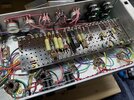
Looks like I’m stuck here for a few days. Forgot to get a pair of bias capacitors, a few of the Piher resistors were incorrect, can’t find my bag of diodes, and got to check on a couple of other little things. Oh well, got a few other things going on. Hopefully, next Saturday I will be able to power this up.
View attachment 48717
Seriously, Man...that looks better than some of the boutique builds I've seen....
OP
SG John
Ambassador of Cool Guitars and Amps.
Seriously, Man...that looks better than some of the boutique builds I've seen....
Thanks Rob!


syscokid
Ambassador of War & Peace
Looking good, brother John! But please allow me to nitpick a bit...:
1: Keep V1's grid wires as short as possible. Especially the grid wire for pin 2. I see a lot of excess right at the input jack.
2: V1's red heater wire to pin 4/5 could easily be shortened a couple of inches. I see that excess loop as an antenna for interference.
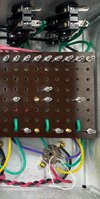
1: Keep V1's grid wires as short as possible. Especially the grid wire for pin 2. I see a lot of excess right at the input jack.
2: V1's red heater wire to pin 4/5 could easily be shortened a couple of inches. I see that excess loop as an antenna for interference.
Looking good, brother John! But please allow me to nitpick a bit...:
1: Keep V1's grid wires as short as possible. Especially the grid wire for pin 2. I see a lot of excess right at the input jack.
2: V1's red heater wire to pin 4/5 could easily be shortened a couple of inches. I see that excess loop as an antenna for interference.
View attachment 48724
Any reason it can't be shielded???

chilipeppermaniac
Ambassador of Decibels
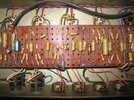
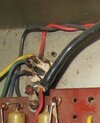
The point is to keep away the DC wires from the AC wires as much as possible John has room to chopstick the wires in place.
View attachment 48735
Hey 67, You got any Catsup to go with all that Mustard?
OP
SG John
Ambassador of Cool Guitars and Amps.
The point is to keep away the DC wires from the AC wires as much as possible John has room to chopstick the wires in place.
Don't know why I didn't think of using chopsticks? I have a couple of pairs in the machinist chest that's just behind the amp. I use them for just about all other electronics stuff.
syscokid
Ambassador of War & Peace
@SG John: Just like this...The point is to keep away the DC wires from the AC wires as much as possible John has room to chopstick the wires in place.
View attachment 48735

No reason at all. I'm assuming that John is trying to keep his JTM45 build as authentic as possible, though. A stock JTM45 is not a very gainy amp compared to more modern Marshall amps. Therefore a shielded cable at the grids of V1 might not make a difference. But.... If it was me... yeah sure, I would be installing shielded cables at V1 just for the halibut!Any reason it can't be shielded???

ivan H
Ambassador of Tubes & Grooves

Looking good SG John, looking forward to seeing more progress. I notice a few of the turrets have twisted axially in the board. Did you do this to facilitate component fitment or has it happened during shipping?? While they'll not come out of the board easily, they aren't "overly tight" in there & can carefully be moved axially. Cheers
Edit:
Shortening the green input wires would be good.
A tip for when soldering wires to turrets on the underside of the board. Strip a little excess so the bare wire can be fed up through the turret from the bottom, then bend (hook) it over the top of the turret at 180 degrees before snipping it off. This will prevent the wire from accidentally falling out the bottom of the turret when soldering components. Cheers
Edit:
Shortening the green input wires would be good.
A tip for when soldering wires to turrets on the underside of the board. Strip a little excess so the bare wire can be fed up through the turret from the bottom, then bend (hook) it over the top of the turret at 180 degrees before snipping it off. This will prevent the wire from accidentally falling out the bottom of the turret when soldering components. Cheers
Last edited:
@SG John: Just like this...
View attachment 48747
No reason at all. I'm assuming that John is trying to keep his JTM45 build as authentic as possible, though. A stock JTM45 is not a very gainy amp compared to more modern Marshall amps.
Sounds like you are describing my Origin 50H!!!
Is it closely related??? Or, is it more closely related to a JMP???

Amp Mad Scientist
Ambassador of Heresy
JTM45, JMP, is almost the same amp. One stage preamp, "low gain." (actually, low sensitivity) ("gain") is not really the right word.Sounds like you are describing my Origin 50H!!!
Is it closely related??? Or, is it more closely related to a JMP???
JCM800 2203 2204 is a high sensitivity 2 stage preamp. The extra preamp stage increases the sensitivity. Actually it doubles the sensitivity.
The origin- we don't have a schematic.
But I'm thinking probably when the origin is non-boosted mode, it's JTM45 / JMP low sensitivity.
A JMP is just a slightly modified JTM 45. Very small difference.
A 800 2203 2204 is a modified JMP, again only a small modification.
JTM45 / JMP Low sensitivity
V1A preamp>
.................................>resistors Mixer> V2 input
V1B preamp>
JCM 800 High Sensitivity
V1A preamp> V1B Preamp > V2 input
In the high sensitivity, the 2 preamp stages V1A V1B are combined in a chain --- instead of separated then mixed. --------[mesa calls this "cascade," but mesa did not invent cascade]
Chaining the 2 preamp stages together doubles the input sensitivity.
JTM45, JMP, is almost the same amp. One stage preamp, "low gain." (actually, low sensitivity) ("gain") is not really the right word.
JCM800 2203 2204 is a high sensitivity 2 stage preamp. The extra preamp stage increases the sensitivity. Actually it doubles the sensitivity.
The origin- we don't have a schematic.
But I'm thinking probably when the origin is non-boosted mode, it's JTM45 / JMP low sensitivity.
A JMP is just a slightly modified JTM 45. Very small difference.
A 800 2203 2204 is a modified JMP, again only a small modification.
JTM45 / JMP Low sensitivity
V1A preamp>
.................................>resistors Mixer> V2 input
V1B preamp>
JCM 800 High Sensitivity
V1A preamp> V1B Preamp > V2 input
In the high sensitivity, the 2 preamp stages V1A V1B are combined in a chain --- instead of separated then mixed. --------[mesa calls this "cascade," but mesa did not invent cascade]
Chaining the 2 preamp stages together doubles the input sensitivity.
Thanks, Man!@!
I'm learning!!!!!
Interior shot of Origin 50H with key components identified:
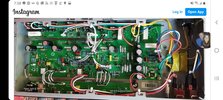
Who can find the Tone Devil in this screenshot???
Who can find the Tone Devil in this screenshot???
OP
SG John
Ambassador of Cool Guitars and Amps.
Thanks!Looking good SG John, looking forward to seeing more progress.
I notice a few of the turrets have twisted axially in the board. Did you do this to facilitate component fitment or has it happened during shipping?? While they'll not come out of the board easily, they aren't "overly tight" in there & can carefully be moved axially. Cheers
They arrived like that. Tried straightening a couple.
Edit:
A tip for when soldering wires to turrets on the underside of the board. Strip a little excess so the bare wire can be fed up through the turret from the bottom, then bend (hook) it over the top of the turret at 180 degrees before snipping it off. This will prevent the wire from accidentally falling out the bottom of the turret when soldering components. Cheers
Now you tell me. Hopefully they stayed put, as I was thinking about that while soldering.
ivan H
Ambassador of Tubes & Grooves
The Origin amps have their roots in the JMP amps.Sounds like you are describing my Origin 50H!!!
Is it closely related??? Or, is it more closely related to a JMP???
The JTM amps had a "shared cathode" arrangement (meaning the cathode of both triode's (one for each channel) were tied together, thus "sharing" the cathode resistor & bypass capacitor). Coupling caps were the same value for each channel (0.022uf). The only thing that made the bright channel brighter was the use of a "treble peaking" capitor across the "mixer resistor" of the bright channel. These "mixer resistors" combine the signal coming out of V1 of both channels before it is applied to V2a. As such, there is not so much of a tonal difference between the two channels as there is with the JMP's.
The JMP series amps saw several circuit changes that effectively made the bright channel a good bit brighter.
Firstly, the V1 cathodes were split apart. The "normal" channel's cathode retained the previous resistor & bypass capacitor values (or the bypass cap value was made even larger), however the "bright channel" was given a much smaller value cathode bypass capacitor value of 0.68uf, resulting in a frequency roll-off below (approximately) 720hz. The bright channel coupling capacitor was changed to a smaller value of 0.0022uf, again rolling of low end. The treble peaking cap across the mixer resistor was retained. This all resulted in the bright channel of the JMP's being noticeably more "upper mid & treble accentuated" than the previous JTM's bright channel.
Another change encorporated in the JMP's was the inclusion of a 0.68uf cathode bypass capacitor on the V2a cathode (again rolling off around 720hz), making the JMP's "as a whole" more upper mid & treble accentuated than the JTM's.
We all know how to "blend" the two channels on the 4 hole amps. The Origin amps input you guitar to both channels & the "tilt" control is used to blend them. Cheers
Last edited: