18 Watt MojoTone Kit Build With Conversion To JCM800 Circuitry:

Inspector #20

Ambassador of Tone
Fallen Star
Country flag
Ok,

I'm seriously contemplating this build as a science project of sorts. However, I want to convert the amp to more of a JCM800 style circuitry. @Amp Mad Scientist and @ivan H (and others) have told me this is not at all a difficult conversion/

My goal is super-tight bass response.

I researched and found a few clues as to the differences between the early style JTM45 and the later JCM 800 style circuits:

- The huge 250µF (often 330µF) cathode bypass cap on the 1st tube in the JTM45 and this contributes heavily to the muddy sound; Marshall split the cathode on the 1st tube and gave the 1987's Brilliant channel a 0.68µF bypass cap (and a 2.7kΩ cathode resistor) that shaves everything near/below Low-E in a way the Normal doesn't. That helps tighten distortion right off.

- The changes to the channel mix resistors and volume pot bright cap for the Brilliant channel of the 1987 bring more mids back into play for this channel compared to the JTM45. But in practice, and combined with the other two bass cuts in the 1987 Brilliant channel, there is a lot of apparent bass-cut here. It helps keep distortion clearer in the 1987 than the JTM45. In other words, it sounds like early-70's rock.

- The 1987 adds a 0.68µF bypass cap to the 1st gain stage of V2. This has the effect of boosting gain of this stage compared to the JTM45, but again focuses the extra signal gain towards the mids/highs.

- The 1987 trims the coupling caps going into the output tubes by 1/5th. This doesn't so much cut bass (0.022µF against 220kΩ extends below guitar-range), but it does help the output stage recover from momentary input-overload better. This makes distortion less "splatty" (technically, it's faster recovery from blocking distortion).

So, before I drop the $$$$ on this amp, I want to lay this out before the amp Gods so I can plan for it from the very first turret.

I want an amp that will deliver clear and defined high-gain tone, even when being pounded by a TS-9 with heavy bass frequency dialed in while simultaneously offset with dimed mid range frequencies...

let's discuss this...
 
Have you built or assembled an amp before?

Since your contemplating on building a low wattage JCM800, you should look into this:

The Marshall 18 watters and the 35 watt JTM's use tubes rather than a solid state circuit for rectifiers. Tight and gainy amps are usually supplied with SS rectification to enhance tightness and a more focused bass.

On the other hand... There are adaptive modules that are inserted into an amp's tube rectifier socket that will convert the rectification to solid state.
 
Have you built or assembled an amp before?

Since your contemplating on building a low wattage JCM800, you should look into this:

The Marshall 18 watters and the 35 watt JTM's use tubes rather than a solid state circuit for rectifiers. Tight and gainy amps are usually supplied with SS rectification to enhance tightness and a more focused bass.

On the other hand... There are adaptive modules that are inserted into an amp's tube rectifier socket that will convert the rectification to solid state.

This would be a first amp build, but I've built wire harnesses for antique vehicles, so I am sure I could pull it off.

I'm very interested to learn more about these adaptive modules...
 
You can do it Robert.
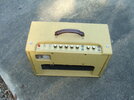
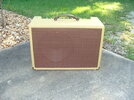
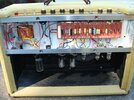
I built a Marshall 18 watt kit from Trinity Amps.
DSC02401.JPG
DSC02399 (copy).JPGDSC02406.JPG
Used a transformer set & choke from a Deluxe reverb, and built it for 6V6 power tubes & tube rec.
Eminence 12" neo speaker for weight reduction, and a 10 ply birch backyard made & tweed covered cabinet.
It worked right off, and still works perfectly. Not even a hiccup.
Started it up on a home made light bulb limiter. All was well.

I did have guidance & blessing of Sarasota amp guru Gary Druin, of Hurricane amps, but he was around just to check my homework, All the construction was by me.

So to sum it up, If I can build a kit, anyone can.
 
I'm very interested to learn more about these adaptive modules...
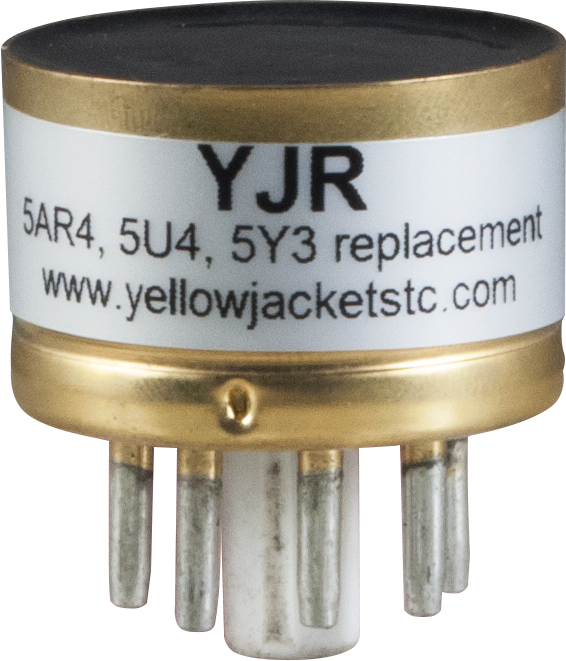
Here you go...:

20200902_060439.jpg
 
Here you go...:

View attachment 48152
Never tried one but like all things unknown, it scares me.
Especially the NOTE at the end of the paragraph below.

So if that's the case, my DSL 15 is solid state rectified, but has no standby switch.
Now I'm wondering if there's a limiting circuit of some sort to allow a gradual warmup, as it does take a few moments to "power up".

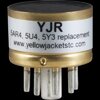
Solid State Rectifier Replacement for 5AR4, 5U4 and 5Y3
This is a great non-destructive mod "(reversible) as the Yellow Jacket Solid State Rectifier plugs in where your current \5AR4/GZ34, 5U4, 5Y3 or similar full-wave rectifier tubes are in your amp.

The YJR converts your amp’s vacuum tube rectifier to a solid state rectifier, reducing tube sag for a tighter sound and feel.

  • Converts most audio amplifiers which use a vacuum tube rectifier 5AR4/GZ34, 5U4 or 5Y3 to a solid state device.
  • Safe for all common amplifiers and transformers.
NOTE! Because there is no warm-up of a rectifier tube when using this solid state device, it is critical that a standby switch is used that will allow the power tube filaments to warm up and generate an electron 'cloud' around the cathode before high voltage is applied. This will prevent 'cathode stripping' in the power tubes. It is a good idea to use a standby switch when using vacuum tube rectification, but it is critical when using solid state rectification.
 
NOTE! Because there is no warm-up of a rectifier tube when using this solid state device, it is critical that a standby switch is used that will allow the power tube filaments to warm up and generate an electron 'cloud' around the cathode before high voltage is applied. This will prevent 'cathode stripping' in the power tubes. It is a good idea to use a standby switch when using vacuum tube rectification, but it is critical when using solid state rectification.
To be honest, I don't believe this. I bet there can be a nasty thread among experienced amp gurus that will agree or disagree with that advise about a standby switch. Maybe you can ask your amp guru his thoughts about the subject. I would be interested in what he has to say!
 
To be honest, I don't believe this. I bet there can be a nasty thread among experienced amp gurus that will agree or disagree with that advise about a standby switch. Maybe you can ask your amp guru his thoughts about the subject. I would be interested in what he has to say!

I always allow my amps 5 minutes warm up before switching them off standby.
 
To be honest, I don't believe this. I bet there can be a nasty thread among experienced amp gurus that will agree or disagree with that advise about a standby switch. Maybe you can ask your amp guru his thoughts about the subject. I would be interested in what he has to say!
He hates sag, he builds solid state rectifiers into the board of most of his larger amps with the quad of diodes. But they all have standby switches. My Hurricane V8 has a tube rec and no standby.
So he must err on the side of caution.
Very interesting...
 
He hates sag, he builds solid state rectifiers into the board of most of his larger amps with the quad of diodes. But they all have standby switches. My Hurricane V8 has a tube rec and no standby.
So he must err on the side of caution.
Very interesting...

Forgive my ignorance, but isn't a standby fairly common???
 
20200902_092851.jpg
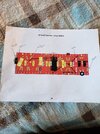
Robert, this is the diagram I used for my 1987 build. Especially note the 10uf cap I used on the first stage per discussion with Ivan. The bass is very tight and I love the fullness when I blend the two channels together. Works great with my RAT and Soul Food. The build was based on a 1968 schematic someone at Metro did from a sock amp. Evidently there is some variation on the stock amps.
 
Ok,

I'm seriously contemplating this build as a science project of sorts. However, I want to convert the amp to more of a JCM800 style circuitry. @Amp Mad Scientist and @ivan H (and others) have told me this is not at all a difficult conversion/

My goal is super-tight bass response.

I researched and found a few clues as to the differences between the early style JTM45 and the later JCM 800 style circuits:

- The huge 250µF (often 330µF) cathode bypass cap on the 1st tube in the JTM45 and this contributes heavily to the muddy sound; Marshall split the cathode on the 1st tube and gave the 1987's Brilliant channel a 0.68µF bypass cap (and a 2.7kΩ cathode resistor) that shaves everything near/below Low-E in a way the Normal doesn't. That helps tighten distortion right off.

- The changes to the channel mix resistors and volume pot bright cap for the Brilliant channel of the 1987 bring more mids back into play for this channel compared to the JTM45. But in practice, and combined with the other two bass cuts in the 1987 Brilliant channel, there is a lot of apparent bass-cut here. It helps keep distortion clearer in the 1987 than the JTM45. In other words, it sounds like early-70's rock.

- The 1987 adds a 0.68µF bypass cap to the 1st gain stage of V2. This has the effect of boosting gain of this stage compared to the JTM45, but again focuses the extra signal gain towards the mids/highs.

- The 1987 trims the coupling caps going into the output tubes by 1/5th. This doesn't so much cut bass (0.022µF against 220kΩ extends below guitar-range), but it does help the output stage recover from momentary input-overload better. This makes distortion less "splatty" (technically, it's faster recovery from blocking distortion).

So, before I drop the $$$$ on this amp, I want to lay this out before the amp Gods so I can plan for it from the very first turret.

I want an amp that will deliver clear and defined high-gain tone, even when being pounded by a TS-9 with heavy bass frequency dialed in while simultaneously offset with dimed mid range frequencies...

let's discuss this...
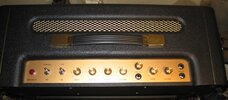
The huge 250µF (often 330µF) cathode bypass cap on the 1st tube in the JTM45....

The 250uF cap extends the frequency response down to subsonic frequencies.
The subsonic, in turn overloads the next stage (V2 compression stage) resulting in a muddy sort of farting sound quality.
Changing this cap to .68uF or 1 uF (for example) rolls off the subsonic overload.
* If you like to see the frequency response based on the bypass cap, and compare different bypass caps, use this calculator:
This calculator does not require deep technical knowledge. It's simplified.

- The 1987 adds a 0.68µF bypass cap to the 1st gain stage of V2. This has the effect of boosting gain of this stage compared to the JTM45, but again focuses the extra signal gain towards the mids/highs.

V2: is not a gain stage.
It is a compression stage.
The sensitivity is boosted, but the gain is not increased, it's decreased.
The output gain of V2 is always LESS than the input of V2. This is because the output of V2 is a cathode follower.

There is a difference between "sensitivity" and "gain." This is really important.
Although people frequently mix the 2 terms up.
More explanation of this to follow.

Adding the bypass cap to V2A increases the frequency response in a certain range. It also causes more subsonic lows to be rolled off.
Again, use the calculator to see this - on a graph:

A "gain" stage works like this:
Input = s
Output = S
The stage added gain.
---------------------------------------------------------
But, the V2 stage in a Marshall adds only sensitivity and compression, not gain. The cahode follower subtracts gain.
Like this:
input =
S
output = s

Compression: the input reaches a certain level, then the output is limited to a certain level. It cannot go any further.
No matter how hard the input is pushed, the output does not increase.


input is this = s
Or, input is this = S

But, the V2 output is always this: S
No matter how hard or soft the input of V2 stage is pushed,
the output can only be this = S
It never increases beyond that level.

This is "limiting." Just like a compressor / limiter in a recording studio.

The result:
loud passages or soft passages come out at the same level. That constant audio level is maintained.
It makes very soft passages louder.
It keeps very loud passages from exceeding that same certain limit.

The output of the preamp is "smoothed." Loud and soft comes out at a uniform audio level which never increases or decreases.

You can also call this type of circuit "a compander."
It is a expander, compressor, and a limiter, all at the same time.

A. This is why a Marshall amp is always loud ------ no matter how hard- or soft - you are playing.
B. It makes soft passages louder.
C. It limits loud passages to the same limit as the soft passages.

D. The dynamic range is removed.
Loud and soft come out at ==== the same level.
 
Last edited:
Back
Top