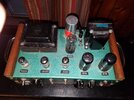
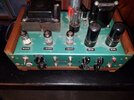
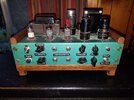
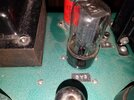
Slowly, as usual for me

Are they saying AC is going to short through the rectifier to the output?
This, I don't know. That's why I was asking if the tube rec fails, can that cause damage to other parts of the amp? Or maybe just the fact that if the tube rec shorts it acts like a Standy Switch and doesn't allow any voltage to get to the filter caps and all the other little goodies. I'm clueless... help... :confused2:
 
Great info here, thanks for sharing.
I used the diodes on the unused rectifier socket pins too, also from the Rob Robinette pages.
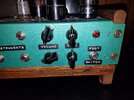
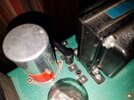
These are 4 builds 5-18w.
I am re-thinking this but I think the basic premise of preventing AC out on the B+ circuit seems sound.

So far, I have not encountered any ill effects, that I am aware of.
Would this be more of a concern on higher wattage amps?
I'm thinking no because the high voltages present and the chance of arcing across the pins with the diodes and wiring in closer proximity would be the same.
Very interesting thing to contemplate, especially from my DIY perspective.
 
I think in my entire professional career (45 years), I have seen 2-3 rectifier tubes (without diodes) short out (at the most).
Rectifier tube failure in guitar amps is very rare.
Of course, most of those amps were Fender amps.
I've had 3 or 4 new production GZ34's fail over probably a 6 or 7 year period which made me go back to old production (Blackburn Mullard) GZ34's. Looking at music/amplifier related & audiophile or vintage electronics type forums show that new production GZ34 failures are not that rare.
What type rectifier tubes have you seen fail in Fender amps & were they new or old production types?
While some Fender's do use the GZ34, the 5Y3 & 5U4 are more commonly used. Both these types differ from the GZ34 in that they feature a directly heated cathode (the filament IS the cathode), where the GZ34 features an indirectly heated cathode (cathode is a sleeve around the filament). The 5Y3 & 5U4 also have higher internal resistance than a GZ34, due to the anodes being spaces further from the cathodes. Still, like any tube they can fail.
Well it's a lot of (enough) amps, but the fuse would blow if the rectifier rarely shorts.
I'm just wondering what the advantage is?
Are they saying AC is going to short through the rectifier to the output?
The reasoning behind the protection diodes (diodes in series with rectifier anodes) is twofold.
1) Silicon diodes have better peak inverse voltage handling ability than a tube rectifier, so they help or protect the tube rectifier in this regard.
2) To keep the high AC voltage from the circuitry in the event of rectifier tube (short type) failure. While the audio tubes don't like to be hit with this high AC voltage, the filter capacitors like it even less, much less. Hit with the high AC voltage, the main filter will dead short. This is not a good thing as it can then in turn take out the power transformer.
We would like to think that the main fuse will blow & protect the power transformer, but this is not always the case. The main fuse current rating will be at least 2 times (usually more) the actual current draw of the amp when running, & is usually a "slow blow" type to cope with the current draw at power on. Because of this the main fuse may not always blow in time to prevent power transformer failure. I personally in the past have had a 50 watt public address amplifier come in for repair exhibiting this type failure, where an old production 5AR4 had shorted & taken the main filter & PT out with it. I'm sure if you search online you'll find reports of others experiencing this type rectifier tube/PT failure. Cheers
 
Last edited:
I've had 3 or 4 new production GZ34's fail over probably a 6 or 7 year period which made me go back to old production (Blackburn Mullard) GZ34's. Looking at music/amplifier related & audiophile or vintage electronics type forums show that new production GZ34 failures are not that rare.
What type rectifier tubes have you seen fail in Fender amps & were they new or old production types?
While some Fender's do use the GZ34, the 5Y3 & 5U4 are more commonly used. Both these types differ from the GZ34 in that they feature a directly heated cathode (the filament IS the cathode), where the GZ34 features an indirectly heated cathode (cathode is a sleeve around the filament). The 5Y3 & 5U4 also have higher internal resistance than a GZ34, due to the anodes being spaces further from the cathodes. Still, like any tube they can fail.
The reasoning behind the protection diodes (diodes in series with rectifier anodes) is twofold.
1) Silicon diodes have better peak inverse voltage handling ability than a tube rectifier, so they help or protect the tube rectifier in this regard.
2) To keep the high AC voltage from the circuitry in the event of rectifier tube (short type) failure. While the audio tubes don't like to be hit with this high AC voltage, the filter capacitors like it even less, much less. Hit with the high AC voltage, the main filter will dead short. This is not a good thing as it can then in turn take out the power transformer.
We would like to think that the main fuse will blow & protect the power transformer, but this is not always the case. The main fuse current rating will be at least 2 times (usually more) the actual current draw of the amp when running, & is usually a "slow blow" type to cope with the current draw at power on. Because of this the main fuse may not always blow in time to prevent power transformer failure. I personally in the past have had a 50 watt public address amplifier come in for repair exhibiting this type failure, where an old production 5AR4 had shorted & taken the main filter & PT out with it. I'm sure if you search online you'll find reports of others experiencing this type rectifier tube/PT failure. Cheers
Well, that does it... yup! I'm going to install backup diodes on my only amp that has a tube rectifier. Also going to install soft-start inrush current limiters on every amp that I own that doesn't have one already. Syscokid is going radically wild... Get out of my way... Muhahahaha... :run:
 
Well, that does it... yup! I'm going to install backup diodes on my only amp that has a tube rectifier. Also going to install soft-start inrush current limiters on every amp that I own that doesn't have one already. Syscokid is going radically wild... Get out of my way... Muhahahaha... :run:
Just don't mount protection diodes on the socket using un-used pins if you are using diodes in series with the rectifier's plates. My personal recommendation, if you are wanting to add protection is to use a single 1,000V 3A diode to connect the rectifier tube to the 1st filter capacitor (cathode of diode towards filter). This way, the rectifier tube is operating as intended & in the event it ever shorts, no AC can get to the circuitry (the diode acts as a half wave rectifier, only letting the positive halves of the waveforms through to the circuitry).
The new production GZ34's that I had fail were Sovtek's & Chinese types. Mr Plexi67 recommend I use JJ's & I have since used these in others amps with no failures as yet (& no protection diodes). Cheers
 
Just don't mount protection diodes on the socket using un-used pins if you are using diodes in series with the rectifier's plates. My personal recommendation, if you are wanting to add protection is to use a single 1,000V 3A diode to connect the rectifier tube to the 1st filter capacitor (cathode of diode towards filter). This way, the rectifier tube is operating as intended & in the event it ever shorts, no AC can get to the circuitry (the diode acts as a half wave rectifier, only letting the positive halves of the waveforms through to the circuitry).
Thanks, Ivan... :cheers:

The new production GZ34's that I had fail were Sovtek's & Chinese types. Mr Plexi67 recommend I use JJ's & I have since used these in others amps with no failures as yet (& no protection diodes). Cheers
Ha ha... My tube rectified amp has the Sovtek 5AR4!!!! I'm doomed... :BH: But wait... I'll check my little stash... and lo and behold, I have a backup rec tube... a 15 year old but never used, JJ GZ 34! Maybe I should swap the Sovtek for the JJ, and just keep it simple (stupid!).
 
The new production GZ34's that I had fail were Sovtek's & Chinese types. Mr Plexi67 recommend I use JJ's & I have since used these in others amps with no failures as yet (& no protection diodes). Cheers


Ha ha... My tube rectified amp has the Sovtek 5AR4!!!! I'm doomed... :BH: But wait... I'll check my little stash... and lo and behold, I have a backup rec tube... a 15 year old but never used, JJ GZ 34! Maybe I should swap the Sovtek for the JJ, and just keep it simple (stupid!).

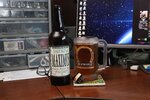
All my amps that need tube rectifiers are either vintage U.K. made Mullard or RCA badged Mullard.
 
All my amps that need tube rectifiers are either vintage U.K. made Mullard or RCA badged Mullard.
Last time I remembered, you're a firm believer of supplying your vintage amps with vintage tubes of the same era. Not only do I think this is very cool, it also shows you're a very cool amp nerd too. If I could find a deal that I would be comfortable with, I too would go with what is the best... ;)
 
All my amps that need tube rectifiers are either vintage U.K. made Mullard or RCA badged Mullard.
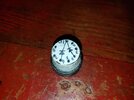
This also reminds me: I don't think I've ever used this, but have you ever tried one of these?
IMG_2218.JPG

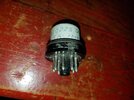
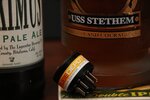
No, not the beer.... jeez! The TubeDepot gizmo:
IMG_2219.JPG

Solid state rectifier tube socket adapter! Yup, F those tubes, no on sag, increase B+ voltages! I think it's evil... :dood:
 
Back
Top