
You are using an out of date browser. It may not display this or other websites correctly.
You should upgrade or use an alternative browser.
You should upgrade or use an alternative browser.
Marshall Style 1987 Build, Which Choke?
- Thread starter Cadorman
- Start date

Amp Mad Scientist
Ambassador of Heresy

I'm collecting parts for a 50 watt 4 hole Marshall build and trying to decide what choke to go with. It appears that there a 3 versions throughout the years and I am trying to figure out which would be best for what I am doing.
3 Hy 250ma
5 Hy 120ma
20 Hy 70ma
I have been working with the Marstran 1987 schematic, which was reverse engineered from a 1968 Marshall. What effect, if any, will using different choke values have on the amp?
The choke functions to attenuate AC ripple (hum) noise in the power supply.
The choke functions along with the filter capacitors to "purify" DC high voltage that will run the amplifier.
By adding a choke, filtering of noise becomes more efficient, compared to filter capacitors alone.
A filter cap choke system -- can be compared to -- a filter cap resistor system.
The choke capacitor system is more efficient (in many ways but not all) than the resistor capacitor method.
But
Combining a choke (depends on value) with a capacitor (depends on value) can also produce a frequency resonance in the power supply.
The idea is to combine a choke and cap to obtain the best attenuation of AC ripple, without creating unwanted resonance at some audio frequencies.
There are several capacitors for filtering in the guitar amp (which also changes the final outcome).

syscokid
Ambassador of War & Peace
Have you, or anybody else, familiar with the PSU Designer II (free) software from the Duncan's Amp Pages?The choke functions to attenuate AC ripple (hum) noise in the power supply.
The choke functions along with the filter capacitors to "purify" DC high voltage that will run the amplifier.
By adding a choke, filtering of noise becomes more efficient, compared to filter capacitors alone.
A filter cap choke system -- can be compared to -- a filter cap resistor system.
The choke capacitor system is more efficient (in many ways but not all) than the resistor capacitor method.
But
Combining a choke (depends on value) with a capacitor (depends on value) can also produce a frequency resonance in the power supply.
The idea is to combine a choke and cap to obtain the best attenuation of AC ripple, without creating unwanted resonance at some audio frequencies.
There are several capacitors for filtering in the guitar amp (which also changes the final outcome).
I found the software link yesterday. Haven't downloaded it yet. On the surface, it looks complicated, but maybe it isn't...

Link:
Amp Mad Scientist
Ambassador of Heresy
Have you, or anybody else, familiar with the PSU Designer II (free) software from the Duncan's Amp Pages?
I found the software link yesterday. Haven't downloaded it yet. On the surface, it looks complicated, but maybe it isn't...
Link:
Yes that's really cool. You don't need to be an engineer to use it.
syscokid
Ambassador of War & Peace
Thanks AMS
Yes that's really cool. You don't need to be an engineer to use it.
OP

Cadorman
Ambassador of the Catocaster
So I have a 33/33 uf can where the 32/32 uf goes and 50/50 uf cans in place of the two 40/40 uf caps shown on the original Marstran 1987 schematic. Is this enough of a change to even matter? I can't image the 33uf would, but the others are a 25% change. I haven't seen any new 40uf dual can capacitors.
OP
Cadorman
Ambassador of the Catocaster
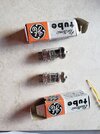
I got new toys in the mail! These will be V1 and V2. Scored these for about $22 each including shipping. Need to find a reasonable one for V3 now and I'm still trying to decide if I should spring for some vintage Mullard EL34s, or just run the reissues I have. Chassis and faceplates were ordered from Valvestorm a couple days ago.

BFT Gibson
Ambassador of Originality
tech did the Hoffman on mine. Then trainwreck 3 PPIMV..amp is so usable. Even at low vol sounds great. As MV comes down the amp gets real rad. Really responded to the 1960bx cab switcheroo last week.Kept 2 greenies on top & put Vintage& 75 on bottom

ivan H
Ambassador of Tubes & Grooves

I wouldn't sweat substituting the 50uf capacitors where the schematic shows 40uf. Electrolytic capacitors typically have -/+20% tolerance (or more), so they'll be fineSo I have a 33/33 uf can where the 32/32 uf goes and 50/50 uf cans in place of the two 40/40 uf caps shown on the original Marstran 1987 schematic. Is this enough of a change to even matter? I can't image the 33uf would, but the others are a 25% change. I haven't seen any new 40uf dual can capacitors.
I've always liked GE 12AX7's, definitely better than any new production types. I'm imagining you'll be happy with them. I'd suggest picking V3 out of you 3 pre-amp tubes first (it's arguably the most important as it drives the power tubes). I like a strong 12AX7 in V3. Try each of your 12AX7's in the V3/PI position to find the one that gives closest to a 7.2V~7.3V plate differential voltage. Don't bother looking for a "balanced triodes" 12AX7 for V3, the PI is un-balanced to start with.View attachment 42027
I got new toys in the mail! These will be V1 and V2. Scored these for about $22 each including shipping. Need to find a reasonable one for V3 now and I'm still trying to decide if I should spring for some vintage Mullard EL34s, or just run the reissues I have. Chassis and faceplates were ordered from Valvestorm a couple days ago.
As for the vintage or NOS Mullard EL34's, it's up to you, but I'll say this:
I spring for NOS xf2 Blackburn Mullard EL34's & Blackburn Mullard &/or Brimar 12AX7's in my amps that are built using period correct NOS circuit components (coupling & tone/ treble peaking capacitors & resistors), the best transformers I can buy etc, but amps that aren't built with period correct circuit components etc don't get them, well, not the xf2 EL34's, anyway. Hope this helps. Cheers
syscokid
Ambassador of War & Peace
I'd suggest picking V3 out of you 3 pre-amp tubes first (it's arguably the most important as it drives the power tubes). I like a strong 12AX7 in V3. Try each of your 12AX7's in the V3/PI position to find the one that gives closest to a 7.2V~7.3V plate differential voltage. Don't bother looking for a "balanced triodes" 12AX7 for V3, the PI is un-balanced to start with.
ivan H
Ambassador of Tubes & Grooves
I think we have spoken before about the output imbalance inherent in this long tailed pair PI design & the benefits of achieving a difference of 7.2~7.3V (or as close as possible to this) on the PI plates.
Most 12AX7's have imbalanced triodes, both in current (mA) & transconductance (gm) & so, when plugged into V3 will result in slightly different voltages on each of the PI's plates. By trying different 12AX7's in V3, one of them will hopefully get close to that ideal 7.2~7.3 V difference between the two plate voltages.
Cheers
syscokid
Ambassador of War & Peace
Yes we did! And it lead me to mod my 2204, with 6550's, with PI trimmer. Works great!I think we have spoken before about the output imbalance inherent in this long tailed pair PI design & the benefits of achieving a difference of 7.2~7.3V (or as close as possible to this) on the PI plates.
Amp Mad Scientist
Ambassador of Heresy
Sysco, gone wild.Yes we did! And it lead me to mod my 2204, with 6550's, with PI trimmer. Works great!
View attachment 42071
Amp Mad Scientist
Ambassador of Heresy
View attachment 40354
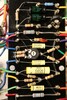
I'm just finishing putting leads on the board. Have all the small parts on hand. Hopefully I can order the chassis from Valvestorm in a couple of weeks and then get the iron on it's way.
Dude,
are those resistors precision, wire wound, mil spec, 0.000352 % ? I thought so.
I only saw resistors like that in a test / calibration lab.
OP
Cadorman
Ambassador of the Catocaster
They are the mil spec Dale resistors. Some from Digi-Key and some from Tube Depot. I like to live on the edge.Dude,
are those resistors precision, wire wound, mil spec, 0.000352 % ? I thought so.
I only saw resistors like that in a test / calibration lab.
Amp Mad Scientist
Ambassador of Heresy
They are the mil spec Dale resistors. Some from Digi-Key and some from Tube Depot. I like to live on the edge.
Original cost to taxpayers $4768.92 each, purchased by mouser for 12 cents each from government Lawrence Livermore nuclear laboratory surplus sale....
Those resistors are built to withstand 50 Gs.
OP
Cadorman
Ambassador of the Catocaster
So you're saying I paid for them twice? Man.....Original cost to taxpayers $4768.92 each, purchased by mouser for 12 cents each from government Lawrence Livermore nuclear laboratory surplus sale....
Amp Mad Scientist
Ambassador of Heresy
So you're saying I paid for them twice? Man.....
That's the thing about mil spec parts--- it's designed to survive re-entry to Uranus ( you always pay for it twice).
syscokid
Ambassador of War & Peace
I like those Dale/Vishay resistors too. Their Plain-Jane looks, are very uniformed and conformative. Metal film with consistency. They don't drift when you sneeze...That's the thing about mil spec parts--- it's designed to survive re-entry to Uranus ( you always pay for it twice).
