
You are using an out of date browser. It may not display this or other websites correctly.
You should upgrade or use an alternative browser.
You should upgrade or use an alternative browser.
Since there's been some talk
- Thread starter Session 5
- Start date

ChasFred
Ambassador of Smooth Operations

Tell us something we didnt already know.Im UNWOUND
ChasFred
Ambassador of Smooth Operations
I'm curious about this wound 3rd string stuff. Tell me about it.
I prefer the wound 3rd because to me and my ear the unwound 3rd never sounds just right.
Just a matter of personal likes.

eclecticsynergy
Ambassador of Electric Synergy
I've used D'Addarios since the 70s with very few defective strings out of many, many hundreds of sets. They used to include a sticker with each set and at one point I had a whole milk crate full of them, enough to wallpaper a small room (was gonna do the bathroom of my studio but I never did).
XL110 has been my set of choice for most of that time. Now that my hands are older, I tried a set of .0095s on one PRS. I liked the feel and found my two biggest concerns were needless. There was almost no decrease in output, nor any problem with fretting out when I played hard. The only downside was, they just wouldn't behave well for me on slide parts. I suspect lower tension was the main issue but I think having less mass was also a contributing factor.
Am in the process of (sooner or later) setting up one of my Les Pauls as a dedicated slide axe, with slightly higher action and a set of robotuners to make altered tunings simple. I have one that's nearly ten pounds and it gets uncomfortable after a couple of songs so I figure that one's a good candidate for slide since I'd only use it for a few tunes at a time.
Once I do that, I'll probably switch all my other 24¾" scale guitars over to the .0095 set. The 25½" scale guitars are another story. I've been using pure-nickel wound .010s for a little more bendability and warmer tone on the low strings. I don't know if the .0095s are available in pure nickel and I might just switch them all to .009s.
BUT I've been wanting to try out a Hendrix gauge set too, at least on a Strat or two. Jimi used lighter G, low A, and low E: .010, .013, .015, .026, .032, .038.
According to Roger Mayer this helps alleviate the overly loud G string, always a problem with the vintage pole stagger on most Strat pickups.
XL110 has been my set of choice for most of that time. Now that my hands are older, I tried a set of .0095s on one PRS. I liked the feel and found my two biggest concerns were needless. There was almost no decrease in output, nor any problem with fretting out when I played hard. The only downside was, they just wouldn't behave well for me on slide parts. I suspect lower tension was the main issue but I think having less mass was also a contributing factor.
Am in the process of (sooner or later) setting up one of my Les Pauls as a dedicated slide axe, with slightly higher action and a set of robotuners to make altered tunings simple. I have one that's nearly ten pounds and it gets uncomfortable after a couple of songs so I figure that one's a good candidate for slide since I'd only use it for a few tunes at a time.
Once I do that, I'll probably switch all my other 24¾" scale guitars over to the .0095 set. The 25½" scale guitars are another story. I've been using pure-nickel wound .010s for a little more bendability and warmer tone on the low strings. I don't know if the .0095s are available in pure nickel and I might just switch them all to .009s.
BUT I've been wanting to try out a Hendrix gauge set too, at least on a Strat or two. Jimi used lighter G, low A, and low E: .010, .013, .015, .026, .032, .038.
According to Roger Mayer this helps alleviate the overly loud G string, always a problem with the vintage pole stagger on most Strat pickups.


I'm curious about this wound 3rd string stuff. Tell me about it.
I prefer the wound 3rd because to me and my ear the unwound 3rd never sounds just right.
Just a matter of personal likes.
Yeah. after you play with a wound third for awhile, you discover the more balanced timbre between the D string and the G string. Actually, with my Strat, I realized the improvement instantly.
Also, have you ever noticed how the G string always seems to be the string that presents tuning issues? A wound 3rd doesn't have near the tuning problems.
Overall, I think it makes chords sound more balanced. As I said earlier, this is especially true of Strats. The wound 3rd is a little less abrupt than a plain 3rd. This alleviates some of the Strat spikiness.
Now, switching to a wound 3rd does require a bit of work. You will need to reintonate your G string saddle. When using a plain 3rd, the G string saddle normally ends up at a position to the rear of the D string saddle. With a wound 3rd, it is usually just the opposite. The G string saddle sort of continues the geometry of the other wound string saddles and will usually end up just slightly forward of the D string saddle, as shown below in the pic of my Stratocaster:
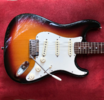
Also, I found that when I switched to a wound 3rd on my 2014 SG, I had to use a nut file to just slightly widen the nut slot. I'm using a .018 wound third on that guitar. However, I didn't have to do this with my 2007 Les Paul Custom. I have a Graphtech XL nut on my Washburn and I didn't have to widen that slot for a .018 wound 3rd. I didn't have to mess with the nut slots on my Strat, either. I have a .017 wound 3rd on my Jackson and my Les Paul Studio. Those also didn't need any work. Only my 2014 SG needed a little tweaking. You just have to pay attention to your situation. If the string "pings" when you tune it, that is a sign that the string is binding in the nut, requiring a slight widening of the slot.
One final thing, a wound 3rd works fine with most bends, but if you play music that incorporates extreme bends on the G string, you may find that a wound 3rd doesn't give you quite the bending range you need. For me, I find that a wound 3rd doesn't restrict me on the types of blues or rock bends I normally do. So, that will be an individual, stylistic thing which may or may not be an issue.
ChasFred
Ambassador of Smooth Operations
Well said Smitty, your start needs a Tortoise shell pick guard. Just my opinion. Then it would look like my G&L, or you could just be . . . you. LMAOYeah. after you play with a wound third for awhile, you discover the more balanced timbre between the D string and the G string. Actually, with my Strat, I realized the improvement instantly.
Also, have you ever noticed how the G string always seems to be the string that presents tuning issues? A wound 3rd doesn't have near the tuning problems.
Overall, I think it makes chords sound more balanced. As I said earlier, this is especially true of Strats. The wound 3rd is a little less abrupt than a plain 3rd. This alleviates some of the Strat spikiness.
Now, switching to a wound 3rd does require a bit of work. You will need to reintonate your G string saddle. When using a plain 3rd, the G string saddle normally ends up at a position to the rear of the D string saddle. With a wound 3rd, it is usually just the opposite. The G string saddle sort of continues the geometry of the other wound string saddles and will usually end up just slightly forward of the D string saddle, as shown below in the pic of my Stratocaster:
View attachment 37693
Also, I found that when I switched to a wound 3rd on my 2014 SG, I had to use a nut file to just slightly widen the nut slot. I'm using a .018 wound third on that guitar. However, I didn't have to do this with my 2007 Les Paul Custom. I have a Graphtech XL nut on my Washburn and I didn't have to widen that slot for a .018 wound 3rd. I didn't have to mess with the nut slots on my Strat, either. I have a .017 wound 3rd on my Jackson and my Les Paul Studio. Those also didn't need any work. Only my 2014 SG needed a little tweaking. You just have to pay attention to your situation. If the string "pings" when you tune it, that is a sign that the string is binding in the nut, requiring a slight widening of the slot.
One final thing, a wound 3rd works fine with most bends, but if you play music that incorporates extreme bends on the G string, you may find that a wound 3rd doesn't give you quite the bending range you need. For me, I find that a wound 3rd doesn't restrict me on the types of blues or rock bends I normally do. So, that will be an individual, stylistic thing which may or may not be an issue.
ChasFred
Ambassador of Smooth Operations
With all this talk about strings, did anybody ever play flat wound strings? Bass players don't count here.
When I first started playing all I would use were Black Diamond flat wounds. Heavy as hell, but easy on the newbie finger tips.
Then my best friend Bob introduces me to regular wound strings, and DAMN the light bulb turned on sooo bright it exploded .
When I first started playing all I would use were Black Diamond flat wounds. Heavy as hell, but easy on the newbie finger tips.
Then my best friend Bob introduces me to regular wound strings, and DAMN the light bulb turned on sooo bright it exploded .
OP

Session 5
Ambassador of Strings & Wings

I prefer the wound 3rd because to me and my ear the unwound 3rd never sounds just right.
Just a matter of personal likes.
Maybe your hearing is out of tune Chas..

ChasFred
Ambassador of Smooth Operations
Maybe your hearing is out of tune Chas..
Oh your a funny man huh . . . good one.

Chubbles
Ambassador of Sarcastic Tone
I think you just dated yourself, and me.......SLINKY!A string a String a marvelous thing everyone knows its......er wait .....no something went wrong........

gball
Ambassador of Boogie
Yeah. after you play with a wound third for awhile, you discover the more balanced timbre between the D string and the G string. Actually, with my Strat, I realized the improvement instantly.
Also, have you ever noticed how the G string always seems to be the string that presents tuning issues? A wound 3rd doesn't have near the tuning problems.
Overall, I think it makes chords sound more balanced. As I said earlier, this is especially true of Strats. The wound 3rd is a little less abrupt than a plain 3rd. This alleviates some of the Strat spikiness.
Now, switching to a wound 3rd does require a bit of work. You will need to reintonate your G string saddle. When using a plain 3rd, the G string saddle normally ends up at a position to the rear of the D string saddle. With a wound 3rd, it is usually just the opposite. The G string saddle sort of continues the geometry of the other wound string saddles and will usually end up just slightly forward of the D string saddle, as shown below in the pic of my Stratocaster:
View attachment 37693
Also, I found that when I switched to a wound 3rd on my 2014 SG, I had to use a nut file to just slightly widen the nut slot. I'm using a .018 wound third on that guitar. However, I didn't have to do this with my 2007 Les Paul Custom. I have a Graphtech XL nut on my Washburn and I didn't have to widen that slot for a .018 wound 3rd. I didn't have to mess with the nut slots on my Strat, either. I have a .017 wound 3rd on my Jackson and my Les Paul Studio. Those also didn't need any work. Only my 2014 SG needed a little tweaking. You just have to pay attention to your situation. If the string "pings" when you tune it, that is a sign that the string is binding in the nut, requiring a slight widening of the slot.
One final thing, a wound 3rd works fine with most bends, but if you play music that incorporates extreme bends on the G string, you may find that a wound 3rd doesn't give you quite the bending range you need. For me, I find that a wound 3rd doesn't restrict me on the types of blues or rock bends I normally do. So, that will be an individual, stylistic thing which may or may not be an issue.
Completely off topic, but I really wish Fender would go back to using those saddles. The stupid stamped-steel ones are really a dumb retro-move.
Completely off topic, but I really wish Fender would go back to using those saddles. The stupid stamped-steel ones are really a dumb retro-move.
I agree 100%. Supposedly, the stamped steel sound better. I dunno. What I do know is that the cast saddles are much more comfortable when doing palm mutes. I really don't like the protruding allen heads on the stamped steel saddles. I realize the original Strats had a bridge cover which covered the saddles, similar to the Telecaster ash tray. But, that was, like, over 60 years ago.

Cadorman
Ambassador of the Catocaster
All very good info. I do drop the screws on the G position of all my Gibson pickups. Read in an article somewhere that the wound strings reduce magnetism hence the jump in volume as you move from D to G. I usually end up with low E dropped, A stock, D raised, G dropped, B dropped a smidge and high E about stock. I just play and try to balance the output string to string.
All very good info. I do drop the screws on the G position of all my Gibson pickups. Read in an article somewhere that the wound strings reduce magnetism hence the jump in volume as you move from D to G. I usually end up with low E dropped, A stock, D raised, G dropped, B dropped a smidge and high E about stock. I just play and try to balance the output string to string.
A lot of modern Strat pickups also have the G pole piece lowered, which sort of compensates for things. But, the pole pieces in many Strat pickups, such as mine, are not adjustable (unless I heat up my pickup with a soldering iron and force the pole piece down - which I don't want to do). So, changing strings is the easiest solution.
Even so, I like the effect on my other guitars. Though, again, it is most beneficial in a Strat - at least to my ears.
gball
Ambassador of Boogie
I use the Graphtec string saver saddles on my Strat. Really like them.
That's what I put on my last Strat, because it came with those ridiculous stamped-steel things from the factory. The GraphTec's were a huge improvement, even if kind of ugly.