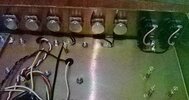
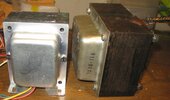
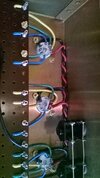
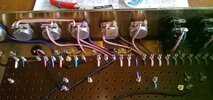
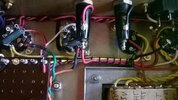
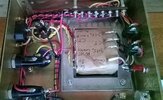
JTM50 Black Flag build, finally under way.

@ivan H
Watching you work is an honor and a privlege.
Thanks for the kind words guys. Being here with all the fine folk at TTR is an honorable & a privilege.
Sysco, yes, the heater CT is grounded along with the inputs & V1 cathodes, hopefully you can see it hereWP_20190310_00_13_40_Smart-1.jpg
I'll try to elaborate on why to do this. You want to ground the heater supply in the "quietest" point, so as far from the PT (which is a large hum source) as possible. Electrically (& in a perfect world, where both sides of the heater winding are "balanced"), you could think of the heater CT as a pivot point, about which the opposing voltage in each half of the heater winding swings. So no current should flow in the CT. As there no such thing as a perfect world, or perfectly balanced heater winding, a little current does flow in the CT. As such, grounding it at the quietest ground is advantageous. The same applies to heater supply's using an "artificial" CT (two 100 ohm resistors). You want to ground the resistors as far from the PT as possible, so usually at V1.
I never use PT mounting bolts as ground points, they pass through the PT laminate & a transformer works off (fluctuating) magnetics, so using as a ground tie point will introduce hum. Cheers
Edit: re heater CT grounding. Even with a "perfectly balanced" winding, you want the CT grounded at the quietest point as any noise (hum) will be injected into (or superimposed on) the supply through the CT (pivot point). That some current flows in the CT is even more reason to ground it away from the PT. Cheers
 
Last edited:
Ivan love the board material looks real

Last summer I scored a NOS 784-139 I think they are the best EL34 50 watt OPT ever made
Very nice score. Original iron is rarely offered for sale, especially NOS.
The board material is really nice, I wish I could have got more from him. I have no idea where he was obtained it from either. Cheers
 
Thanks for the kind words guys. Being here with all the fine folk at TTR is an honorable & a privilege.
:cheers:

Sysco, yes, the heater CT is grounded along with the inputs & V1 cathodes... I'll try to elaborate on why to do this. You want to ground the heater supply in the "quietest" point, so as far from the PT (which is a large hum source) as possible. Electrically (& in a perfect world, where both sides of the heater winding are "balanced"), you could think of the heater CT as a pivot point, about which the opposing voltage in each half of the heater winding swings. So no current should flow in the CT. As there no such thing as a perfect world, or perfectly balanced heater winding, a little current does flow in the CT. As such, grounding it at the quietest ground is advantageous. The same applies to heater supply's using an "artificial" CT (two 100 ohm resistors). You want to ground the resistors as far from the PT as possible, so usually at V1.
I never use PT mounting bolts as ground points, they pass through the PT laminate & a transformer works off (fluctuating) magnetics, so using as a ground tie point will introduce hum.
Wow, thank you!

Glad you mentioned artificial center taps. On my current amp build, I was going to install the resistors and ground the artificial CT in the same area of the pilot light. But not anymore!
 
:cheers:


Wow, thank you!

Glad you mentioned artificial center taps. On my current amp build, I was going to install the resistors and ground the artificial CT in the same area of the pilot light. But not anymore!

It is not uncommon for Fenders to grounds their artifical ground resistors at the pilot light. But every little precaution helps.
 
:cheers:


Wow, thank you!

Glad you mentioned artificial center taps. On my current amp build, I was going to install the resistors and ground the artificial CT in the same area of the pilot light. But not anymore!

Great read on the CT @ivan H . I will incorporate that into my knowledge base.

My 6G2 artificial CT is at the pilot lamp, and is very quiet.
Not dead quiet, but nothing that gets me wishing it were less.
 
Great read on the CT @ivan H . I will incorporate that into my knowledge base.

My 6G2 artificial CT is at the pilot lamp, and is very quiet.
Not dead quiet, but nothing that gets me wishing it were less.
It's quite common practice to ground a heater supply's artificial CT at a heater supplied indicator lamp, but theoretically, as far from the PT as possible is better. Even better still is to DC elevate the heater supply. With "cathode biased" power tubes you can simply tie the heater CT (or artificial CT) to the power tube cathodes. Otherwise, derive a filtered 50~70VDC node (use a voltage divider) off the HT supply (usually off the "screen" node) to tie the CT to. Cheers
 
@ivan H - can you explain the purpose of a 'screen grid filter?'
Sure. Basically, each "stage" of the amplifier's circuit is supplied with nice clean, steady DC by its own HT (or B+) "node" & each node has its own filter capacitor (aka "smoothing" cap or "reservior" cap). The recitifier does not provide pure, clean DC, rather, pulses of DC (fluctuating with the AC supply's frequency). So the "screen filter's" jobs are the same as all the HT rail's filter caps;-
To smooth any ripple in the DC, to filter any AC superimposed onto the DC out (pass it to ground), to keep the stage's node at a constant +DC potential (it doesn't do this alone) & to provide the stage with an un-inerupted & steady supply of nice clean DC.
Electrolytic (filter) capacitors need to have reasonably good "ripple current" handling capability. When filter caps wear down they progressively lose some of their ripple current handling capability. This is why worn filters cause an amp to hum, as they can no longer properly smooth the rippled DC provided by the rectifier.
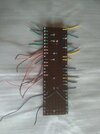
Last night I attached the flying leads to the boardIMG_20191102_064702.jpg
I know it looks very untidy at the moment, but once properly fitted & all leads soldered in it will look much neater. Doing this was again quite time consuming as once a few leads are attached the board is temporarily installed on the stand offs & the leads cut to the required length. Then repeat, repeat, repeat. Sometime today I'll attach the leads that I previously laced up & the two leads that will feed the power tube grids, then get the board installed & leads all soldered up. Then, after thoroughly going through with a metre to ensure all is good & everything is connected where it should be, I'll start on populating the board. Cheers
 
Last edited:
Even better still is to DC elevate the heater supply. With "cathode biased" power tubes you can simply tie the heater CT (or artificial CT) to the power tube cathodes. Otherwise, derive a filtered 50~70VDC node (use a voltage divider) off the HT supply (usually off the "screen" node) to tie the CT to.
Is this type of hum rejection more for high gain amps or just any amp?
 
Sure. Basically, each "stage" of the amplifier's circuit is supplied with nice clean, steady DC by its own HT (or B+) "node" & each node has its own filter capacitor (aka "smoothing" cap or "reservior" cap). The recitifier does not provide pure, clean DC, rather, pulses of DC (fluctuating with the AC supply's frequency). So the "screen filter's" jobs are the same as all the HT rail's filter caps;-
To smooth any ripple in the DC, to filter any AC superimposed onto the DC out (pass it to ground), to keep the stage's node at a constant +DC potential (it doesn't do this alone) & to provide the stage with an un-inerupted & steady supply of nice clean DC.
Electrolytic (filter) capacitors need to have reasonably good "ripple current" handling capability. When filter caps wear down they progressively lose some of their ripple current handling capability. This is why worn filters cause an amp to hum, as they can no longer properly smooth the rippled DC provided by the rectifier.
Last night I attached the flying leads to the boardView attachment 33951
I know it looks very untidy at the moment, but once properly fitted & all leads soldered in it will look much neater. Doing this was again quite time consuming as once a few leads are attached the board is temporarily installed on the strand offs & the leads cut to the required length. Then repeat, repeat, repeat. Sometime today I'll attach the leads that I previously laced up & the two leads that will feed the power tube grids, then get the board installed & leads all soldered up. Then, after thoroughly going through with a metre to ensure all is good & everything is connected where it should be, I'll start on populating the board. Cheers

Wow, Man...That's mind boggling!!!!
 
Is this type of hum rejection more for high gain amps or just any amp?
It will be more noticeable with higher gain amps, but any amp with AC heated valves will benefit from it.
So, I've just finished wiring the board in. I haven't gone through & tidied it up yet so the wiring may look a bit untidy, but here's a few progress pics.
Pre amp sockets wired WP_20190311_21_04_35_Smart.jpg
Controls wiredWP_20190311_20_52_48_Smart.jpg
The bright cap fitted to volume 1 is an RS (radio spares)100pf silver Mica cap. This is the correct value for these amps, though I would have liked to use an RS dogbone cap for this.
Though these amps did not have grid stopper resistors on the power tube I chose to fit them (5k6). WP_20190311_20_51_21_Smart.jpg
I'm still waiting for the ARS 16uf/500V PI filter capacitor that will mount on the chassis sidewall to arriveWP_20190311_20_54_14_Smart.jpg
Hopefully early in the upcoming week.
So I'll go through & tidy the pre amp tube wiring, then thoroughly check everything with a meter before populating the board. Cheers
 
Last edited:
Back
Top