Marshall Phase Inverter Voltages

And now a question about the Marshall circuit board layout...

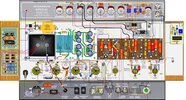
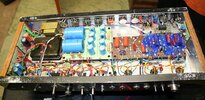
On my two JCMs, I have flipped the component layout at V1 and the circuit board. Is this counterintuitive for proper operation of the amp?

View attachment 25749
No, not at all. I think it makes sense for the signal path to flow from one side of the amp to the other without crossing back over itself.
From reading through old tube application & data manuals though, I know that the "b" triode is the quieter of the two.
When I built my 2204/#39 amp I rotate the pre amp sockets 180 degrees to have the quieter "b" triode 1st, & used the same V1 layout that you have.
Regarding the 7.3V PI plate differential voltage (which is right on the money), you'll want the power amp up working reasonably loud to notice a difference (sustain). Good to see you put the V1a grid stopper right at the socket & that you have the bypass & coupling caps "outter foil" correctly oriented. Cheers
 
Last edited:
No, not at all. I think it makes sense for the signal path to flow from one side of the amp to the other without crossing back over itself.
Thanks, and good to know. I thought I might have committed a major No-No. I was preparing to rip it out!

From reading through old tube application & data manuals though, I know that the "b" triode is the quieter of the two.
When I built my 2204/#39 amp I rotate the pre amp sockets 180 degrees to have the quieter "b" triode 1st, & used the same V1 layout that you have.
More madness to absorb!

Regarding the 7.3V PI plate differential voltage (which is right on the money), you'll want the power amp up working reasonably loud to notice a difference (sustain).
I was afraid you were going to say that... :rolleyes2:

Good to see you put the V1a grid stopper right at the socket & that you have the bypass & coupling caps "outter foil" correctly oriented.
It's all part of that Madness... :cheers:
 
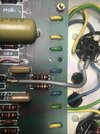
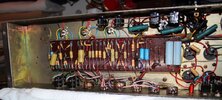
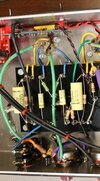
Sorry for the slow reply. Here are the pictures you requested.

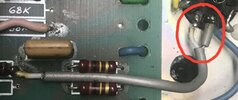
It definitely looks like the wire going from the 68K resistor to pins 6 and 7 was an add on, and why would it jump the two together? Pin six is Anode Triode #1 and pin seven is the Grid Triode #1. It looks like there should have originally been a green wire from the 68K resistor to pin seven.


IMG_5731.JPG


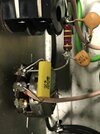
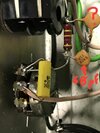
Looks like an extra cap was added at the input.


IMG_5735.JPG


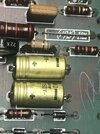
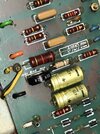
Here's a couple of shots of the other are you asked for.


IMG_5730.JPG


IMG_5734.JPG


I'll try to check the B+ voltage in the morning. Sorry it's taken so long.

I wish the orientation didn't get changed when I loaded these. Oh well.
 
Last edited:
B+ voltage on pin 3 of both V4 and V5 were 367 VDC.

Pin 5 at the other end of those capacitors were 371 VDC.
 
Sorry for the slow reply. Here are the pictures you requested.
First of all... How do you like how this Marshall is sounding? Is the tone slightly nasally at all?

Regarding this pic:
2019-07-07 09.42.38.jpg
This is the old Marshall Hot Shield trick. It's designed to kill highs. This could have been done at the factory, or as an aftermarket mod. IMO, this is a very dangerous circuit design. If that shielded cabling was to fail by having the shielding wire, that is connected to the high voltage of pin 6, short out against the main conductor wire to the grid, pin 7, it could send all that DC voltage into the input and all the way into your guitar strings! There are a couple other methods that are safer and just about accomplishes the same thing. Personally, I would reconfigure this area.

Looks like an extra cap was added at the input.
Looking at this pic of yours:
2019-07-07 10.08.35.jpg
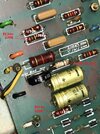
The stock 470k resistor is bypassed with 2 ceramic caps that are in series. One cap value is 68pF, and the other is unknown unless you can describe the printed values on the other side of that cap. Stock value of this cap is supposed to be 470pF.

The yellow "Bright" cap is the stock value of 1000pF, but a ceramic type was originally used here. This is the first time I've seen a metalized poly cap used as a bright cap. Silver micas is a popular substitute for the ceramics.

Is this amp operating on EL34s? Because:
2019-07-07 10.33.09.jpg
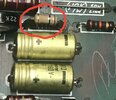
... a 100k resistor was added in parallel to the original bias range-setting resistor, which I cannot clearly see its color bands. Anyways, it looks like this amp was originally set up with 6550s, and a mickey-mouse approach was used to bias the EL34s. I would reconfigure this area, too.
 
Hi, thanks for posting. The sounds a bit shrill. It's not terrible, but could sound better. It sounds nowhere near as nice as my '79 JMP 100 watt.

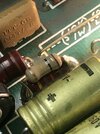
It looks like the upside down cap says 500M.

IMG_5758.JPG


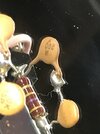
Then, that piggybacked resistor looks like it is 47K. I couldn't get a good photo, but it looks like yellow, purple, orange, gold.


IMG_5757.JPG


That film capacitor was something a friend threw on to see if it would fix the drastic volume differences between the high and normal inputs. I'll add some silver mica caps to my shopping list.

I was hoping to make a detour to You-Do-It Electronics yesterday to buy some parts. If I can find an electronics store while I'm in Buffalo this week, I will grab some stuff. Otherwise I'll hit them up on Saturday.

So far, I should get some:
470pF caps
220K resistors to get the spec up to EL34.
What should I replace that piggy back resistor mess with?
Green, Blue, Yellow, and Pink wire.
If there's anything else, like maybe 68K resistors I should have on hand, let me know.
 
The sounds a bit shrill. It's not terrible, but could sound better. It sounds nowhere near as nice as my '79 JMP 100 watt.
The "Hot Shield" mod might have something to do with this. Please get a second, third, & fourth opinion on this.

It looks like the upside down cap says 500M.
OK... I think that's a 500pF. Plus the other 68pF cap... ya got 568pF, instead of 470pF (Or even a 500pF). You might like the 568 value better. Keep an open ear on this.

That film capacitor was something a friend threw on to see if it would fix the drastic volume differences between the high and normal inputs.
Nah... Different type of cap won't change those volume differences. The high input engages an additional gain stage. There are mods out there that address this scenario. I've yet to learn how to do this.

So far, I should get some:
470pF caps
220K resistors to get the spec up to EL34.
What should I replace that piggy back resistor mess with?
Green, Blue, Yellow, and Pink wire.
Those piggy-back resistors add up to 33K.
Check this out, John:
27980
 
:cheers:
Thanks for all the info. Hopefully, next weekend I can get those resistors and the wiring to V1 taken care of.
 
John read the B+ voltage at the yellow wire 1 watt 10k resistor and you have a jumper wire ( 10k 1 watt 50w link )
that is your dropping string to your PI I would shoot for 300v on your PI pin 1 and 6 and 200v V-1 and V-2 pin 1 and 6
use a 2 watt resistor on that jumper remove the wire and add a 10k to start with and go up in value to drop the PI to 300v

look at the 1969 Hendrix amp at that time the dropping resistors look like a 15k and a 2k2 17.2k total
that said back then USA wall voltage was 110 VAC My Park 75 has two 15k for a total of 30k

Hendrix amp.jpg
 
A 12AX7 was designed for 250VDC max I put the NOS money tube in the PI they can take the higher voltage
And change the bias resistors from 150k too 220k
Note their is no tone to be gained on dropping or bias resistors
 
On Dumble #183 ODS B+ was only 465 volts then B+2 3k 10 watt resistor to B+3 to get in the 300 volt range on the PI
then 22k to get V-2 and V-1 to 200 volt range.

183ver11.jpg

#183.jpg
 
John read the B+ voltage at the yellow wire 1 watt 10k resistor and you have a jumper wire ( 10k 1 watt 50w link )
that is your dropping string to your PI I would shoot for 300v on your PI pin 1 and 6 and 200v V-1 and V-2 pin 1 and 6
use a 2 watt resistor on that jumper remove the wire and add a 10k to start with and go up in value to drop the PI to 300v

look at the 1969 Hendrix amp at that time the dropping resistors look like a 15k and a 2k2 17.2k total
that said back then USA wall voltage was 110 VAC My Park 75 has two 15k for a total of 30k

Hi Steve, For the two watt resistor, is that a 10K?

There are no electronic stores like I have in Boston here in Buffalo, so I'll need to order some stuff on line tomorrow to get it home by the weekend.

I want to make sure I have a good list of stuff ready.

BTW, voltage at my house is 120 if that makes a difference.
 
John get a selection of 2 watt 10k 11k 12k 15k 18k 20k they are cheap


221k 1% 1/2 watt should be fine for the bias resistors order 3 221k and one 47.5k


I was going to try returning it to stock. Once it's back to original, I'll decide if the tone needs any shaping from there.
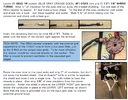
Don't know if you know anything about using shielded coax cables for your input grid wire to pin 7 of V1. I copied this from a Metro Amp Assembly Manual for one if their old kit amps that they used to sell:
28117


That's a 22 gauge shielded coax cable that is being used. You can run it under the board or over it like I did here:28118

Remember that my wiring layout for V1 is flipped compared to yours. The Input 68K is connected to pin 2 on mine, and yours will be pin 7.
 
Hi SG John, sorry I haven't been here of late, I've had quite a lot on this last week & free time has been limited. You have been in good hands with Sysco & Plexi though.
You mention that the amp is a little "shrill". Might I ask, where are you setting the Master Volume? If you are setting the master low it contributes quite a bit to the amp sounding thin or shrill (the phase inverter being "driven" really thickens the tone). If you usually set the master up around 6 or 7 (or higher), disregard the previous.
Next, the "treble peaking" circuit, located between the "low" input & the volume pot (comprised of the 470k resistor paralleled by the two ceramic disk caps). The stock cap value here is either a (single) 500pf or 470pf cap.
To explain how this circuit works, the 470k resistor attenuates all frequencies, except those passing through the cap (highs & high mids).
It appears on my 'phone that the two ceramic disk caps on your treble peaking circuit (a 68pf & a 500pf) are wired in series. This would give a total value of 59.859pf (60pf). This value would leave only the very high highs unattenuated. I personally would use a 500pf here.
This brings us to the choice of ceramic disk or silver Mica for this cap. Silver micas impart a "smooth" quality to the highs while ceramic Disk caps impart a "grainy" quality to the highs. For blues & blues/rock the silver micas work well. For harder, more aggressive rock the ceramics work well.
Besides using a "hot shield", a safer approach that Marshall used to combat shrillness in these amps was to install a small value (1kV ceramic disk) cap between the V1 pin 6 & pin 8 leads (mounted on the board).
However, I agree with your returning the amp to stock & correctly configuring the bias supply for EL34's before even thinking whether tone shaping mods might be of benefit. Cheers
 
Back
Top