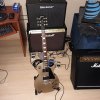
Hot Rodding a DSL40C???

I must admit that minimizing external effects really does appeal to me more after using pedals en vivo.

I am happy to have just purchased my first ever Wah pedal - a Dunlop made in California - and my Boss FV30L is Great In the FX loop....but I abhor having to run effects at the front of the amp, then another set of cables to and from the volume pedal....
 
Not so sure. All that functionality and tone doesn't come cheap, from Marshall or anybody else. Their pricing is right in line with competitive amps from other makes. It's a rarefied territory with amps like that, not too many companies making such feature-laden models.
Well, that’s good to know!

I suppose the backdrop of my comment is derived from the fact that tube technology is not new...in fact, it is very old and quite obsolete in nearly all areas of audio today except guitar amplification and certain audiophile disciplines.

I just spec’d out a 725 watt amp for a job. Ain’t no tubes in it!

There’s also nothing new about resistors, capacitors, and transformers...they’ve been around since, like, the dawn of electronics.

Tubes, as much as I like them, really are the buggy-whips of audio technology. I work with a guy who used to work for American Amplifier in Maryland. He was quite surprised when I told him about the popularity of tubes in the world of guitars. He used to have access to scores of tubes in bins...tubes that would draw huge dollars today...that used to cost pennies...tubes that used to be throw-away items. He thought tubes had completely died out.

So, I may have been guilty of inversely equating the age of the technology with the cost of the product, ie., since it’s old, it shouldn’t be very expensive. This may have been a mistake on my part.

But, it does make me wonder what the same product as a JVM would cost if the name “Marshall” were not associated with it.

Again, don’t misunderstand. I’m not anti-tube. I like using them and enjoy the experience. Honestly...I now prefer them. Also, if the price of tube amps is due to the the cost of keeping the employees (wages, health insurance, retirement, and other compensation - which is probably the real reason for the price) I’m glad to pay it. Personally, I’d rather pay for a human being’s compensation than some smoke-blowing about technology that literally dates back to the 1920’s.
 
Last edited:
I suppose the backdrop of my comment is derived from the fact that tube technology is not new...in fact, it is very old and quite obsolete in nearly all areas of audio today except guitar amplification and certain audiophile disciplines.

I just spec’d out a 725 watt amp for a job. Ain’t no tubes in it!

There’s also nothing new about resistors, capacitors, and transformers...they’ve been around since, like, the dawn of electronics.

Tubes, as much as I like them, really are the buggy-whips of audio technology. I work with a guy who used to work for American Amplifier in Maryland. He was quite surprised when I told him about the popularity of tubes in the world of guitars. He used to have access to scores of tubes in bins...tubes that would draw huge dollars today...that used to cost pennies...tubes that used to be throw-away items. He thought tubes had completely died out.

So, I may have been guilty of inversely equating the age of the technology with the cost of the product, ie., since it’s old, it shouldn’t be very expensive. This may have been a mistake on my part.

But, it does make me wonder what the same product as a JVM would cost if the name “Marshall” were not associated with it.

Again, don’t misunderstand. I’m not anti-tube. I like using them and enjoy the experience. Honestly...I now prefer them. Also, if the price of tube amps is due to the the cost of keeping the employees (wages, health insurance, retirement, and other compensation - which is probably really the real reason for the price) I’m glad to pay it. Personally, I’d rather pay for a human being’s compensation than some smoke-blowing about technology that literally dates back to the 1920’s.

If I thought I could drive this 1997 Marshall Valvestate VS265 night after night without it taking a dump, I would probably just use it and add effects as required.
 
I suppose the backdrop of my comment is derived from the fact that tube technology is not new...in fact, it is very old and quite obsolete in nearly all areas of audio today except guitar amplification and certain audiophile disciplines.

I just spec’d out a 725 watt amp for a job. Ain’t no tubes in it!

There’s also nothing new about resistors, capacitors, and transformers...they’ve been around since, like, the dawn of electronics.

Tubes, as much as I like them, really are the buggy-whips of audio technology. I work with a guy who used to work for American Amplifier in Maryland. He was quite surprised when I told him about the popularity of tubes in the world of guitars. He used to have access to scores of tubes that would draw huge dollars today...that used to cost pennies. He thought tubes had completely died out.

So, I may have been guilty of inversely equating the age of the technology with the cost of the product, ie., since it’s old, it shouldn’t be very expensive. This may have been a mistake on my part.

But, it does make me wonder what the same product as a JVM would cost if the name “Marshall” were not associated with it.

Again, don’t misunderstand. I’m not anti-tube. I like using them and enjoy the experience. Honestly...I now prefer them. Also, if the price of tube amps is due to the the cost of keeping the employees (wages, health insurance, retirement, and other compensation - which is probably really the real reason for the price) I’m glad to pay it. Personally, I’d rather pay for a human being’s compensation than some smoke-blowing about technology that literally dates back to the 1920’s.

Thing is, very few companies can even pull off what Marshall does with the JVMs, and the few that can charge similar or more money. Ain't no "boutique" amps out there that can do what a JVM can, with the channel assignment, programmable effects loop, emulated out and midi integration (128 presets!) and all the extras on top of what is essentially an ultra high-gain plexi. The use of tubes isn't new, no, but you're paying for so much more with an amp like that.
 
As I move along with these music projects, I understand why guys like Gary Moore and Yngwie have to hit Marshall's so hard with a tube screamer just to get anything out of them...
 
As I move along with these music projects, I understand why guys like Gary Moore and Yngwie have to hit Marshall's so hard with a tube screamer just to get anything out of them...

Some other amps actually have some of that circuitry built-in, but you don’t know about it. The Blackstar HT series had built-in diode clipping, similar to what you’d have in a drive pedal. I don’t know if other Blackstars did, as well. I’ve read on other forums that certain Marshalls had built-in diode clipping, too.

Though I’m not straight-up opposed to that, it’s almost never marketed as such, and maybe I’d prefer to use my own pedal, vs. what was built-into the amp.

The funny thing is...a person could theoretically dislike the idea of using pedals for dirt, yet (depending on the amp) could unwittingly be using a similar type of circuitry when they kick in their overdrive channel!
 
Last edited:
Thing is, very few companies can even pull off what Marshall does with the JVMs, and the few that can charge similar or more money. Ain't no "boutique" amps out there that can do what a JVM can, with the channel assignment, programmable effects loop, emulated out and midi integration (128 presets!) and all the extras on top of what is essentially an ultra high-gain plexi. The use of tubes isn't new, no, but you're paying for so much more with an amp like that.

I can understand that, and I appreciate the additional info. Attention to detail, build quality, and innovative ideas (even if using existing technology) has value and is worth money.

Thanks for the insight.
 
Yup, Sysco. I figured so.

Now if one were to tell me why one would want to clip the guitar's signal, I will add to my understanding considerably.

Diode clipping is essentially how distortion pedals work. The signal is run through a pair of diodes that are oriented in opposite directions. The peaks of the signal are clipped, giving the distortion sound.

There is also gain and level circuitry. But, that’s it in a nutshell.
 
Back
Top