
You are using an out of date browser. It may not display this or other websites correctly.
You should upgrade or use an alternative browser.
You should upgrade or use an alternative browser.
Sorgenkind
- Thread starter bea
- Start date

OP

bea
AmBASSador of the F Clef

It's time to continue, isn't it?
Filling the two round holes...
Take some pear from the wood rests, plane it and cut it into two halves:


Cut some round slices

Do some additional sound holes and supprt everything from the back of the top:

Lets quote Mick Jagger: "Paint it Black"

You see, i avoid to remove the neck as long as possible....
Filling the two round holes...
Take some pear from the wood rests, plane it and cut it into two halves:
Cut some round slices
Do some additional sound holes and supprt everything from the back of the top:
Lets quote Mick Jagger: "Paint it Black"
You see, i avoid to remove the neck as long as possible....
OP
bea
AmBASSador of the F Clef
Ok, next chapter (we are prossing a lot faster that the actual project which is still daily, better nightly, work...). A neck reset is necessary. Which in this case involves roughly cutting out the neck with a (dowel-) saw which allows working without damage to the finish of the neck and removing the rests of the wood with a chisel.

Here You see the old dovetail tenon i cut (better tried to cut..) 30 years ago.

A bit of cleanup:

And insert a new block into the gap:

Note the centerline - i am still in the hope to set the neck correctly this time.

Here You see the old dovetail tenon i cut (better tried to cut..) 30 years ago.
A bit of cleanup:
And insert a new block into the gap:
Note the centerline - i am still in the hope to set the neck correctly this time.


OP
bea
AmBASSador of the F Clef
Patience yes - its a major skill for my job. Skill ... mhmm, limited. Actually too limited to go semipro...You have both patience and skill! Nice work - more please!!

OP
bea
AmBASSador of the F Clef
Now, what's missing? Right. It requires new tonebars. Although this is a cheap and not very well built thinline with a laminated top, its acoustic sound was pretty cool. Two things had resp. should have had a large impact: the pickup holes acted as additional sound holes and made the guitar sound more lively. The sound was still ok when the holes were closed but the improvement was so strong that i did not put the pickups back again. The neck pickup hole made for the larger effect.
As i closed these holes, i need a compensation. That's the main motivation behind the openings in the two round plates, not just decoration.
There has probably another effect: the weakness of the top immediately behind the neck pickup hole. Although i do not know for sure, i assume that it allowed the main part of the top to move a lot easier than it would have done if the top was stable. It must have been something like that, because the massive tone bars led to a high, uneven and to very "ringing" tap tone. (luckily i found some YT videos showing me how the tap tones should sound...)
The rough soundbars, one with a rough sketch of my ideas. Well, actually already fitted into the surface, which took me a few days of work with chalk and a sharp knife. As the top was partly sunken in, the job was more difficult than usual.
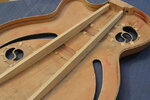
So in order to achieve a nice acoustic sound i must carefully design the tone bars: they need to be stiff where the top is weak and the load is high, and they do not need to be stiff elsewhere.
The stiff areas need to be, of course, underneath the bridge and the problem zone around the neck block and the former pickup holes. That zone would have become a problem zone even without the destructive modifications by the previous owner. Reason: the dome of an archtop is able to carry a lot of the load just by its shape. That dome ended pretty far away from the end block - below the fingerboard extension the top has always been flat. And it was lacking support.
Glueing in and cutting a rough shape to the maximum thickness with a chisel.

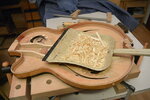
Final shape - i was brave and risked some massive scalloping. Unfortunately i'll see if it holds statically not before the guitar is closed and strung up. Mhmm, no risk no fun...
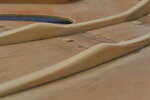
Here a closeup. Note that a decided to add 2 mm between the bridge and the heel area. I mistakingly cut a bit too deep (would not have happened if i owned a violin plane). The tap tone was already a bit dull, now it is better ("bell like").
As i closed these holes, i need a compensation. That's the main motivation behind the openings in the two round plates, not just decoration.
There has probably another effect: the weakness of the top immediately behind the neck pickup hole. Although i do not know for sure, i assume that it allowed the main part of the top to move a lot easier than it would have done if the top was stable. It must have been something like that, because the massive tone bars led to a high, uneven and to very "ringing" tap tone. (luckily i found some YT videos showing me how the tap tones should sound...)
The rough soundbars, one with a rough sketch of my ideas. Well, actually already fitted into the surface, which took me a few days of work with chalk and a sharp knife. As the top was partly sunken in, the job was more difficult than usual.
So in order to achieve a nice acoustic sound i must carefully design the tone bars: they need to be stiff where the top is weak and the load is high, and they do not need to be stiff elsewhere.
The stiff areas need to be, of course, underneath the bridge and the problem zone around the neck block and the former pickup holes. That zone would have become a problem zone even without the destructive modifications by the previous owner. Reason: the dome of an archtop is able to carry a lot of the load just by its shape. That dome ended pretty far away from the end block - below the fingerboard extension the top has always been flat. And it was lacking support.
Glueing in and cutting a rough shape to the maximum thickness with a chisel.
Final shape - i was brave and risked some massive scalloping. Unfortunately i'll see if it holds statically not before the guitar is closed and strung up. Mhmm, no risk no fun...
Here a closeup. Note that a decided to add 2 mm between the bridge and the heel area. I mistakingly cut a bit too deep (would not have happened if i owned a violin plane). The tap tone was already a bit dull, now it is better ("bell like").

Dewesq55
Well-Known Member

What did you use for the tone bars?Now, what's missing? Right. It requires new tonebars. Although this is a cheap and not very well built thinline with a laminated top, its acoustic sound was pretty cool. Two things had resp. should have had a large impact: the pickup holes acted as additional sound holes and made the guitar sound more lively. The sound was still ok when the holes were closed but the improvement was so strong that i did not put the pickups back again. The neck pickup hole made for the larger effect.
As i closed these holes, i need a compensation. That's the main motivation behind the openings in the two round plates, not just decoration.
There has probably another effect: the weakness of the top immediately behind the neck pickup hole. Although i do not know for sure, i assume that it allowed the main part of the top to move a lot easier than it would have done if the top was stable. It must have been something like that, because the massive tone bars led to a high, uneven and to very "ringing" tap tone. (luckily i found some YT videos showing me how the tap tones should sound...)
The rough soundbars, one with a rough sketch of my ideas. Well, actually already fitted into the surface, which took me a few days of work with chalk and a sharp knife. As the top was partly sunken in, the job was more difficult than usual.
View attachment 1890
So in order to achieve a nice acoustic sound i must carefully design the tone bars: they need to be stiff where the top is weak and the load is high, and they do not need to be stiff elsewhere.
The stiff areas need to be, of course, underneath the bridge and the problem zone around the neck block and the former pickup holes. That zone would have become a problem zone even without the destructive modifications by the previous owner. Reason: the dome of an archtop is able to carry a lot of the load just by its shape. That dome ended pretty far away from the end block - below the fingerboard extension the top has always been flat. And it was lacking support.
Glueing in and cutting a rough shape to the maximum thickness with a chisel.
View attachment 1891
View attachment 1892
Final shape - i was brave and risked some massive scalloping. Unfortunately i'll see if it holds statically not before the guitar is closed and strung up. Mhmm, no risk no fun...
Here a closeup. Note that a decided to add 2 mm between the bridge and the heel area. I mistakingly cut a bit too deep (would not have happened if i owned a violin plane). The tap tone was already a bit dull, now it is better ("bell like").
View attachment 1893

Dewesq55
Well-Known Member
Thanks. I have never made an acoustic instrument yet so I didn't know what ia "usual."Spruce, as usual.
OP
bea
AmBASSador of the F Clef
Spruce actually has some very interesting properties: large Young's modulus, hence a large stiffness in relation to its density. It is actually stiffer than a piece of maple of the same dimensions. Other woods with a similar density as spruce have a pretty small Young's modulus, e.g., poplar, willow or basswood.
That's the reason why spruce is used for light constructions of great stability, be it instrument tops or houses.
That's the reason why spruce is used for light constructions of great stability, be it instrument tops or houses.
OP
bea
AmBASSador of the F Clef
Next logical chapter is the new endblock. You might have noticed that the block has already been fitted into the gap before i made the tone bars. But now it time to cut the dovetail mortise to fit to the old tenon. There were two difficulties:
a) when i reset the neck some 30 years ago i used a dovetail with parallel flanks, not a v shaped one. Never do this again, at least with hand tools; it is so much harder to achieve a close fit than with the usual V shaped dovetail...
b) the heel of the body is round and oblique in any dimension, and apparently it has alway been round and oblique. So a well defined reference plane is missing.
Which means: make one. Perpendicular to the glueing surface of the bottom, but slightly oblique against the main axis of the guitar and thus following the shape of the heel. Given the existing tenon this seemed to be easiest to me:

Copy the tenon to the end block:

Cut it a bit too narrow and then *slowly* fit the tenon into the mortise. Always (try to...) control the orientation of the neck. Anyway, to some degree the outcome is not perfectly predictable. At least regarding my skills.

Done. On first sight the orientation is as i wanted it to have. At least almost. And far better than before:

In order to define the neck angle better i need to shim the mortise a bit:

Unfortunately, on the final steps of the procedure the neck block broke :-(
So glue it and give it a bandage. The other end block was also broken and glued a few weeks ago. A good opportunity to give it a bandage as well - a piece of wood glued to the block in cross grain direction.

Now we are almost in time with the present state of the project.
Todo:
repair the two breakouts in the new block.
extend the neck tenon with a shim and level that to the end block
match with the glueing surface of the bottom.
make to fillers of wood to close the gap on the sides of the heel.
repair the finish
a) when i reset the neck some 30 years ago i used a dovetail with parallel flanks, not a v shaped one. Never do this again, at least with hand tools; it is so much harder to achieve a close fit than with the usual V shaped dovetail...
b) the heel of the body is round and oblique in any dimension, and apparently it has alway been round and oblique. So a well defined reference plane is missing.
Which means: make one. Perpendicular to the glueing surface of the bottom, but slightly oblique against the main axis of the guitar and thus following the shape of the heel. Given the existing tenon this seemed to be easiest to me:
Copy the tenon to the end block:
Cut it a bit too narrow and then *slowly* fit the tenon into the mortise. Always (try to...) control the orientation of the neck. Anyway, to some degree the outcome is not perfectly predictable. At least regarding my skills.
Done. On first sight the orientation is as i wanted it to have. At least almost. And far better than before:
In order to define the neck angle better i need to shim the mortise a bit:
Unfortunately, on the final steps of the procedure the neck block broke :-(
So glue it and give it a bandage. The other end block was also broken and glued a few weeks ago. A good opportunity to give it a bandage as well - a piece of wood glued to the block in cross grain direction.
Now we are almost in time with the present state of the project.
Todo:
repair the two breakouts in the new block.
extend the neck tenon with a shim and level that to the end block
match with the glueing surface of the bottom.
make to fillers of wood to close the gap on the sides of the heel.
repair the finish
OP
bea
AmBASSador of the F Clef
So, the last photos for a while:
I have extended the dovetail tenon by a shim and will adapt it to the shape of the bottom which is not quite plain in the glueing area. Again using the old luthiers trick to rub some chalk onto the reference surface and rub that on the surface to be matched. Everywhere where that becomes white, the wood has to be removed. The white spots will then enlarge with time.

White spots are still pretty small, aren't they?

Meanwhile that step is finished. What remains? A lot of fine work: replacements for the rims around the heel of the neck. I needed to cut them away with the end block. And the repair or at least try to repair those many scratches in the finish. Hard to show visually but necessary. And of course close the box position the tailpiece. Final polish of the body before the neck can be glued. Many details which will take their time...
I have extended the dovetail tenon by a shim and will adapt it to the shape of the bottom which is not quite plain in the glueing area. Again using the old luthiers trick to rub some chalk onto the reference surface and rub that on the surface to be matched. Everywhere where that becomes white, the wood has to be removed. The white spots will then enlarge with time.
White spots are still pretty small, aren't they?
Meanwhile that step is finished. What remains? A lot of fine work: replacements for the rims around the heel of the neck. I needed to cut them away with the end block. And the repair or at least try to repair those many scratches in the finish. Hard to show visually but necessary. And of course close the box position the tailpiece. Final polish of the body before the neck can be glued. Many details which will take their time...