DIY pedal help (Ivan needs a break)

RVA

Ambassador
Mates,

I am doing a stripboard build of the Earthquaker Devices Speaker Cranker, a JFET boost (I think!).
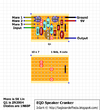
EQD Speaker Cranker.png

It is pretty simple and Ivan already educated me on stripboard basics, but I have 2 more questions. Ivan has always helped without reservation, but as you all know, my questions run deep and need to be spread around or I could hurt someone!! So here they are:
1. Where is the LED?
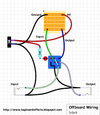
2. I could use help with the stomp switch wiring.
-------------
FYI- this was advice in the comments for putting an LED on a mini, but I think the above is a regular layout, so it should be there

Just connect the resistor inline with a daisy chain from the 9V supply, or if width isn't a problem for you, just add an extra column and put the resistor from the 9V row to one of the lower rows. Maybe the row that the transistor base is on, with a cut to isolate it obviously.
------
Thanks for any help.
 
It is laid out in a way that suits your build. The relevant wiring leaves your project board in different places though, but the color coding is correct. The switch layout is there in the pic I posted.
If you adapt the wiring positions to your project, the only thing missing is your “more” knob.
 
  • Like
Reactions: RVA
A lot of stripboard layouts don't make allowance for the indicator LED, this being one of them. When adding an indicator LED we need to include a (series) current limiting resistor. This resistor can be placed on either side of the LED, + supply or ground. If only powrring the effect with 9VDC, a 1k or 1k5 resistance will be fine but I usually throw a 4k7 in dirt box type effects so I can use higher supply voltages if I want. This value is still fine for 9VDC supply, the LED just wont be as bright. I usually place the resistor right at the DC supply socket. I usually place the LED close to the DC supply socket, so after soldering the resistor to the LED & heatshrink insulating I can simply connect the free end of the resistor to the DC socket. Then run a wire to the footswitch for grounding the LED. If the LED isn't placed close to the DC supply socket, simply use wires to connect it. I find it easiest to put the current limiting resistor in the + feed to the LED, but either side does the same thing. Hope this helps. Oh, questions are fine, never a problem, but its good to have things where all can see so others can benefit if needed. Cheers

Edit: The layout Don has supplied is good. As you can see, you current limiting resistance value isn't critical, just use the higher 4k7 value if you want to use a higher supply voltage than the typical 9VDC. Take the supply from either the DC socket or board, whichever is most convenient for you. Cheers
2nd Edit: Wiring the footswitch the same as you have on your previous builds will be fine. Cheers
 
Last edited:
  • Like
Reactions: RVA
It is laid out in a way that suits your build. The relevant wiring leaves your project board in different places though, but the color coding is correct. The switch layout is there in the pic I posted.
If you adapt the wiring positions to your project, the only thing missing is your “more” knob.
A lot of stripboard layouts don't make allowance for the indicator LED, this being one of them. When adding an indicator LED we need to include a (series) current limiting resistor. This resistor can be placed on either side of the LED, + supply or ground. If only powrring the effect with 9VDC, a 1k or 1k5 resistance will be fine but I usually throw a 4k7 in dirt box type effects so I can use higher supply voltages if I want. This value is still fine for 9VDC supply, the LED just wont be as bright. I usually place the resistor right at the DC supply socket. I usually place the LED close to the DC supply socket, so after soldering the resistor to the LED & heatshrink insulating I can simply connect the free end of the resistor to the DC socket. Then run a wire to the footswitch for grounding the LED. If the LED isn't placed close to the DC supply socket, simply use wires to connect it. I find it easiest to put the current limiting resistor in the + feed to the LED, but either side does the same thing. Hope this helps. Oh, questions are fine, never a problem, but its good to have things where all can see so others can benefit if needed. Cheers

Edit: The layout Don has supplied is good. As you can see, you current limiting resistance value isn't critical, just use the higher 4k7 value if you want to use a higher supply voltage than the typical 9VDC. Take the supply from either the DC socket or board, whichever is most convenient for you. Cheers
2nd Edit: Wiring the footswitch the same as you have on your previous builds will be fine. Cheers
OK, so D1 in the footswitch wiring above is the LED? Sub a 4k7 resistor for the 2k2 and follow the rest of the wiring, or the wiring from my Prince of Tone...right?
 
OK, so D1 in the footswitch wiring above is the LED? Sub a 4k7 resistor for the 2k2 and follow the rest of the wiring, or the wiring from my Prince of Tone...right?

You are correct sir.
LED=light emitting “diode”
Indeed! I can’t wait to hear this one:D
Best of luck sir!:cheers:
 
Oh....so it’s a waiting game then...ok...I’m a patient human.
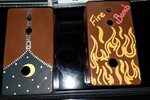
Sure! Build two of them! Will your paralegal be doing some artwork on these?
 
  • Like
Reactions: RVA
Don has fielded those questions nicely, thanks Don. We can calculate the "minimum" value current limiting resistance required for any given LED, using the following equation;
R=(E-Vf) x 1000/1,
where R is the resistance in ohms,
E is the supply voltage,
I is the LED's current in mA &
Vf is the forward voltage drop of the LED (typically around 2V).

We would need to look up the particular LED's data sheet (specs), but for example, we'll suppose the Vf = 2V & that I (LED current) = 20mA. (typical)

Supply voltage / Resistance
6V. = 220 ohms
9V. = 330 ohms
12V. = 560 ohms
24V. = 1200 ohms

You can see from this why I say that the resistance value isn't critical. By using a bigger value than needed we simply know that regardless of the particular LED's specs it'll be fine. Cheers
 
Back
Top