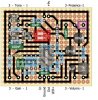
DIY Pedal build - Rookie Style!!

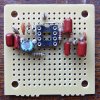
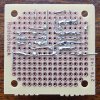
Next time I think I will solder the components as I place them in rather than place them all in before I solder. I am going blind!!!!! Needless to say, my first run is not pretty, and consequently, there shall be NO pics of the underside. Let's hope it works!

View attachment 16457
Usually, I solder just a few at a time. 2 to 5 components.

Are all those resistors 1/4 watts?

I like that vise that's holding the board.
 
Usually, I solder just a few at a time. 2 to 5 components.

Are all those resistors 1/4 watts?

I like that vise that's holding the board.
Live and learn! The resistors are all rated for at least 25vdc. I recall some of them specifically saying 1/4w.

I just got the vise. $12. I find it essential.
 
Last edited:
Live and learn! The resistors are all rated for at least 25vdc. I recall some pf them specifically saying 1/4w.

I just got the vise. $12. I find it essential.
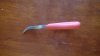
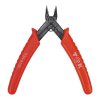
Resistors: I asked because I noticed that a couple of your larger size resistors is keeping you from making things real pretty in there. You can use 1/8 watt sized resistors in a effects pedal circuit, too. Lead Bender tools are a very useful and inexpensive to have:

260686584.jpg

A source for the above combo:
ALL PRODUCTS

Info and link to that vise?
 
Resistors: I asked because I noticed that a couple of your larger size resistors is keeping you from making things real pretty in there. You can use 1/8 watt sized resistors in a effects pedal circuit, too. Lead Bender tools are a very useful and inexpensive to have:

View attachment 16463

A source for the above combo:
ALL PRODUCTS

Info and link to that vise?
Thanks!

Here is the vise.

https://www.amazon.com/gp/product/B00Q2TTQEE/ref=oh_aui_detailpage_o01_s00?ie=UTF8&psc=1
 
To be totally honest, I would not have wanted to show the underside of the board of my first few point to point builds either. Its a "practise" type thing where you get better at with a few builds. Here, from the "runoffgroove" fx building site we see an example of point to pointC__Data_Users_DefApps_AppData_INTERNETEXPLORER_Temp_Saved Images_tr2-perf.png C__Data_Users_DefApps_AppData_INTERNETEXPLORER_Temp_Saved Images_trperf-top.jpg C__Data_Users_DefApps_AppData_INTERNETEXPLORER_Temp_Saved Images_trperf-bottom.jpg
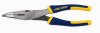
As we can see, the board underside is not particularly pretty & this is from someone well used to this type of construction, so I would not be too worried about how the underside looks RVA. Just check it well through a good magnifier to make sure everything follows the diagrams, all connections are complete & no bridged tracks. I usually load a few components at a time, but sometimes more. I find a pair of curved, longnose pliers like theseWP_20180712_001.jpg invaluable for shaping the component leads on the board underside. That vice is the best I have seen RVA, I need one of those. Funny you posted the Kenny Rogers thing Robert, I have built fx following the diagrams only to find, when completed that the controls operate in reverse. The fix is to simply swap the leads to the outer two lugs on the pots. Keep at it RVA, your doing well & the board undersides get better looking with practise. Cheers

Edit; Note on the "runoffgroove" board that there are resistors mounted "standing on end", this is common practise, look inside a 70's or 80's transistor radio etc & you will see it done often, so this can be done where a resistor physically wont fit as shown on the diagram. Cheers

Edit 2; I also find desoldering braid invaluable with this type construction, & yes, I've needed to use it often during board builds. Cheers
 
Last edited:
To be totally honest, I would not have wanted to show the underside of the board of my first few point to point builds either. Its a "practise" type thing where you get better at with a few builds. Here, from the "runoffgroove" fx building site we see an example of point to pointView attachment 16469 View attachment 16470 View attachment 16471
As we can see, the board underside is not particularly pretty & this is from someone well used to this type of construction, so I would not be too worried about how the underside looks RVA. Just check it well through a good magnifier to make sure everything follows the diagrams, all connections are complete & no bridged tracks. I usually load a few components at a time, but sometimes more. I find a pair of curved, longnose pliers like theseView attachment 16472 invaluable for shaping the component leads on the board underside. That vice is the best I have seen RVA, I need one of those. Funny you posted the Kenny Rogers thing Robert, I have built fx following the diagrams only to find, when completed that the controls operate in reverse. The fix is to simply swap the leads to the outer two lugs on the pots. Keep at it RVA, your doing well & the board undersides get better looking with practise. Cheers

Edit; Note on the "runoffgroove" board that there are resistors mounted "standing on end", this is common practise, look inside a 70's or 80's transistor radio etc & you will see it done often, so this can be done where a resistor physically wont fit as shown on the diagram. Cheers

Edit 2; I also find desoldering braid invaluable with this type construction, & yes, I've needed to use it often during board builds. Cheers
Cool info... :gotta-love:
 

Nice. A good, small pair of side cutters is absolutely essential & the curved long nose pliers make shaping the leads into tracks so much easier. I couldn't imagine doing point to point type building without either of them. Cheers
 
  • Like
Reactions: RVA
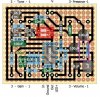
Ivan, what is the grey line I outlined in the purple box? Is that supposed to be an insulated connecting wire? Thanks

pot..JPG
 
That is what I thought. So insulated since it cuts across, right? Is that why it is grey?

My interpretation is that since it seems to be depicted as existing on the component side of the board, it doesn’t “need” to be insulated...but insulation will not “hurt” anything.
 
My interpretation is that since it seems to be depicted as existing on the component side of the board, it doesn’t “need” to be insulated...but insulation will not “hurt” anything.
I had not thought about it as topside. That is interesting
 
Sorry I'm late, but yes, it is a jumper or link as Thatbastarddon said, & yes, its usually just a piece of uninsulated wire on the component (top) side of the board, something like a scrap piece of cut off lead from a resistor or capacitor will suffice, though a piece of insulated wire will also be fine. Try keeping it flat against the top of the board. Alternately (I just noticed this), notice that the track to the top end of the jumper link is coming off lug 2 of the presence pot,,, you "could" just run a lead from lug 2 (middle lug) on the presence pot to lug 3 on the volume (level) pot & save having to construct the two bits of track & the jumper link. I often modify board layouts to suit my needs. Cheers
 
Last edited:
Sorry I'm late, but yes, it is a jumper or link as Thatbastarddon said, & yes, its usually just a piece of uninsulated wire on the component (top) side of the board, something like a scrap piece of cut off lead from a resistor or capacitor will suffice, though a piece of insulated wire will also be fine. Try keeping it flat against the top of the board. Alternately (I just noticed this), notice that the track to the top end of the jumper link is coming off lug 2 of the presence pot,,, you "could" just run a lead from lug 2 (middle lug) on the presence pot to lug 3 on the volume (level) pot & save having to construct the two bits of track & the jumper link. I often modify board layouts to suit my needs. Cheers
Nice thinking. Another question please. Why is lug 1 of the presence pot connected to just a hole without any component or ground connection? See below.


pot2.JPG
 
Last edited:
Back
Top