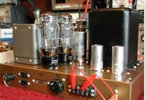
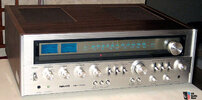
While looking at home audio gear on REVERB this morning . . .

ChasFred

Ambassador of Smooth Operations
Country flag
it occurred to me that back in the 70's and 80's we paid mega bucks for high end stereo gear that was . . . SOLID STATE yet we insisted on our guitar amps which were played in bars and other places with less than perfect sound reproduction to be tube so we could have the PURE sound.

I think I am missing something here. We listened to our music heroes with solid state systems and then HAD to have tube amps to reproduce the sound we heard. Seems just a tad asinine to me.

By the way more pictures will follow today of my tube amp build I am working on.
 
I was around 6 when he built it. They are long gone :(

In 1979 I bought this SS 175 WPC bad boy at the same time I bought a set of Wharfdale speakers. I blew out the woofers in both speakers within a year. I sold it to a guy at work in the 90s and his brother still has it.


FF6D9C4E-1118-479D-9ED9-1E2356E63E59.jpeg
 
it occurred to me that back in the 70's and 80's we paid mega bucks for high end stereo gear that was . . . SOLID STATE yet we insisted on our guitar amps which were played in bars and other places with less than perfect sound reproduction to be tube so we could have the PURE sound.

I think I am missing something here. We listened to our music heroes with solid state systems and then HAD to have tube amps to reproduce the sound we heard. Seems just a tad asinine to me.

By the way more pictures will follow today of my tube amp build I am working on.

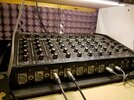
I recall growing up in my Mom's recording studio and all the old equipment there...Teac Multi Track, Tape Echoplex, Neumann U57 (?) Microphones that looked like they were stolen from the local drive-in theatre and mixing consoles with knobs instead of sliders.

The old Centaur Mixing Console in Mom's studio.:
Studio 3.jpg

What I remember most was the whacky things we did to get a good recorded tone.

I specifically recall putting an amp in an upholstered, curved back barrel chair, with a microphone on the seat cushion and the amp facing the back of the chair.

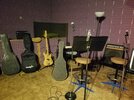
I remember going to the local egg farm in Lindsay, California and buying 1,500 egg crates to change the acoustics of Mom's studio.

This photo of Mom's old studio was taken last year and the crates are still on the job 35 years later:
Studio 1.jpg

I recall stuffing the back of a Twin Reverb with pillows to get the tone right on tape. We even put a tiny Fender amp in a plastic trash can once - with a hole cut in the side - where we stuck a SM-57.

Even using a single speaker in a box to create a kind of poor man's isolation cabinet:
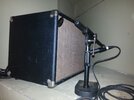
IMG_20170418_57546.jpg

At Buck Owens Studio in Bakersfield, I remember Terry Christofferson walking around with a buzzing/humming Telecaster, and producer Jim Shaw telling him over the intercom to stop moving and stand in place once the noise level dropped to its lowest.

Shaw at the console in Buck's Chester Avenue Studio in Bakersfield 1978:
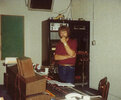
Jim Shaw.jpg

I remember we used a 150' guitar cable to take the "bright edge" off a certain Telecaster.

So much "White Magic" went into those old records and we really didn't know how else to do it. There weren't many options then.

I think when I saw Ritchie Blackmore with a Marshall Major, I suppose I thought that's what I needed to grasp that kind of tone. It took me years to save up for an SLP and, looking back, while it was quite loud, it didn't sound good at low volumes, had no effects loop, no reverb and required a pickup truck to move it.

Now we have digital studios in a PC. We also have things like the Boss E-Band JS-8 Amp Simulator (and countless more modern modeling devices) that can give you a wide range of tones with just a guitar and a cable.

I believe that tube amplifiers and passive pickups have a certain character that cannot be replicated and I feel like capturing these archaic devices - with the latest in recording software - is the perfect balance of new and old technologies combined.

I still use rather unorthodox methods to get a certain tone, whether it be a hundred feet of cable's inherent capacitance, or using a cardboard box to funnel sound into a microphone, these crazy "old world" methods creates tonal signatures that just cannot be replicated in the digital world.

Long may tube amplifiers snd passive pickups reign....
 
Last edited:
My dad was a EE and was always tinkering with something. Back in the early 60s he built 2 of these Heathkit amps and had a kickass stereo system.

View attachment 11865

Guitar amps and stereo amps have very different missions. The guitar amp is part of the music creation chain, the stereo amp is for the recreationnof that music. The guitar amp can sound like anything is wants - and distortion and weird EQ spikes are often desireable. The stereo’s job is to be as flat and accurate throughout the frequency range as possible so it can try to receeate sounds as close to the original as it can.

Plus, at the high end there have always been hi-fi tube amps. I used to own a Conrad-Johnson amp and preamp that were all-tube signal path, 100 watts per side. Giant, heavy and expensive but crushed anything solid state for sound quality and dynamics. Many hi-end amps are still tube. The receivers from the 70’s like Marantz and Technics were mid-range pieces at best, and they all had SS power sections because of the price point.
 
Guitar amps and stereo amps have very different missions. The guitar amp is part of the music creation chain, the stereo amp is for the recreationnof that music. The guitar amp can sound like anything is wants - and distortion and weird EQ spikes are often desireable. The stereo’s job is to be as flat and accurate throughout the frequency range as possible so it can try to receeate sounds as close to the original as it can.

Plus, at the high end there have always been hi-fi tube amps. I used to own a Conrad-Johnson amp and preamp that were all-tube signal path, 100 watts per side. Giant, heavy and expensive but crushed anything solid state for sound quality and dynamics. Many hi-end amps are still tube. The receivers from the 70’s like Marantz and Technics were mid-range pieces at best, and they all had SS power sections because of the price point.

I haven't heard some of those names in years!!!!
 
Last edited:
Guitar amps and stereo amps have very different missions. The guitar amp is part of the music creation chain, the stereo amp is for the recreationnof that music. The guitar amp can sound like anything is wants - and distortion and weird EQ spikes are often desireable. The stereo’s job is to be as flat and accurate throughout the frequency range as possible so it can try to receeate sounds as close to the original as it can.

Plus, at the high end there have always been hi-fi tube amps. I used to own a Conrad-Johnson amp and preamp that were all-tube signal path, 100 watts per side. Giant, heavy and expensive but crushed anything solid state for sound quality and dynamics. Many hi-end amps are still tube. The receivers from the 70’s like Marantz and Technics were mid-range pieces at best, and they all had SS power sections because of the price point.

The one's I remember most from the old days were the Fender Showman amps....that and the old Tweed Deluxes. I think there is still one sitting behind the drum screen at Mon's place....
 
The one's I remember most from the old days were the Fender Showman amps....that and the old Tweed Deluxes. I think there is still one sitting behind the drum screen at Mon's place....

well just push it to the side and I will be over for it right away.
 
you all muusta ate a SHITE TON of EGGS!
studio-1-jpg.11869
 
Back
Top