I think I already spoke at length in another thread on the same topic, but I'll say
that it makes NO difference whether you attach your capo above or below the neck.
No difference. The capo still clamps the neck and raises the pitch.
The capo allows one player to play higher up the neck and another player to
play lower down, and the different voicings make the mix between them
more interesting for the audience. That's about it.
Some of us use them all the time. I began with a capo early, as a way to
transpose the chords I knew well into a key where I could sing. Closed minded
guitarists would dis them, calling them "cheaters" for this reason.
But they are very useful for a beginning player with a limited vocal range
and a limited knowledge of chord patterns. I have spent my life disregarding
the opinions of the closed minded. It keeps a person mentally nimble, doing
this.
For the advanced player, the capo and the voicings of chords work
together to open a rich avenue for stylistic work. There is plenty
to explore, especially when you add a "partial capo" to your bag of
tricks. The one illustrated clamps three strings... where I have it gives
an open A chord with no fingers on the fretboard... but the guitar is not
tuned to an open tuning. So this adds a lot of stylistic and tonal
richness to a song when used right. And it's easy to work into.

In my group (which I recently retired from) my long time music partner would tune his guitar
a full step low, and I would play in standard pitch. So we were able to perform interesting duets
without stepping on each other, and add to this by using capos.
Sometimes I would use two: a normal capo and a partial capo, and play G pattern chords and riffs
in the key of Bb, like so:

With his down tuned guitar, Davie could play C Pattern chords and riffs
in Bb with no capo, and we'd have an interesting sound. Plus, Bb is a good
key for me, vocally.
Ya follow?
Another cool way to use the partial capo is to clamp it from the top
and press down the A, D and G strings at the second fret.
Then play chords and riffs in E using the D pattern, and getting the
voicings of that pattern plus the great low E bass note. Like this:
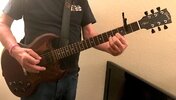
So okay, I realize that stylistically, this doesn't seem too metallic.
So metalheads can feel free to ignore it all, only those who like to
experiment with other styles might find this arcane lore useful. *grins


