Interesting.
I still don't use, have never used, and don't particularly understand the use for,
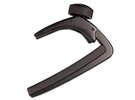
A capo.
We can't barre chord up in here, or what?
I know I'm all wrong, but I just don't get it.
Halp!
Good question. Addressing your question requires a bit of a dive into some theory...so buckle up!
For starters, let's talk about the real purpose of the capo, which is a little different than what people normally think about when they decide to use one. The actual purpose of the capo is to change the key of the guitar. In standard tuning, a guitar is in the key of C. It is not in C
oncert C, however. The most well-known example of an instrument in Concert C is the piano. The guitar is a full octave below that. This means, if you play a middle C on the guitar, it will sound like an octave below middle C on the piano So, whereas the guitar is in the key of C, it is actually an octave below Concert C. One way to prove to yourself that a guitar is in the key of C is to play music written for piano. You will be in tune with it.
Okay...so that was some background information - the bottom line being that the guitar is in a certain key, and the capo is used to change the key of the instrument.
Now, it is true that most people aren't actually thinking about changing keys when they use the capo; they are usually thinking about making it easier to play open chords in different positions on the neck.
So, why can't you just use barre chords instead?
The reason has to do with a concept called, "chord voicing." Chord voicing is the order of the note intervals in the chord. Take the open G chord. The notes that comprise that chord, from lowest to highest, are G-B-D-G-B-G. This would be the intervals 1-3-5-1-3-1. Now, consider a fully-barred G chord. Here, the notes are G-D-G-B-D-G. These would be intervals 1-5-1-3-5-1. The open C is similar. Its intervals are 1-3-5-1-3. The barre C is 1-5-1-3-5
See the difference? This is why an open G chord has a different sound than the barre G. It emphasizes different intervals. True, you could play a barre G instead of an open G and it would not be out of tune and would still work okay, but its sound - its voicing - would not be the same.
What this means is that if the key of a song is changed, and you want to preserve the voicing - the intervalic order - of the chords in the new key, the best way (sometimes, the ONLY way!) to do it is with a capo.
Now, it is true that if you play a style of music that utililizes mostly power chords, you can easily change keys and never need a capo. But, if playing styles of music that rely on more open voicings, there are times when using a capo to fundamentally change the key of the guitar is the best route to go.