What's on Your Workbench?

I need to lower the locking nut on my Jackson. I'm thinking the best method will be to grind down the back of the nut. I would rather not remove material from the neck, and I'm not sure if filing the slots themselves is advisable.

You can reduce the nut, but care must be taken to keep it square.
 
Last edited:
EVH Wolfgang Standard Nut Shelf....

View attachment 84428
Just for the sake of always learning... Rob: the angle of the shelf looks pretty square to me, taking its front wall as reference. I'm assuming that the falloff towards the back means there is an additional angle/ happening that shouldn't be there, yes? Or is it the nut bottom surface that has an angle that shouldnt be there?

In any case: what do you think would be the root cause for this, how would you address it and what would the corrective measures be? Strict QC question here...
 
And don't get me started on the Gretsch cast metal, non-magnetic screws that fail on removal.
Rob, can I ask you for some more details about the fastener itself (type, size, thread head/socket combo, material, heat treatment if any, etc.) and what kind of failure is happening (socket stripping, head shearing from body, thread stripping, etc...)? Quick aside here: more than 20 years ago, having just landed in Canada with a very young family, I got a job as a sourcing / purchasing agent for a fastener distribution company. Worked there for almost 10 years before moving on to cheffin'.

Quoting uncle Sean Connery in "Rising Sun": "perhaps I can be of assistance?" :LOL:
 
OK, can I ask you for some more details about the fastener itself and (type, size, thread head/socket combo, material, heat treatment if any, etc? Quick aside here: more than 20 years ago, having just landed in Canada with a very young family, I got a job as a sourcing / purchasing agent for a fastener distribution company. Worked there for almost 10 years before moving on to cheffin'.

Quoting uncle Sean Connery in "Rising Sun": "perhaps I can be of assistance?" :LOL:

Non-magnetic, cast (pot) metal screws in all areas, to include pickguards, tuners, truss rod covers, etc.

Most of the time, the "cross" in the phlips screw twists out when removing it.

What can you expect from a China build?
 
I've noticed that with the cheap screws too.
I recently bought new #1 and #2 Craftsman phillips just to have new / fresh tips, just for the guitar bench.
Seemed the best choice from what they stock at the nearby Lowe's.

Not high end tools but decent stuff for this type of work.
The Husky black handled screws drivers at Home Depot (which I tend to avoid for reasons I wont mention here) are pretty good too.
 
And what is the core issue, and the fix, for that EVH locking nut you posted Rob?
 
Non-magnetic, cast (pot) metal screws in all areas, to include pickguards, tuners, truss rod covers, etc.

Most of the time, the "cross" in the phlips screw twists out when removing it.

What can you expect from a China build?
OK, so if I understand correctly the issue is drive socket strippage. Am I correct in assuming that by "pot metal" and "cast" and it being non-magnetic (nonferrous?) it's a zinc or zinc alloy screw we're talking about?

Just off the top of my head I can think of a few possible causes. On this end: using a mismatched screw driver bit size / type relative to the head socket drive size / type (e.g: a #2 phillips driver bit on a #1 pozi or frearson or phil 2 screw socket); using more torque than required for the screw size, type and material; drive socket being improperly formed / stamped; screw being improperly rolled (bad thread / off-center); defective heat treatment of the screw (if applicable); the list goes on...

All in all, I concur with you that most likely it may be shoddy/cheap manufacture from the supplier. You may want to suggest to Fender to "tighten a few screws" in their overseas sourcing department and hold their suppliers feet to the fire. Pun DEFINITELY intended, BTW. :p
 
The design engineer did not do their CNC angles properly and did not build a prototype to verify the design OR the nut manufacturer changed the design later and did not inform the manufacturer.
 
In my previous life, this would trigger what we called a PDAR (part discrepancy action request) to engineering to investigate what changed (assuming the original design was done properly).
 
I've noticed that with the cheap screws too.
I recently bought new #1 and #2 Craftsman phillips just to have new / fresh tips, just for the guitar bench.
Seemed the best choice from what they stock at the nearby Lowe's.

Not high end tools but decent stuff for this type of work.
The Husky black handled screws drivers at Home Depot (which I tend to avoid for reasons I wont mention here) are pretty good too.
Yep, that happens when you factor mild low-carbon steel (1008, 1010) into the equation. mild steel screws (basically the standard for everyday use) can be easily stripped if using the wrong size driver bit or the head sheared off if using too much torque when driving it either way. A stripped bit usually signifies a low-quality heat treatment (hardening) of it.

To avoid that ALWAYS take the time to make sure the sriver bit fits snugly and without any kind of wobble (as slight as it may be) into the screw drive socket. AND that one is using the right type of bit, as they can be easily confused, especially in the cross-socket family. And that one, to the measure the budget allows, buys better-quality tools and accessories. Always better to buy best-quality once a year, than shoddy every week.
 
In my previous life, this would trigger what we called a PDAR (part discrepancy action request) to engineering to investigate what changed (assuming the original design was done properly).
Which, if my memory serves well, is intimately related to a NCR (nonconformance record/report) triggered by the mandatory qc inspection happening at the moment of receiving the product and which would trigger also a quarantining / segregation of the product in question, which would most likely lead to either a rework (bcs)/ rejection (wcs). GOTTA LOVE QA and QC, MAN!!! Applicable to ALL industries, including fasteners and food!

:2Thumbs:
 
The design engineer did not do their CNC angles properly and did not build a prototype to verify the design OR the nut manufacturer changed the design later and did not inform the manufacturer.
I would suggest to start by checking the part against the current blueprint (verify version). Specially the critical dimensions / parameters. They should match to specified tolerances: ± angle, distance, center, etc...
 
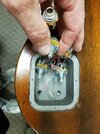
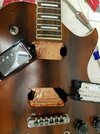
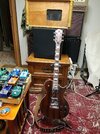
Finally got around to shielding the cavities of this AXL husk build from 2017.
The buzz was pretty loud, it is much quieter now. Not dead quiet, but much improved.

Didnt take picks with the ground leads soldered to the copper tape in the pickup cavities.
The shielding paint in the control cavity is MG Chemicals - 841AR-15ML Nickel Print (Conductive Paint). Expensive but it works.
I used shielded wire to the switch, grounded at a pot / one end only.

I have not played this one much lately and am reminded just how good it plays and sounds.
I'm leaving in Eb for now.

20220703_174428_001-2.jpg20220705_134703-2.jpg20220705_185011-2.jpg
 
Nice work, Smithy!
@Sp8ctre
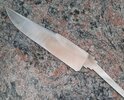
Chris, every time I see an ad spot for the show "Forged in Fire" - I think of you.
Maybe down the road you get a shot there.
 
Back
Top