
You are using an out of date browser. It may not display this or other websites correctly.
You should upgrade or use an alternative browser.
You should upgrade or use an alternative browser.
What do you use to record?
- Thread starter Heket
- Start date


If you want to multitrack record on iOS there is an app called DAW Multitrack that will do up to 24 tracks (after upgrade). It's a nice, straight forward little app that should work with the iRig. It works really well with lots of stuff actually. I've used the Apogee Jam, several USB interfaces with the apple camera kit USB adapter.I am so interested in getting started with this but cant buy equipment right now. I'm going to have another go using the Irig and Garageband.
I find that app easier to get along with than garage band...but I'm a simple, "no frills" kind of guy.

jtcnj
Ambassador of the Crossroad
Thanks Don.If you want to multitrack record on iOS there is an app called DAW Multitrack that will do up to 24 tracks (after upgrade). It's a nice, straight forward little app that should work with the iRig. It works really well with lots of stuff actually. I've used the Apogee Jam, several USB interfaces with the apple camera kit USB adapter.
I find that app easier to get along with than garage band...but I'm a simple, "no frills" kind of guy.
Ya, I struggle with the learning curve too, mainly because I want to play and record, not play around with the recording interface. Time is too precious to waste.
my Irig headphone out is not working, I tried all things my best Google-Fu could turn up.
But, I can live with just hearing my playing unplugged to get started.
For me it's all down to reliable performance in demanding situations. I have my share of recording experience.Thanks Don.
Ya, I struggle with the learning curve too, mainly because I want to play and record, not play around with the recording interface. Time is too precious to waste.
my Irig headphone out is not working, I tried all things my best Google-Fu could turn up.
But, I can live with just hearing my playing unplugged to get started.
Is your Sennheiser mic this model?Cool! I probably need to fiddle around with mic position a bit. I'm using a Sennheiser version of the SM58 which I can never remember the model number for, it's really supposed to be for vocals I think but it's the only mic I have. I also have the 2i2 and use Audacity.
I dunno, maybe it's just because of played the bass for a while now, but most guitar recording samples I've tried sound harsh and buzzy. Maybe it's mixing and EQ advice I need more of.
https://www.amazon.com/Sennheiser-D...00006I5R7/ref=cm_cr_arp_d_product_top?ie=UTF8
If you're getting "harsh and buzzy" results, and haven't already tried this...you may want to work the mic position incrementally further off the center of the speaker, while keeping the mic as close to the speaker grill as possible, and check your results as you go. I'm not personally familiar with any of the Sennheiser mic's, but the spec on that model looks good enough for rock and roll.
Recording digitally, you may want to make sure you're not recording "too hot". Try to keep your tracks absolute peak levels in your DAW(Audacity) well below 0db... Like -8 to -14db. It's easier to raise a well captured signal, and impossible to fix a digitally clipped captured signal(and digital clipping is usually considered pretty harsh sounding...even little transient ones).
Also, make sure you are not clipping at your mic pre-amp(2i2)... Leave yourself some headroom for emotional swing, and don't light up that little red light. A lot of people sound check much flatter than when they actually perform. My drummer is a prime example of that in both volume, and tempo...as am I when doing vocals...we get excited about what we're doing. Clipping that excitement, at any stage, is a bummer.
You could read for days about mixing, and eq techniques. There are lots of different sources out there, and lots of different opinions. There used to be a chart that I liked....about eq frequency and instruments...Found it:
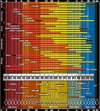
Cut what you don't like/need in frequency, and leave what you do like for each instrument...but leave room for each different voice.
Last edited:

BGood
Well-Known Member
On your 2i2 make the loudest noise you can with the instrument and adjust the gain until you never see any red around the knob, just green. Then lower it another 5°. I usually end up with the knob at around 12 o'clock.... but most guitar recording samples I've tried sound harsh and buzzy. Maybe it's mixing and EQ advice I need more of.
OP

Heket
Well-Known Member
On your 2i2 make the loudest noise you can with the instrument and adjust the gain until you never see any red around the knob, just green. Then lower it another 5°. I usually end up with the knob at around 12 o'clock.
Don't worry, I do this anyway
 There's definitely no clipping going on, if there is I re-record it. It's obvious to see if a track is clipped, even if it doesn't show up as doing so on the interface. I definitely do need to experiement with mic placement though. My issue is when in the past I've found a good sound it's been quite far away from the speaker, and amplifying the signal such a large amount afterwards in the DAW makes buzzing noises, or too much general ambient noise.
Shure SM57/58 use the same mic element mounted behind different wind screens. They are essentially the same microphone, except the windscreen on the 58 keeps the element further from the sound source etc.I am no expert on microphones, but isn't the SM58 a voice mic ? The SM57 is a dynamic designed for instruments. Could that be your problem ? Could be it is too sensitive to the frequencies of a string instrument ?
I couldn't tell you anything firsthand about the Sennheiser in question.
Last edited:
I like to use an Audix i5 for my guitar cab. The other guitar player in my band likes me to use a Shure SM57 on his.
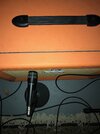
This is generally the placement I use on my Orange 1x12(I just walked down to the studio an snapped a couple of quick pics...
And from the front...
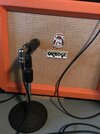
I have it way off the cone, but angled slightly toward it... mainly because of the stand positioning limitations.
For clarity, I moved it to a more visible speaker cab, with the same model of speaker installed...
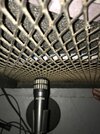
...and from the front...oops...it looks like I can't post that one for whatever reason. I'll try again next post.
edit: that's not actually the same model of speaker...now that i look at the frame with flash...same company though.
This is generally the placement I use on my Orange 1x12(I just walked down to the studio an snapped a couple of quick pics...
And from the front...
I have it way off the cone, but angled slightly toward it... mainly because of the stand positioning limitations.
For clarity, I moved it to a more visible speaker cab, with the same model of speaker installed...
...and from the front...oops...it looks like I can't post that one for whatever reason. I'll try again next post.
edit: that's not actually the same model of speaker...now that i look at the frame with flash...same company though.
Last edited:
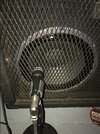
There we go...sorry for the dust, and blur, and such.
I can't get the smileys to show up today...Ah ... like we say around here, I'll go to bed less dumb tonight.
Thanks
I have had the opportunity to rip both apart before...that's what made me look in to replacement parts years ago.
just one in many disastrous learning opportunities.
eSGEe
Ferengi Ambassador of Trade
SMilies are down--- we are experiencing some technical difficulties---- we ask that you please---bear with us-----
OF course --- IT COULD HAVE BEEN THE RUSSIANS!!!!!!!!!!!!!!!!--- my dog poop in the haul last week---- he blamed Putin -----BUWAHAHAHAHAHAHAHAHAHA
in all reality the Geneva Convention forbides me to record the horrid crap I call "noodling" --- say its cruel and inhuman.....as well as inhumane
OF course --- IT COULD HAVE BEEN THE RUSSIANS!!!!!!!!!!!!!!!!--- my dog poop in the haul last week---- he blamed Putin -----BUWAHAHAHAHAHAHAHAHAHA
in all reality the Geneva Convention forbides me to record the horrid crap I call "noodling" --- say its cruel and inhuman.....as well as inhumane
BGood
Well-Known Member
http://shureblog.co.uk/faq-whats-the-difference-between-the-sm58-and-the-sm57/
Having recently compared the classic SM58 with a Beta58, it seems logical to progress forward with further comparisons. This time, we’re tackling one of the most frequently asked questions put to our technical support team: What makes the SM57 different from the SM58?
The 57 and 58 microphones are actually based on the same cartridge design. The main difference is in the grille. The SM58 was designed for vocal applications, and therefore uses a ball grille with built in pop filter to eliminate plosives.
The SM57 is designed as an instrument microphone, where a smaller grille size is more practical and plosives are less of a concern. Subsequently, the SM57 does not use a ball grille with pop filtering and instead features an integral resonator/grille assembly, where the grille is actually part of the cartridge.
Each grille design places the diaphragm of each microphone in a different acoustical environment. The distance from the top of the grille to the diaphragm is shorter on the SM57 compared to that of the SM58, which allows for a more pronounced proximity effect through closer mic positioning. Additionally, the different resonator/grille assembly design of the SM57 produces a slightly higher output above 5 kHz.
IT’S ALL A MATTER OF MICROPHONE APPLICATION
Although the SM57 was originally intended for instrument applications, there are plenty of examples through music history of it being used as a vocal microphone. This is because the increased proximity effect – and 5KHz frequency boost – can be used to the engineers advantage with certain vocalists. In other words, the same qualities that help instruments, can sometimes also bolster certain voices. It’s all a matter of what works for your application. Experimentation, and using your ears remains the key factor.
So there you have it, they’re actually pretty similar, with subtle, but potentially significant differences.
Having recently compared the classic SM58 with a Beta58, it seems logical to progress forward with further comparisons. This time, we’re tackling one of the most frequently asked questions put to our technical support team: What makes the SM57 different from the SM58?
The 57 and 58 microphones are actually based on the same cartridge design. The main difference is in the grille. The SM58 was designed for vocal applications, and therefore uses a ball grille with built in pop filter to eliminate plosives.
The SM57 is designed as an instrument microphone, where a smaller grille size is more practical and plosives are less of a concern. Subsequently, the SM57 does not use a ball grille with pop filtering and instead features an integral resonator/grille assembly, where the grille is actually part of the cartridge.
Each grille design places the diaphragm of each microphone in a different acoustical environment. The distance from the top of the grille to the diaphragm is shorter on the SM57 compared to that of the SM58, which allows for a more pronounced proximity effect through closer mic positioning. Additionally, the different resonator/grille assembly design of the SM57 produces a slightly higher output above 5 kHz.
IT’S ALL A MATTER OF MICROPHONE APPLICATION
Although the SM57 was originally intended for instrument applications, there are plenty of examples through music history of it being used as a vocal microphone. This is because the increased proximity effect – and 5KHz frequency boost – can be used to the engineers advantage with certain vocalists. In other words, the same qualities that help instruments, can sometimes also bolster certain voices. It’s all a matter of what works for your application. Experimentation, and using your ears remains the key factor.
So there you have it, they’re actually pretty similar, with subtle, but potentially significant differences.
Your room probably sounds better than mine too.Tried is your way, but I have (I think) better results with the mic basically in same position, but a foot away.
I should experiment and ... take notes.
 The method I illustrated above takes crappy acoustics most of the way out of the equation. Also, I'm set up for recording a full band live, and monitoring each other etc.
 I do occasionally set up room mic's for tracking but mostly for drums to be honest...but not usually dynamic mic's...condensers, or ribbon, or both in combination.(I always have a ribbon, and condensor set up for mid/side recording in the studio...sometimes it actually sounds good...not the performance, but the recording of it
 ...)
...)
Jim Morrison used a SM57 live often.
Pull the screen of a SM58, and you have a great(unprotected) instrument mic...but that's how I got the opportunity to learn that they used the same mic cartridge
Pull the screen of a SM58, and you have a great(unprotected) instrument mic...but that's how I got the opportunity to learn that they used the same mic cartridge