What Blues Needs (IMHO)

Fiesta Red

Well-Known Member
Country flag
This is something I posted a few years ago on a couple of other music/guitar sites, but I’d like the opinion of those who’ve never read it:

I love Stevie Ray Vaughan.
His music.
His playing style.
His tone.
His singing voice.

The instruments and effects and amps he used has affected my instrument choices (along with a million other blues and rock players) down to this day.

His battered-Strat-and-black-bolero-cowboy-gypsy image—too often imitated, and never equaled—was a spectacular package to behold.

The background story of a less-handsome little brother living in the shadow of a often-dismissive and sometimes-contentious older sibling resonates greatly with me (personally)…add the ramshackle Oak Cliff childhood and status as an outsider in his own hometown, it becomes even more resonant to me.

His initial professional struggles and failures, followed by unexpected success in a landscape of synths, drum machines and hairspray makes me smile.

The fact that he told an established superstar (David Bowie), “Thanks but no thanks, I got my own thang to do…” when it could have led to a lot of professional exposure just oozes Texas Swagger (which I love).

The fact that his ground-breaking first album was recorded in just a couple of days of studio time borrowed from another superstar (Jackson Browne), along with the tickling of my Guitar Nerddom because those studio session led to SRV discovering a rare and iconic amplifier (Dumble), which shaped his sound even further.

The story arc of alcohol and drug abuse, hitting rock bottom, then redemption through rehab, then making two more (spectacular) albums while sober, overcoming his fear of playing without some chemical help/enhancement is inspiring.

The similar and related aspect of a toxic and occasionally abusive marriage, which fell apart and was followed by a meet-cute story of literally seeing a girl on the side of the road in a foreign country and stopping to introduce himself, is a dramatic rom-com in the making.

The fact that the second album of his sober life was two full-circle moments (reuniting with Nile Rogers, who was instrumental in Stevie’s first professional success on David Bowie’s “Let’s Dance” and—probably more importantly—the first full album of playing with his big brother) deepens the tragedy and inspiration—the romance, if you will.

His untimely death, when on the brink of…well, who knows what…is tragic and painful for fans of his music as well as his bandmates and friends.
 
Part 2:

Even the melodrama of his backing band moving forward with (first) the Arc Angels and (second) Storyville, with episodes of playing with multiple guitarslingers (Susan Tedeschi, Kenny Wayne Shepherd, etc) littered along the way is interesting and melancholic.

I don’t know why Hollywood hasn’t snapped up the rights to make this into a movie. The entire story is as cinematic as award-winning biopics like The Buddy Holly Story, La Bamba (Ritchie Valens), Ray (Ray Charles) or Walk The Line (Johnny Cash).

Jimmie’s quote sums it up pretty good:
“The world misses his music, but I miss my brother.”

Not to diminish Jimmie’s relationship with Stevie or his pain, but a lot of people feel the same way, myself included.

Having said all that, there is a second aspect to Stevie’s death that I think goes just as deep and has affected the music (blues) I love so much.

Stevie’s death was a severe blow to the music world, but more so to the blues world in particular. He led the charge, the revolution, the resurrection of Blues music as a viable and profitable product in the 1980’s. His success led to wider recognition for artists who’d been around and playing music for a long time—folks like Robert Cray, whose smoother delivery and sweeter sound belied his ability to *Bring It* when the time came, and his brother’s band, the Fabulous Thunderbirds—who’d already made four of the finest blues albums in history, yet been released and relegated by their label because mainstream success eluded them. The attention given to Stevie led to attention being given to Jimmie and Kim Wilson, who were given another chance, and delivered in spades throughout the rest of the decade.
 
Part 3:
The whole Austin Blues scene—centered especially around Clifford Antone’s namesake club—was already firmly established by 1983, when “Texas Flood” was released…but the success of the disc brought more national, and eventually international attention to the scene. It grew exponentially, but still seemed to stay true to its roots. Clifford’s habit of mixing new young blood with old legendary players (like putting the T-Birds behind Muddy Waters, putting Stevie onstage with Albert King and later, dropping Sue Foley off to play with Buddy Guy and Albert Collins) continued to foster new growth while strengthening old roots, to great results. The Texas Blues scene became so dominant that a mainstream movie set in Chicago (Adventures in Babysitting), used a Texas Blues guy (Albert Collins) for an important scene, instead of drawing from the local Chicago talent that was undoubtedly available.

The Dallas and Fort Worth blues scenes (close in geography but distant in style and personnel) grew greatly as well; Houston’s pre-existing scene benefitted along the way.
Blues had a scene that could be a worldwide focal point. All was good.

However, there’s some evidence that the whole thing started crumbling when Stevie died.
Just like an old tree doesn’t die just because a limb or two cracks, it wasn’t an immediate collapse. There was great blues and blues-based music made—in Texas and elsewhere—after Stevie’s death (and there still is).

The first big problem was that a lot of people decided that somebody—anybody—needed to fill Stevie’s boots…and the second big problem was that a lot of guitarists tried.

I’m not criticizing the Vaughan-a-bees for their musicianship. Anybody that can reasonably cop SRV’s licks obviously has some talent, aptitude and ability on guitar. But by copying him note-for-note, lick-by-lick and tone-for-tone, those copyists are missing what made Stevie so revolutionary.

Stevie Vaughan copied, borrowed and stole from everybody (as all good musicians do), not just a singular source. He could have made a (reasonable) career just copying Hendrix (like Ernie Isley and Robin Trower and Lance Lopez have done)…he also sounded so much like Albert King that Nile Rogers told David Bowie, “Man, I didn’t know you wanted that on your album—if I’d known, we could have called Albert himself!” (I’m paraphrasing, don’t @me).
But Stevie wisely took a plank or a brick or a shingle from each of his heroes’ homes and made his own castle.

Listening to an album you’d hear traces of Lonnie Mack or Buddy Guy or Hubert Sumlin or Kenny Burrell or Otis Rush or Howlin’ Wolf or the aforementioned Albert King and Jimi Hendrix—or a dozen other influences…but he also sounded exactly like himself, like all those flavors were being blended up in that beat-up Strat and spewed out through a pair of Vibroverbs.
His music was impactful because it sounded familiar, but it also sounded fresh.

He was embraced by his forebears and old-time blues fans was because they could hear his respect for and homages to themselves and their peers.

He was embraced by newer blues enthusiasts because it wasn’t a fourth-generation rehash of what they’d been listening to all their lives.

Stevie sounded like old blues, but with a second gear.

But nowadays, when I hear “Latest Vaughnabee X” I think, “Not bad…now show me your second gear.”

Some have grown into it—they started out with him as a major (or even singular) influence, and matured as a musician to where his influence is still heard, but has become a piece of the puzzle rather than the whole picture.

Some have never grown beyond it, and seemingly never will. They’re not just stuck in first gear, some have put the car in park and they’re just idling.

The problem this phenomenon (“finding/becoming the next SRV”) created is that blues and blues/rock stagnated for 20 years. There was little or no growth, overall, and a large number of marginal blues fans have grown tired of the genre…and since the money isn’t made on the hard-core fans, but rather the (larger) mainstream demographic, festivals, clubs and even regional scenes have shrunk, suffered or died.

The hardcore fans (such as me) are still there; I’ve branched out and explored sub-genres that I was aware of but not well-versed in (North Mississippi Hill Country Blues artists such as Junior Kimbrough and RL Burnside, as well as their acolytes such the North Mississippi All-Stars and The Black Keys). Artists such as Eve Monsees and Mike Flanigan have come into their own, and I’ve also continued to follow the folks who were around during Stevie’s lifetime—Derek O’Brien, Lou Ann Barton, the recently deceased Denney Freeman, Sue Foley (one of my favorite guitarists), and of course, big brother Jimmie.

But I love the style and the art form, going as far back as Bessie Smith and Sylvester Weaver and on through Robert Johnson and Son House and Charley Patton and on through Muddy and Wolf and BB and…you get the point. I love blues, and I’ll keep listening to it.

So what is needed?

Well, in a way we need what we’ve been searching for—another Stevie Ray Vaughan…
No, not yet another person who plays like him, but a player who combines all the cool elements of their forebears and puts out a different-but-familiar sound that’s enjoyable across the board.
I was hoping it would be Gary Clark, Jr and Eve Monsees.

Mr. Clark has done a lot, and received a lot of mainstream attention, but his influence hasn’t become as wide-spread as SRV’s was…

I love the fact that Mr. Clark has re-opened Antone’s nightclub and Mrs. Monsees-Buck (yes, she married the Fabulous Thunderbirds’s original drummer, Mike Buck) is now proprietor of Antone’s Record Shop, but their musical influence is far from the mainstream, in total.

Blues needs a new revolution, a new scene, a new explosion…and us blues fans need it now!
 
:sleep:

I was deeply into Blues in the mid '90s up until just a few years ago. It fell off my planet and is nowhere to be found now. Seems so out of touch and far in the past these days.

Seems the 'ol 12 bar has really ran its course.

Of course this is just my .02.

(Deep apologies for growing away from blues.) :rolleyes:
 
Last edited:
Part 3:
The whole Austin Blues scene—centered especially around Clifford Antone’s namesake club—was already firmly established by 1983, when “Texas Flood” was released…but the success of the disc brought more national, and eventually international attention to the scene. It grew exponentially, but still seemed to stay true to its roots. Clifford’s habit of mixing new young blood with old legendary players (like putting the T-Birds behind Muddy Waters, putting Stevie onstage with Albert King and later, dropping Sue Foley off to play with Buddy Guy and Albert Collins) continued to foster new growth while strengthening old roots, to great results. The Texas Blues scene became so dominant that a mainstream movie set in Chicago (Adventures in Babysitting), used a Texas Blues guy (Albert Collins) for an important scene, instead of drawing from the local Chicago talent that was undoubtedly available.

The Dallas and Fort Worth blues scenes (close in geography but distant in style and personnel) grew greatly as well; Houston’s pre-existing scene benefitted along the way.
Blues had a scene that could be a worldwide focal point. All was good.

However, there’s some evidence that the whole thing started crumbling when Stevie died.
Just like an old tree doesn’t die just because a limb or two cracks, it wasn’t an immediate collapse. There was great blues and blues-based music made—in Texas and elsewhere—after Stevie’s death (and there still is).

The first big problem was that a lot of people decided that somebody—anybody—needed to fill Stevie’s boots…and the second big problem was that a lot of guitarists tried.

I’m not criticizing the Vaughan-a-bees for their musicianship. Anybody that can reasonably cop SRV’s licks obviously has some talent, aptitude and ability on guitar. But by copying him note-for-note, lick-by-lick and tone-for-tone, those copyists are missing what made Stevie so revolutionary.

Stevie Vaughan copied, borrowed and stole from everybody (as all good musicians do), not just a singular source. He could have made a (reasonable) career just copying Hendrix (like Ernie Isley and Robin Trower and Lance Lopez have done)…he also sounded so much like Albert King that Nile Rogers told David Bowie, “Man, I didn’t know you wanted that on your album—if I’d known, we could have called Albert himself!” (I’m paraphrasing, don’t @me).
But Stevie wisely took a plank or a brick or a shingle from each of his heroes’ homes and made his own castle.

Listening to an album you’d hear traces of Lonnie Mack or Buddy Guy or Hubert Sumlin or Kenny Burrell or Otis Rush or Howlin’ Wolf or the aforementioned Albert King and Jimi Hendrix—or a dozen other influences…but he also sounded exactly like himself, like all those flavors were being blended up in that beat-up Strat and spewed out through a pair of Vibroverbs.
His music was impactful because it sounded familiar, but it also sounded fresh.

He was embraced by his forebears and old-time blues fans was because they could hear his respect for and homages to themselves and their peers.

He was embraced by newer blues enthusiasts because it wasn’t a fourth-generation rehash of what they’d been listening to all their lives.

Stevie sounded like old blues, but with a second gear.

But nowadays, when I hear “Latest Vaughnabee X” I think, “Not bad…now show me your second gear.”

Some have grown into it—they started out with him as a major (or even singular) influence, and matured as a musician to where his influence is still heard, but has become a piece of the puzzle rather than the whole picture.

Some have never grown beyond it, and seemingly never will. They’re not just stuck in first gear, some have put the car in park and they’re just idling.

The problem this phenomenon (“finding/becoming the next SRV”) created is that blues and blues/rock stagnated for 20 years. There was little or no growth, overall, and a large number of marginal blues fans have grown tired of the genre…and since the money isn’t made on the hard-core fans, but rather the (larger) mainstream demographic, festivals, clubs and even regional scenes have shrunk, suffered or died.

The hardcore fans (such as me) are still there; I’ve branched out and explored sub-genres that I was aware of but not well-versed in (North Mississippi Hill Country Blues artists such as Junior Kimbrough and RL Burnside, as well as their acolytes such the North Mississippi All-Stars and The Black Keys). Artists such as Eve Monsees and Mike Flanigan have come into their own, and I’ve also continued to follow the folks who were around during Stevie’s lifetime—Derek O’Brien, Lou Ann Barton, the recently deceased Denney Freeman, Sue Foley (one of my favorite guitarists), and of course, big brother Jimmie.

But I love the style and the art form, going as far back as Bessie Smith and Sylvester Weaver and on through Robert Johnson and Son House and Charley Patton and on through Muddy and Wolf and BB and…you get the point. I love blues, and I’ll keep listening to it.

So what is needed?

Well, in a way we need what we’ve been searching for—another Stevie Ray Vaughan…
No, not yet another person who plays like him, but a player who combines all the cool elements of their forebears and puts out a different-but-familiar sound that’s enjoyable across the board.
I was hoping it would be Gary Clark, Jr and Eve Monsees.

Mr. Clark has done a lot, and received a lot of mainstream attention, but his influence hasn’t become as wide-spread as SRV’s was…

I love the fact that Mr. Clark has re-opened Antone’s nightclub and Mrs. Monsees-Buck (yes, she married the Fabulous Thunderbirds’s original drummer, Mike Buck) is now proprietor of Antone’s Record Shop, but their musical influence is far from the mainstream, in total.

Blues needs a new revolution, a new scene, a new explosion…and us blues fans need it now!
Well, Gary Clark jr. isn't the man to do it. To me he's just OK. People like Samantha Fish? OK, but not great. They broke the mold when they made Stevie Ray. There will never be another. He had it. The right combination, and expression of influences and nobody put it together like him.

I saw Stevie, Robert Cray (whose from my hometown) and Bonnie Raitt inth the same show along with a local act or two. The event started around noon, and Stevie of course was the last act. His set didn't start until just before dusk and he played until about 4am. Voodoo Chile I swear was like 20 minutes long, and for me was the standout from the whole show. I think that was in 1985.

My favorite SRV guitar solo is on China Girl.
 
In my opinion Blues music is not dead, but is certainly missing from the mainstream popularity.
Last year KEXP radio station took my favorite program off the air
"Preaching the Blues" with Johnny Horns as host ran for 20 years or so 9am to noon on Sunday morning in Seattle.
3 hours of eclectic Blues songs and stories.
About the time they started to simulcast with a station in San Francisco they dropped the show.
They moved Greg Vandy's Roadhouse from Wednesday night to Sunday morning.
Greg Is a good DJ, but I have only listened to his show a time or two since the move
Fwiw Gary Clark said in an interview that I read recently he never wanted to be pigeonholed as strictly a blue player
Just my 2c
 
Wow, well written detailed sentiments/overview! Although he's obviously most renowned for his playing, I honestly think what really took SRV over the top was his overlooked vocals (same with Clapton). Everyone acts like they are just serviceable vocalists who can color the music around the licks but seriously try to find a singer who can cover them 75% even while not playing an instrument... Both of them could have gotten hired as lead singers in blues bands even if they never picked up a guitar in their life. If SRV couldn't sing it would've been a pretty tough road to plow carving out a Jeff Beck-Trower type career path especially without the luxury of gaining prominence in the 60's and early 70's when there was far less competition. If he couldn't have occasionally played with The Fabulous Thunderbirds and his brother wasn't prominent, he probably would've ended up as a house blues guitarist for some bar somewhere.
 
Very interesting read. I have always been a blues rock/hard rock guy, but only in recent years have I started getting into actual blues. I have to admit, I was never much of a SRV fan, but I always appreciated what he did. After reading these posts, I may need to take a second look. I just learned way more than I ever thought I would about him.
 
Very interesting read. I have always been a blues rock/hard rock guy, but only in recent years have I started getting into actual blues. I have to admit, I was never much of a SRV fan, but I always appreciated what he did. After reading these posts, I may need to take a second look. I just learned way more than I ever thought I would about him.
His “hits” were hits for a reason…they were great, catchy tunes. However, grab one of the albums he made in his lifetime and listen to the whole album; the deep tracks are “where it’s at”…I’ll include his “The Sky Is Cryin’” disc, even though it is a compilation of unreleased recordings that were put together after he died; it made for a good, cohesive album, even if it was not all made at the same time.

Texas Flood
Couldn’t Stand The Weather
Soul To Soul
In Step
The Sky Is Cryin’ (posthumous compilation)

The Vaughan Brothers “Family Style” was a little different, but still had some great tunes. (Full disclosure: I’m a huge Jimmie Vaughan fan and I play more like Jimmie than Stevie, so that may color my judgement…some people don’t like that album, and that’s ok—if they want to be wrong)

“Live Alive” was kinda messy (too many drugs and drinks and studio overdubs to fix problems with the live performances), but there’s some notable/great moments, including Bill & Ruth Carter’s “Willie The Wimp” and Stevie Wonder’s “Superstition”.

His two “Austin City Limits” performances and two “Montreux Jazz Festival” performances are better documents of his live work, IMHO…some of the second Montreux festival (1986?) show ended up on Live Alive.
 
Your point is really thought provoking that maybe FT hits like "Tough Enuff" or "Wrap it up" wouldn't have much of a shot without SRV making blues prominent again... I honestly think because of ZZ Top Eliminator it still would've but without them literally all you would have is Madonna and George Michael in the mid-late 80's lol.
 
And Robert Cray and George Thorogood and Albert Collins and BB King and Otis Rush and….

That era brought attention back to the old and not-so-old blues guys who were still alive, and renewed interest in the ones who’d already passed away.

Shoot, Buddy Guy hadn’t recorded in a decade, but the revival + Stevie getting after him to get back into the studio gave us one of the finest blues albums of the 1990’s in “Damn Right I Got The Blues”

Some of those great Chess box sets (Muddy, Wolf, Dixon, etc) wouldn’t have happened had that early 80’s blues revival not happened.

It wasn’t all SRV, but he sure was in the forefront of it.
 
The "blues" is a tired old swaybacked nag.

Everything has it's time. 5% is timeless.

I preferred the Lowe and Edmunds produced output of the T-Birds. And Jimmie's solo stuff along with the Vaughan Bros. record.

Stevie had his time. His time is long passed.
 
If he couldn't have occasionally played with The Fabulous Thunderbirds and his brother wasn't prominent, he probably would've ended up as a house blues guitarist for some bar somewhere.
I hate name dropping but I was high school buddies with Fran Christina (Fabulous Thunderbirds drummer) and jammed with him and Duke Robillard many times long before Fran played with Asleep At The Wheel and the T Birds. Robillard is well known for creating the band Roomful Of Blues that (almost won a Grammy Award) and then he replaced Jimmy Vaughn for a while in the T Birds.

Damn! That was a long time ago! It all comes down to being in the right place at the right time and being willing enough to chase the dream.
 
I hate name dropping but I was high school buddies with Fran Christina (Fabulous Thunderbirds drummer) and jammed with him and Duke Robillard many times long before Fran played with Asleep At The Wheel and the T Birds. Robillard is well known for creating the band Roomful Of Blues that (almost won a Grammy Award) and then he replaced Jimmy Vaughn for a while in the T Birds.

Damn! That was a long time ago! It all comes down to being in the right place at the right time and being willing enough to chase the dream.
A friend of mine is Duke's current singer. Back in '79-'82 or so, we'd go see Roomfull of Blues every Tuesday night at Lupo's Heartbreak Hotel in Providence, RI. It was "All you could drink Tuesday" for $5.00 cover charge, If you lost your cup, you'd have to pay the cover charge again. I saw Duke with J. Geils once. The were both on stage with a couple of big old Arch Top guitars playing old jazz and blues standards. No other musicians with them. One of the best shows I've ever seen.

I would have liked to have seen what would have happened as Stevie got older, and who he would have played with. Same goes for Hendrix, as he was also going towards jazz, deeper into the blues, as Jimi was playing with folks like Doriella Du Fontaine of The Last Poets. Similar to the Duke Robillard and Jerome Geils show I saw.
 
Last edited:
My guitar teacher turned me on to Texas Flood when it was released you love Hendrix you'll love Stevie
I got talked into building 150 watt #007 Steel String Singer three years of my life gone at the end of it could have just used a Marshall Major and got close enough
Todd Sharp had a extra set of Altec transformers but wanted $2500.00 plus $550.00 shipping so I had custom transformers made ten sets of each
then the chassis made built the board sets and the components that Dumble used it cost me thousands
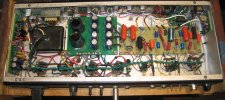
I did build Black Velvet ODS 100 watt a clone of the Dumble amp that SRV used on his first tour that Jackson Browne let Stevie barrow
end of the journey learned a wealth of information
Heck my Robin Ford #102 build 90% their fined tuned the components called My friend Robert amp tech of the stars he found me a set of 28 year old NOS Magic Parts transformers nailed it let a friend use it lasted three world tours then the NOS set of 6L6GC USA made power tubes wore out tried every new production tube
never sounded the same.

ODS-100 High Plate Classis 001.JPG
 
Back
Top