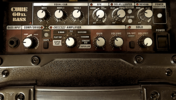
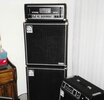
Can’t wait to hear it brother !!todays set up for recording session for next song.. picked up tight rhythm. No room mic this song. View attachment 34953

Can’t wait to hear it brother !!todays set up for recording session for next song.. picked up tight rhythm. No room mic this song. View attachment 34953


Y'all have definitely got some excellent toys to play with! Because of lower back issues, I traded my Ashdown 300 watt 2x10 combo about 3 years ago for a Fender Rumble 40, and have actually played it in a 4 piece band at a benefit for my granddaughter. It's loud, clean, and has an xlr out in case I can't to run through a p.a. system.18 lbs! Weirdly enough, it sounds very much like the Ashdown.


I've heard a lot of good things about the Roland bass cube. But that Jazz bass of yours took my breath away! Gorgeous! Bet it sounds as good as it looks!In all the recordings I've done, I simply plugged my bass straight in to the
engineer's console, and let him mix it. Most of those recordings were done with
a Fender Jazz Bass 1966, which gives a tone that can't be "improved..."
Simple and easy, just concentrate on getting the notes and the timing and the
riffs right.
After I turned 60 I got rid of all the heavy stuff... being a bassist for years meant
that I was used to carrying heavy boxes around, thought of it as part of the job.
I was convinced that a bassist needed to play through a 15" speaker.
But about ten years ago, I was at an event where several bands played on the same stage.
All of us bassists consulted with the sound man and concluded that we'd all play through the
same rig. This helped the sound man who had multiple mixes to arrange, it helped
the transitions because once we got that one bass amp dialed in, we left it there and
the sound man could mix it with all the groups. Each of us checked it out, and had our
own tone setup we could set it to. It was a Roland Cube bass amp, with a lot of
modeling features that I didn't use. I figured out how to get my tone on it very quickly
and so I had some level of confidence after the sound check.
At first I had my doubts, because the Roland used 1/10" speaker and a couple of ports.
But it also had an XLR out, so that went right to the board. Play that through the mains
and it doesn't sound small at all.
The evening went along and I played my set, and I decided that there had been some
improvements in bass amp technology for the 21st century. Up to then I'd been using
a Fender Bassman Compact 1/15, which was an excellent solid state amp that could
do any venue I was invited to play. Large stages, we'd mike it. But after playing the
Roland, and after listening to the other bassists playing through it and the P.A.
I decided I had to have one. I bought a Roland Cube Bass amp. They make several
sizes... mine's the sixty watt version. I can pick it up with one hand.
In all my long years of performing, I don't think I've ever played loud enough to
distort any decent bass amp I had. I've always had to be part of a mix, and figured it
was my job to play clean as possible. So I did... the Fender J-bass excels at this.
I've distorted some guitar amps I played through,
that sounds like "amp failure" to me, and I don't like the tone.
Especially if it's my amp. It sounds like destruction.
So I like the Roland because it has some features... it has a LOT of features. It's a
modeling amp. I used to own some bass pedals, but I sold all those after getting the
Roland. The features sound pretty good to me. My approach to "features" on a bass
amp is to use the barest minimum of any of them. It's got chorus, delay, overdrive and
compression. The first time I used the Roland, it was somebody else's amp. So I
zero'd out the 'features" and ran it flat, and controlled my tone with the controls on my
Fender bass. That worked fine. Keep it simple, stupid...
After I bought my own ( I sold the Fender Bassman to a young guy for $100, he was
delighted) I spent some time checking out the Roland effects, and the different modeling
settings on this amp. I like the tone I can get using the least possible setting... I turn
the chorus until the light just comes on, then turn it back till it just goes off, then one
more tiny tweak... and the same with the delay. For some songs I'll turn up the drive
and get a little bit of that in my signal without busting any eardrums. And the compression
works very well. The ports on the bottom also work very well. That's my amp.
View attachment 37107
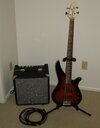
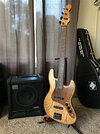
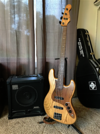
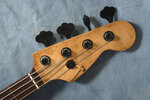
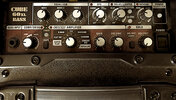
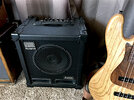
Here's my Warmoth Fretless J-bass with my Roland CBXL-60. I can plug the Warmoth
right into the recording desk, or use the XLR out if I want the tone of the amp.
It models a lot of amps that I wouldn't use... I usually use the Fender Bassman setting
because it sounds like my tone. If any maker can get models and effects right,
it's Roland IMHO. They make Boss pedals.
Some Bassists turn their noses up at modeling amps, and using effects, but sometimes after
a show, people will come up and ask me about my bass tone, and tell me it was
interesting. And that's what I want. NOT to be too loud, NOT to cut through the mix,
but to be part of the mix, and add something that the audience finds interesting.
I'm sticking with this one because it does something my old Fender Bassman couldn't do...
It sounds great running at 3. The old Bassman like to be running at 8 or so, much too loud
for most gigs I ever played. The old Fender never was happy running at three.
In all the recordings I've done, I simply plugged my bass straight in to the
engineer's console, and let him mix it. Most of those recordings were done with
a Fender Jazz Bass 1966, which gives a tone that can't be "improved..."
Simple and easy, just concentrate on getting the notes and the timing and the
riffs right.
After I turned 60 I got rid of all the heavy stuff... being a bassist for years meant
that I was used to carrying heavy boxes around, thought of it as part of the job.
I was convinced that a bassist needed to play through a 15" speaker.
But about ten years ago, I was at an event where several bands played on the same stage.
All of us bassists consulted with the sound man and concluded that we'd all play through the
same rig. This helped the sound man who had multiple mixes to arrange, it helped
the transitions because once we got that one bass amp dialed in, we left it there and
the sound man could mix it with all the groups. Each of us checked it out, and had our
own tone setup we could set it to. It was a Roland Cube bass amp, with a lot of
modeling features that I didn't use. I figured out how to get my tone on it very quickly
and so I had some level of confidence after the sound check.
At first I had my doubts, because the Roland used 1/10" speaker and a couple of ports.
But it also had an XLR out, so that went right to the board. Play that through the mains
and it doesn't sound small at all.
The evening went along and I played my set, and I decided that there had been some
improvements in bass amp technology for the 21st century. Up to then I'd been using
a Fender Bassman Compact 1/15, which was an excellent solid state amp that could
do any venue I was invited to play. Large stages, we'd mike it. But after playing the
Roland, and after listening to the other bassists playing through it and the P.A.
I decided I had to have one. I bought a Roland Cube Bass amp. They make several
sizes... mine's the sixty watt version. I can pick it up with one hand.
In all my long years of performing, I don't think I've ever played loud enough to
distort any decent bass amp I had. I've always had to be part of a mix, and figured it
was my job to play clean as possible. So I did... the Fender J-bass excels at this.
I've distorted some guitar amps I played through,
that sounds like "amp failure" to me, and I don't like the tone.
Especially if it's my amp. It sounds like destruction.
So I like the Roland because it has some features... it has a LOT of features. It's a
modeling amp. I used to own some bass pedals, but I sold all those after getting the
Roland. The features sound pretty good to me. My approach to "features" on a bass
amp is to use the barest minimum of any of them. It's got chorus, delay, overdrive and
compression. The first time I used the Roland, it was somebody else's amp. So I
zero'd out the 'features" and ran it flat, and controlled my tone with the controls on my
Fender bass. That worked fine. Keep it simple, stupid...
After I bought my own ( I sold the Fender Bassman to a young guy for $100, he was
delighted) I spent some time checking out the Roland effects, and the different modeling
settings on this amp. I like the tone I can get using the least possible setting... I turn
the chorus until the light just comes on, then turn it back till it just goes off, then one
more tiny tweak... and the same with the delay. For some songs I'll turn up the drive
and get a little bit of that in my signal without busting any eardrums. And the compression
works very well. The ports on the bottom also work very well. That's my amp.
View attachment 37107

View attachment 37119
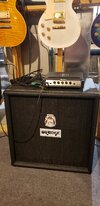
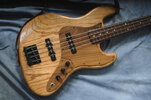
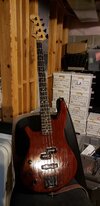
Can't believe I didn't put a pic of this pig up here after I finished it. I'm typically running both pickups wide open through the Ampeg PF350 and Orange 410 cab with no effects. Been using a Sennheiser E609 mic on the cab with good results so far. I haven't played with direct out yet.
That’s funny when you said.Love the grain of the wood!
Beautiful bass ya got there Cadorman! :dood:
Heck of nice strap too!
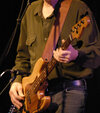
I found when I play bass, I get a bit more animated body wise, I think due to the effort to fret the notes.
Seeing those strap lock made me think I might be needing a set..
That’s funny when you said.
I get more animated!!
I was looking at one of my clips of a tune called #2, I have a bridge portion in the song where I have to keep my pinky on the 9’th fret and hold the D-G stings of an E power chord, then the index finger descends on the A string from the 7’th fret to the 4’th fret, in the progression, lol I lean funny and have an awkward bit of arm movement ha ha ...