RVA
Ambassador
Ok, so looking at the above idea come together I will say this
- Definitely ambitious and eclectic and interesting
- Each idea is a good one
- It is a lot of ideas/components to the end guitar, which adds a larger degree of unpredictability
- Unpredictability is not your thing. You are particular and like things within tight tolerances. For instance, even your #s for the pickups are precise. If in your mind you think you know how they will sound, you are likely mistaken, even if you have chosen the model and brand and get those #s. Again, too many variables.
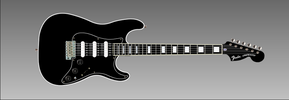
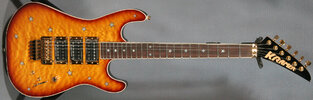
- Three HBs in a guitar is again, unpredictable as to sound. You are cramming pups in there, now over a floyd. Potential placement over strings, etc., leaves a lot of room for variation.
So, if I were a betting man, and I am not, and if you were not in the "room", which you are, I would bet that ultimately, when it is all done, Robert says he dislikes the guitar and is dissapointed.
The truth is, I like you very much and I want this project to succeed. I say you should keep it simple. There are too many ingredients in the soup.
You chose mahogany, which is my personal favorite for looks and to work with when modding. But if is painted, I will take alder or swamp ash just as readily. This leads me to my personal journey with tone wood, not because it is so important here, or I wish to change anyone's mind, but because it relates to the above. There was a multipart video, and in my opinion reasonably unbiased, analyzing whether wood resulted in different tones. There were some interesting experiements which I thought showed some differences, as confirmed by other videos I had seen. I was on the edge of my seat. In the end, the experiment concluded that any difference was so marginal, that it was guaranteed to be obscured by so many other things, like guitar wiring, patch chord length, pedal impedence, all the crap that goes on inside an amp (like tube choice and age and matching and biasing), amp placement, room acoustics, etc. In the end, he said it would be too small a variable to matter. I agreed. To this I added that the listener barely knows the difference between a guitar and a bass, much less a 3/4" maple cap from all hog. So I never cared again, not even a little. I will do credit to Biddlin here, who is the one who got me thinking about this in the first place (story for another time). Could you imagine, even the best of musicians and luthiers among us standing together, listening to you play and saying "hey, you have an orange drop cap in there don't you" or "That must be a brazilian rosewood fretboard, not that east indian crap!!!!!" No, never, not going to happen.
Focus on playability, free your mind of these matters, look the crowd in their collective faces, and ROCK!
This is the semi-humble opinion of a man who plays in his basement.
- Definitely ambitious and eclectic and interesting
- Each idea is a good one
- It is a lot of ideas/components to the end guitar, which adds a larger degree of unpredictability
- Unpredictability is not your thing. You are particular and like things within tight tolerances. For instance, even your #s for the pickups are precise. If in your mind you think you know how they will sound, you are likely mistaken, even if you have chosen the model and brand and get those #s. Again, too many variables.
- Three HBs in a guitar is again, unpredictable as to sound. You are cramming pups in there, now over a floyd. Potential placement over strings, etc., leaves a lot of room for variation.
So, if I were a betting man, and I am not, and if you were not in the "room", which you are, I would bet that ultimately, when it is all done, Robert says he dislikes the guitar and is dissapointed.
The truth is, I like you very much and I want this project to succeed. I say you should keep it simple. There are too many ingredients in the soup.
You chose mahogany, which is my personal favorite for looks and to work with when modding. But if is painted, I will take alder or swamp ash just as readily. This leads me to my personal journey with tone wood, not because it is so important here, or I wish to change anyone's mind, but because it relates to the above. There was a multipart video, and in my opinion reasonably unbiased, analyzing whether wood resulted in different tones. There were some interesting experiements which I thought showed some differences, as confirmed by other videos I had seen. I was on the edge of my seat. In the end, the experiment concluded that any difference was so marginal, that it was guaranteed to be obscured by so many other things, like guitar wiring, patch chord length, pedal impedence, all the crap that goes on inside an amp (like tube choice and age and matching and biasing), amp placement, room acoustics, etc. In the end, he said it would be too small a variable to matter. I agreed. To this I added that the listener barely knows the difference between a guitar and a bass, much less a 3/4" maple cap from all hog. So I never cared again, not even a little. I will do credit to Biddlin here, who is the one who got me thinking about this in the first place (story for another time). Could you imagine, even the best of musicians and luthiers among us standing together, listening to you play and saying "hey, you have an orange drop cap in there don't you" or "That must be a brazilian rosewood fretboard, not that east indian crap!!!!!" No, never, not going to happen.
Focus on playability, free your mind of these matters, look the crowd in their collective faces, and ROCK!
This is the semi-humble opinion of a man who plays in his basement.
Last edited: