
You are using an out of date browser. It may not display this or other websites correctly.
You should upgrade or use an alternative browser.
You should upgrade or use an alternative browser.
USA Made Quality Control:
- Thread starter Inspector #20
- Start date

OP


You have yourself some nice toys there. I have hand tools and a hack saw. I am officially jealous.
I have supported two drift car teams as tuner and lead fabricator. It was fun at the time, but ot gets old quick...

chilipeppermaniac
Ambassador of Decibels
I have supported two drift car teams as tuner and lead fabricator. It was fun at the time, but ot gets old quick...
This is why I figured you could come up with a solution once you put anger out and logic and creative thinking in.

Cadorman
Ambassador of the Catocaster
Are you positive the PCM doesn't need to see the voltage oscillate? The GM's did back in the late nineties to mid 2000's.Ok,
So on a Ford of this vintage. the rear oxygen sensors serve only one purpose - to tell the PCM that the catalysts are operating within an specified efficiency parameter. They are part of the catalyst monitor circuit. Knowing the Ford PCM sends an approximate 5VDC reference signal to the oxygen sensor, its signal voltage jumps up to 0.8 to 0.9VDC when the air/fuel mixture is rich, and drops to around 0.3 volts or less when the air/fuel mixture is lean.
By incorporating a 1 MegΩ resistor and a 1.0uF capacitor, I can send a constant 0.5 to 0.6VDC signal to the PCM. which would staisfy the catalyst monitors and prevent a CEL even if the car had no catalysts at all....
chilipeppermaniac
Ambassador of Decibels
What the heck is that? Cador

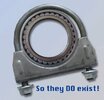
Yeah, but the shiznit is a "water cooled" muffler bearing.Hey Robert. Would one of these help! View attachment 36334
OP
Are you positive the PCM doesn't need to see the voltage oscillate? The GM's did back in the late nineties to mid 2000's.
'Cross Count' strategy began in 2007 for Ford....
OP
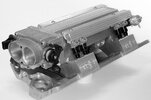
Basically, back in the day a GM engineer snuck a pre-production LT-1 intake manifold out of the factory and we magically got our hands on it and designed a version for the standard small block chev. Of course he got fired.
One of Dad's chums was Chevy engineer Gerry Thompson...we had a lot of 'skunk works' components.
chilipeppermaniac
Ambassador of Decibels
Basically, back in the day a GM engineer snuck a pre-production LT-1 intake manifold out of the factory and we magically got our hands on it and designed a version for the standard small block chev. Of course he got fired.
No great loss, it was a GM firing.

Chubbles
Ambassador of Sarcastic Tone
Poor quality control is an international epidemic. "Made in America" used to be a guarantee of quality. It no longer is.
When I was growing up, "Made in Japan" was a bad thing. Now it costs more for Boss pedals made in Japan (Waza, I think). Who knows, made in China may be next. I'm holding on to my Harley Benton. Anyone wanna buy it now for 10K?
When I was growing up, "Made in Japan" was a bad thing. Now it costs more for Boss pedals made in Japan (Waza, I think). Who knows, made in China may be next. I'm holding on to my Harley Benton. Anyone wanna buy it now for 10K?
Last edited:
chilipeppermaniac
Ambassador of Decibels
Cador, In case you wonder why I am Partially anti GM, it is because once I saw a cutaway of a Northstar engine. THOSE GM engineers designed an engine where you had to take half the top off to get to a starter if you ever had to put a new one in. WHO DOES THIS?
chilipeppermaniac
Ambassador of Decibels
lol i drive f100, f150, f250, n hondas all 1994 and earlier.
