Unmatched Humbucker Coils and Different AWG's - How Far Can I Go???

Wow....I stumbled onto a really good combination and totally by accident.

Reluctantly, I installed the Artec Classic Standard tonight. I've had this pickup for at least a couple of years. I am not sure where it came from. This is one of the Artec Milestone Series, designed for Artec by Gibson's Wolfgang Damm - Father of the P-94 - and now running his own company, Amber Pickups.


Artec Classic Standard.jpg

Originally, this had a rough cast, short A2 magnet, which I replaced with a long, polished A4. It has wood spacers and spec'd out to 8.01k.

I reversed the magnet polarity to make this play 180 degrees out-of-phase in the #2 switch position only.

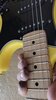
So, tonight, at the urging of @syscokid, @ivan H and @gball , I went ahead and installed it in YelloStrat.

I am using 500k Alpha Mini Pots and 0.01uf Box capacitors.
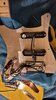
20210120_200327.jpg

The single coils are also Artecs. They are a unique, hum cancelling single that uses bar magnets and screw pole pieces - like a humbucker - so you can mount them right under the strings with no magnetic pull issues.
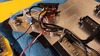

20210120_200343.jpg

I was fully expecting this to be a disaster, but when I plugged it in, I was shocked. It just had the most vibrant and open sound. Very bright and Strat-like if you hit the strings hard, but amazingly dynamic and sensitive to your picking technique. I also felt as if the notes were cleaner coming from this pickup, when compared to the other "hot" ceramics that I have been trying. I was starting to feel like this was just a dull, lifeless guitar and that nothing would improve upon that characteristic, but this pickup really changed everything. Even the guitar's sustain was improved.

Despite being unpotted, I played them through my live rig, sitting right in front of the amp, and I got zero feedback even at high gain.

I pulled an E-Minor backing track off YouTube from "MyDarnJamTracks" and plugged into my Blackstar ID-Core 100, direct out into Audacity.

I performed no post-recording editing. This is just some random noodling to the backing track and there really isn't any kind of structure to it, so please just evaluate the tone and not the mistakes.

P.S. I just installed a brand new set of "Bella Benders" tonight and they really turn your fingers black!!!


20210120_233042.jpg

Really curious to get your collective opinions on this Frankenstein humbucker!!!

@Don O , @Gahr
 
Last edited:
Interesting thing about baseplate materials...

Brass baseplates seem to inject more overtones into a note in general terms. This is one reason (I think) we see brass almost exclusively on pickups with ceramic magnets, because ceramics already have a certian 'sterility' in theie tonal properties.

Overtones to me are an absolutely fascinating aspect of the guitar. I've been reading as much as I can find on the subject in hopes the knowledge may help me discover something.

The high 'e' string on a normal 6 string electric guitar has a fundamental frequency of approximately 330Hz. But if you play the same string at the 12th fret you will be playing one octave higher. An increase of an octave is a doubling of frequency to roughly 660Hz. Even though the lowly 'e' string's fundamental frequency may be 330Hz, the same string is also simultaneously vibrating at other 'harmonic' frequencies, simple multiples of the fundamental. So the second harmonic is twice the fundamental frequency (approximately 660Hz, the same as fretting the same string at the 12th fret) and there is also a third harmonic (approximately 990Hz ) and so on.

The relative volumes of these overtones to each other determines the specific "flavor", "color" or "tone" of an instrument, chord of phrase. So, these overtones can give the listener a sense of "fullness" or "complexity" to even a common note or phrasing played on the guitar.

Any metal within the magnetic field of a pickup will have an influence on that magnetic field, and will itself induce small electrical currents known as eddy currents. Nickel silver is less conducive to eddy currents and is the first choice for that reason. Brass baseplates have a tendency to darken the tone more than nickel silver, but that could be a good reason to use brass if that is the effect you are looking for.
Fender Telecaster pickups often have copper plated steel for baseplates. This also will darken the tone, but the end result sounds good and helps to give the telecaster it’s unique voice. Which overtones are present, and in what ratio, is what determines the Timbre or "tone quality" (or tone color) of an instrument).

AlNico magnets tend to produce more overtones than ceramics. Nickel-silver baseplates tend to give a "cleaner and brighter" tone and doesn't seem to introduce harmonics that might not be wanted. Jazz musicians, famous for their use of complex chordings, may not want additional overtones, as it can make a complex chord sound out of tune.

Potting is another matter. Wax is put into a pickup to keep the windings from vibrating and causing a microphonic squeal or "feedback." The original Gibson PAF's - often thought of as the Holy Grail's of pickups) were not potted. The consensus is that unpotted pickups (like Duncan Seth Lovers) give an "openess" that many describe as "lively" or "touch responsive." Other perceive a slightly more vibrant tone, or being more sensitive to the relatively weaker tonal components of the strings’ vibrations, such as harmonics and overtones. Additionally, they may better project the acoustic tone of the instrument, being more microphonic than the potted pickups.

Of course, the fly in the ointment is squeal or feedback under very high volume and gain applications. Wax potting does help to prevent or minimize this, but it does seem that a potted pickup seems less "complex" and somewhat less exciting to the ear.

Many say that pickups can be made feedback resistant by ensuring adequate tension of the windings on the bobbins and that wax potting is a "band-Aid" for sloppier, high-speed production techniques and one reason to justify the high cost of hand-wound, custom pickups that have better tension and placement/stacking of the windings on the bobbins.

At any rate, this has been an interesting journey and I cannot wait to test this YelloStrat out at an upcoming live, outdoor event at screaming volume levels....
 
Ok,

So, when we look at the early EVH, he used a PAF that, even when winds were allegedly added, was still a super-low ohm pickup, a Variac to reduce the operating voltage of his Marshall, which resulted in a very clean, articulate sound.

George Lynch used a JB SH4 which is wound very hot and the famous Tim Caswell modded #39 Marshall and a TS-808 for a much higher gain sound.
 
Back
Top