Uke Bridge Problem... Need Sage Advice

SIx String Chef

Ambassador of Taste
Country flag
So... my wannabe-Stepson-in-law knows I am delving into the whole guitar tech and repair thing, so he brought up to my home shoffice (workshop/office) a Kala brand uke (I think it's a soprano, all mahogany, model KA-C) that he's had for some time, for me to give it a once-over and see if I can help him fix the strings constantly going out of tune and whatever else I could find.

So, I did the perfunctory cleanup, fret polishing, fretboard oiling, machine head tuner nut tightening, cutting off the excess nylon string, etc. Also rewound the strings properly on the tuners, as the 1st and 2nd were wound the wrong way. This, along with constant retightening and stretching of the strings, seems to have made the strings keep their tuning.

However... The 3rd string (from bottom up), C, has that distinctive sitar-y not-quite-the-right-note-pitch-no-matter-how-fine-you-tune-it double-y note sound that to me spells some bridge issue.

I'm thinking the lack of visible slotting for the strings on the bridge may be to blame, but all the other strings sound decent. So, what say you, TTR brethren?

As usual, would really appreciate your words of wisdom and guidance to fix this issue.
 
So... my wannabe-Stepson-in-law knows I am delving into the whole guitar tech and repair thing, so he brought up to my home shoffice (workshop/office) a Kala brand uke (I think it's a soprano, all mahogany, model KA-C) that he's had for some time, for me to give it a once-over and see if I can help him fix the strings constantly going out of tune and whatever else I could find.

So, I did the perfunctory cleanup, fret polishing, fretboard oiling, machine head tuner nut tightening, cutting off the excess nylon string, etc. Also rewound the strings properly on the tuners, as the 1st and 2nd were wound the wrong way. This, along with constant retightening and stretching of the strings, seems to have made the strings keep their tuning.

However... The 3rd string (from bottom up), C, has that distinctive sitar-y not-quite-the-right-note-pitch-no-matter-how-fine-you-tune-it double-y note sound that to me spells some bridge issue.

I'm thinking the lack of visible slotting for the strings on the bridge may be to blame, but all the other strings sound decent. So, what say you, TTR brethren?

As usual, would really appreciate your words of wisdom and guidance to fix this issue.

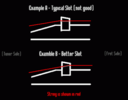
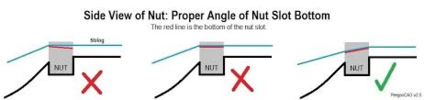
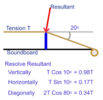
The break angle of the string over the nut, or over the bridge saddle.
Slotting the saddle does not usually fix that problem unless the slot is cut at the correct angle...

1647296337571.png
1647296469005.png
1647296580036.png

And so if you are getting sitar sound, it's probably because the string is flat over the saddle and there is no proper break angle.
 
The nut slot may be to deep. If is is a bone nut, consider the baking soda/superglue trick

The baking soda fix is temporary. I prefer, in a pinch, to use the same material as the nut & superglue, but still it's a temporary fix. Touring techs use that method a lot because they are unlikely to have a combo sander and nut material handy like a luthier's or tech's shop. The baking soda, or dust trick, is great for a quick diagnosis though. It will confirm quickly if that is indeed the source of unwanted noises.

The best solution, when possible, is to just make a new nut out of a blank. IMHO YMMV
 
Last edited:
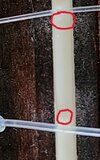
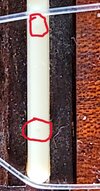
HEre are a few pictures of the bridge and nut.

Strings 4 and 3
Uke Bridge dimples 01.jpg

And strings 2 and 1
Uke Bridge dimples 02.jpg

the bridge is basically unslotted, save for a very slight dimple for each string (shown in the red highlights). I'm guessing this may have happened just by the pressure the strings apply on the bridge, not by design.

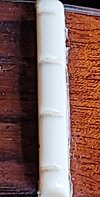
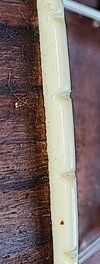
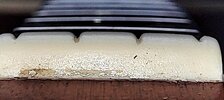
The nut slots seem to be pretty much at very best quite flat, but It seems to me that they slope from the back toward the fretboard, leaving the break surface at the back, if any at all. Depth in the back of the outside slots is shallower, i'd like to think, to accomodate the thinner gauge strings.

Uke Nut 01.jpg

Uke Nut 02.jpg

Uke Nut 03.jpg

Thoughts?
 
HEre are a few pictures of the bridge and nut.

Strings 4 and 3
View attachment 81582

And strings 2 and 1
View attachment 81583

the bridge is basically unslotted, save for a very slight dimple for each string (shown in the red highlights). I'm guessing this may have happened just by the pressure the strings apply on the bridge, not by design.

The nut slots seem to be pretty much at very best quite flat, but It seems to me that they slope from the back toward the fretboard, leaving the break surface at the back, if any at all. Depth in the back of the outside slots is shallower, i'd like to think, to accomodate the thinner gauge strings.

View attachment 81588

View attachment 81589

View attachment 81590

Thoughts?
That's koa wood. The nut slots are cut pretty rough, I would say.
The slots are too flat, there's no break angle.
 
Last edited:
Back
Top