
You are using an out of date browser. It may not display this or other websites correctly.
You should upgrade or use an alternative browser.
You should upgrade or use an alternative browser.
TREBLE BOOSTERS
- Thread starter 67plexi
- Start date


ivan H
Ambassador of Tubes & Grooves

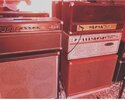
Oh yes, I've just drooled some more. CheersIvan I felt the same way when our friend Aaron sent me this photo of some of Keith Urban's Dumble collection.
View attachment 36976



syscokid
Ambassador of War & Peace

As a substitute for those vintage high stability ceramic caps: What about the modern multi-layer ceramic chips (MLCC) with Class 1 or Class 2 specs?The two capacitors are RS high K (high stability) tubular ceramic "dogbone" types, an 0.005uf & an 0.01uf.
Interesting article... even though most of it is way over my head:

High voltage MLCCs with C0G Characteristics and Replacement Solutions | Solution Guide | Tech Library | TDK Product Center
In recent years, there have been remarkable increases in withstand voltage and capacitance in MLCCs for temperature compensation. In particular, even in fields where film capacitors have traditionally been used, resonance circuits for example, replacement with MLCC is now possible.
ivan H
Ambassador of Tubes & Grooves
I imagine they'd be fine. I didn't read the whole article, but the word "chip" makes me wonder if those particular type are surface mount caps. NPO/COG ceramics are considered the best type ceramics for audio use & can be found in many stompboxes.As a substitute for those vintage high stability ceramic caps: What about the modern multi-layer ceramic chips (MLCC) with Class 1 or Class 2 specs?
Interesting article... even though most of it is way over my head:
High voltage MLCCs with C0G Characteristics and Replacement Solutions | Solution Guide | Tech Library | TDK Product Center
In recent years, there have been remarkable increases in withstand voltage and capacitance in MLCCs for temperature compensation. In particular, even in fields where film capacitors have traditionally been used, resonance circuits for example, replacement with MLCC is now possible.product.tdk.com
I have used polystyrene caps in previous Rangemaster builds, again because of their stability. IIRC, Steve Daniels (Smallbear electronics) recommends these type caps in Rangemaster builds. Cheers
syscokid
Ambassador of War & Peace
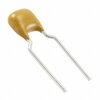
Example: KEMET, .01 uF, ceramic-radial-through hole, COG/NPO, 1% tolerance, 50v rated, low ESL, at $3.54 each from Digi-KeyI imagine they'd be fine. I didn't read the whole article, but the word "chip" makes me wonder if those particular type are surface mount caps. NPO/COG ceramics are considered the best type ceramics for audio use & can be found in many stompboxes.
syscokid
Ambassador of War & Peace
More info, just in case...: Order at least 10 of them, and the price drops about 80 cents each. "Downgrade" to a 2% tolerance, and the price drops an additional whole dollar... $1.90 each! Mouser is same price.… at $3.54 each from Digi-Key
Or just get a cheapy ceramic for like 10 cents each, ha ha…
Would there be anything negative about adding a 100k bias trimmer pot in place of the 68k resistor of the Rangemaster circuit, just in case it's needed to get the desired voltages?
ivan H
Ambassador of Tubes & Grooves
Example: KEMET, .01 uF, ceramic-radial-through hole, COG/NPO, 1% tolerance, 50v rated, low ESL, at $3.54 each from Digi-Key
View attachment 37003
It is the recommended method of getting a transistor that is a bit "off spec" to bias up properly, along with using a trimmer in place of the 3k9 emitter resistor. IIRC, it's not recommended to go below about 27k on the base resistor. Altering the value of the 68k does alter the input impedance & thus frequency response. A bit of deviation & you won't really hear a difference, but for a large deviation you "may" need to slightly adjust the input cap value to compensate.Would there be anything negative about adding a 100k bias trimmer pot in place of the 68k resistor of the Rangemaster circuit, just in case it's needed to get the desired voltages?
One treble booster I build a good while back has a 1k or 2k resistor in series with a 5k pot in place of the 3k9 emitter resistor, allowing me to swap in different type transistors with ease, or make adjustments to compensate for radical temperatures (which we get here).
I'm pretty sure that the two CV7003 transistors you have on order will bias up just fine with the stock circuit values. I would test them on a breadboard or test circuit first to make sure. Cheers
syscokid
Ambassador of War & Peace
DAAAAAAAAANG…! LOOK WHAT FULLTONE CUSTOM SHOP JUST RELEASED:
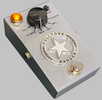
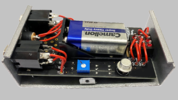
$237!!
 www.fulltone.com
$237!!
Fulltone Musical Products, Inc. | pedals | CS-Ranger
Now Shipping! The Fulltone Custom Shop CS-Ranger. The greatest Rangemaster treble booster clone ever? Here's why I think it could be:

eclecticsynergy
Ambassador of Electric Synergy
That's a really cool one.DAAAAAAAAANG…! LOOK WHAT FULLTONE CUSTOM SHOP JUST RELEASED:
View attachment 37045
View attachment 37046
$237!!
Fulltone Musical Products, Inc. | pedals | CS-Ranger
Now Shipping! The Fulltone Custom Shop CS-Ranger. The greatest Rangemaster treble booster clone ever? Here's why I think it could be:
eclecticsynergy
Ambassador of Electric Synergy
Just got a Lovepedal BBB with "black glass" OC42. Fuzzface and Rangemaster in one housing, with controls for volume, gain and blend.
Full CCW is pure treble boost and full CW is pure FF.
Sounds great. A bit of treble boost adds crispness & cut to the fuzzface, which is germanium-warm in character.
Treble boost is nice too; not as flexible on its own as my Colour Boost since the shelf frequency is preset.
Will do more experimenting with blend settings in days to come.
But IMO it'd be worth the cost just for the brightened fuzz.
Full CCW is pure treble boost and full CW is pure FF.
Sounds great. A bit of treble boost adds crispness & cut to the fuzzface, which is germanium-warm in character.
Treble boost is nice too; not as flexible on its own as my Colour Boost since the shelf frequency is preset.
Will do more experimenting with blend settings in days to come.
But IMO it'd be worth the cost just for the brightened fuzz.
syscokid
Ambassador of War & Peace
PICS DAMMIT, PICS!!!!!Just got a Lovepedal BBB with "black glass" OC42. Fuzzface and Rangemaster in one housing, with controls for volume, gain and blend.
Full CCW is pure treble boost and full CW is pure FF.
Sounds great. A bit of treble boost adds crispness & cut to the fuzzface, which is germanium-warm in character.
Treble boost is nice too; not as flexible on its own as my Colour Boost since the shelf frequency is preset.
Will do more experimenting with blend settings in days to come.
But IMO it'd be worth the cost just for the brightened fuzz.

eclecticsynergy
Ambassador of Electric Synergy
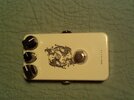
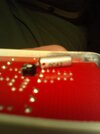
Compact MXR-type housing so I couldn't take a proper gut shot without unsoldering the jacks and taking board out. But the red dot OC42 is on the back; aluminum can protecting the fragile glass. According to Sean (maker of Lovepedals) this batch dates from 1st week of June, 1966.PICS DAMMIT, PICS!!!!!
Sorry for the fuzzy pic - my celphone doesn't do closeups well. (It isn't very good at normal shots either...)
syscokid
Ambassador of War & Peace
Go ahead... I'll wait...Compact MXR-type housing so I couldn't take a proper gut shot without unsoldering the jacks and taking board out.

eclecticsynergy
Ambassador of Electric Synergy
Have played with it for awhile; really very nice indeed. FF side with a bit of treble boost is still my favorite setting.
But the TB side by itself adds a surprising amount of nice germanium grit, in addition to the extra push.
Combining these two circuits was a stroke of genius. Lovepedal has several different pedals with that combo, including the White Dragon fuzz and both Si and Ge versions of this BBB. The Kalamazoo OD has both pre-gain treble boost and a conventional post-gain tone control, useful features on a kick-ass pedal.
But the TB side by itself adds a surprising amount of nice germanium grit, in addition to the extra push.
Combining these two circuits was a stroke of genius. Lovepedal has several different pedals with that combo, including the White Dragon fuzz and both Si and Ge versions of this BBB. The Kalamazoo OD has both pre-gain treble boost and a conventional post-gain tone control, useful features on a kick-ass pedal.
syscokid
Ambassador of War & Peace
Very eloquently said...But the TB side by itself adds a surprising amount of nice germanium grit, in addition to the extra push.

Sounds like you got a killer pedal. I like all the competition out there in the Pedal Effects World. It generates a lot of choices in high quality stuff from the inexpensive to the not-so inexpensive. I've never had the opportunity to play through any Love Pedal products, but judging by their great reputation and cult-like status, I'm not surprised by your comments, so far. Congrats...
eclecticsynergy
Ambassador of Electric Synergy
I'm a big fan of Lovepedals, especially the drives. I have a number of 'em and there isn't a dud in the bunch.
The only one I hardly ever use is an analog ring/ghost-octave pedal, not because it isn't good but because I seldom want that effect.
I love his fuzzes and ODs, and the line has a couple of nice amplike character drives that make great foundation tones.
Great volume knob interaction is a hallmark of them all.
The only one I hardly ever use is an analog ring/ghost-octave pedal, not because it isn't good but because I seldom want that effect.
I love his fuzzes and ODs, and the line has a couple of nice amplike character drives that make great foundation tones.
Great volume knob interaction is a hallmark of them all.