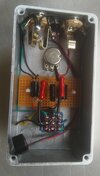
TREBLE BOOSTERS

As far as I remember that Chandler tube drive was held in high regard! I think I was into my Mesa Boogie stage back then, so …. And the blackface Twins always come alive with a good quad of RCA Blackplate 6L6's in em. And it was always pedal friendly. But you can't play " Summer Time Blues " by Blue Cheer with a blackface anything, fer gods sake they recorded the song on a pier, and that goes back a long long time I'm sorry to say View attachment 35404

Blue Cheer ROCKS. I call them THE Original Heavy Metal Band.
 
Met Dickie Peterson when they played in Boston. Real nice guy. A friend opened up for them in Providence, and Dickie wanted to go back to Greg's house after the gig to hang out and drink beer. After everyone passed out, Dickie almost set the house on fire trying to cook a snack. Of course, the house was rented from the girlfriend's parents who live next door. A fun time was to be had for all.
 
Last edited:
"Midrange notching" is an advertising description used by 65 Amps for a long time to describe their Colour Boost treble booster. But in general, those yellow SOZOS caps filter out the low frequencies that will not be boosted. The larger the value of those caps are, the more they're going to allow the lower frequencies to get boosted.
Yep, that makes sense and that's how the pedal sounds to me. I think the "midrange notching" term came around first in describing the rotary on some of their amps, which might actually be notching - I don't know about that. But I'm thinking they just carried the wording over into copy about the Colour Boost (regardless of whether it's like the amps' circuits or not) because users of their brand were already familiar with it as describing a rotary voicing option.
Personally, I've never cared for a treble booster into an amp that's setup for a clean tone. The magic only happens when the amp has already started to break up, and all the way to full saturation. But you can still get some very interesting clean tones by backing off the guitar's volume and tone controls, so long as the amp and treble booster isn't all the way maxed out.
Totally agree there. The whole point of treble boosters was to take your natural overdrive and amp it up while restoring some of the definition that gets lost when tubes are breaking up - while retaining the natural cleanup when you roll back the volume. Treble booster with a clean amp just seems like a recipe for ear-itching harshness. I'm still curious whether the low-mid boost mode of this one might work a little better than a traditional trebleboost into a scooped blackface type voicing. One of these days I'll get around to trying it. Not that I anticipate running it that way seriously - just to satisfy my idle curiosity.
 
New Page 1 is where to go though Fuzz central is a good recourse as well but they have to be critically tuned to get the transitor to sound right, if ya can't it's best to toss and get another one. You need a 10K and a 100K adjustable wheel type part to tune it,
How to do that would just be me cutting and pasting from Geofex, go there and read very carefully... you'll be a pro in no time!
That GEOFX Rangemaster article is a great resource. This is where I learned about them (Rangemaster), & yes, properly biasing the transistor is a must as frequency response is dependent on it. Nice stash of transistors you have there Mr Vox AC30. Cheers
 
Sweetest tempered tuning To my Ear<
on my Guild X-500 Jazz box w/wooden
bridge!

82.41 Hz E , lowest on guitar cept for dropped tunings - 12 cents
110.0 A - 10 cents
146.8 D - 8 cents
196.0 G - 4 cents
246.9 B - 6 cents
329.6 E Open - 3 cents
1319 E 12th Fret
2637 E 24th fret

I was going to start a separate Thread about all this sweetened stuff but while were here and at it … The tuning sweetest to my ears on that guitar has the tuning on the right flatted a few cents on the right. All my octaves are in tune up the neck on every one!
You will find that the degree of inharmonicity varies greatly between octaves.

This is what I hear on that guitar and wondered if anyone else had any experiences with inharmonicity and how you've addressed it! If I tested it out on one guitar a day it would take me over a month to do it so …… any thoughts or ideas would be welcomed.

The gain vs frequency chart in frame #47 was the specks of a perfectly tuned Dallas Rangemaster It, the gain, starts jumping up significantly between 500 hz and 1K. So The Rangemaster just starts killin it from about 329.6, the open E string with progressively more gain up 2 octaves to the 24th fret 2637Hz. Right where we do a lot of our solo's! That's how I see it, but it's all a work in progress subject to change ...
 
Ivan, That's where I learned too. How to tune Wah's , pretty much a lot of stuff a long time ago. I'm still learning from that site as I'm glad it did not move or disappear, just lots of great material to learn …. and dare I say, experiment with
 
Ivan, That's where I learned too. How to tune Wah's , pretty much a lot of stuff a long time ago. I'm still learning from that site as I'm glad it did not move or disappear, just lots of great material to learn …. and dare I say, experiment with
I also learned a lot about wah's from that site. Tube screamer's too (& much more).
The germanium transistor gain & leakage test circuit that R G describes in " Selecting germanium transistors for Gain and Leakage for your Fuzz Face clone" is a must have for accurately testing germanium transistors too.
So much to learn from that site. Cheers
 
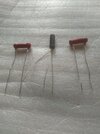
So, I finally got 'round to searching through my "parts stash" to find the main components for an "ultimate Rangemaster" build. Here they areIMG_20191225_094908.jpg
The transistor is a Mullard CV7003, which is a Military spec'd OC44.
The two capacitors are RS high K (high stability) tubular ceramic "dogbone" types, an 0.005uf & an 0.01uf. These are the same type caps as what was used in the original Dallas Arbiter Rangemaster.
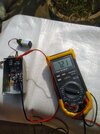
Testing the transistor in circuit (in the first treble booster I ever made), with a new battery that read 9.59V, the transistor biased up perfectly, showing 7.21V at the collector.IMG_20191225_094510.jpg
This is exactly the voltage it should show. For anyone interested, the transistor has 96 hfe & 16 uA (micro amps) leakage. This should make for a treble booster with quite good gain (& proper frequency response).
It's Christmas morning here ATM, so I couldn't cut loose through it in the circuit, however I did quickly plug it into my 5F1 Champ clone, just to make sure the transistor isn't hissy or noisey. Luckily it's not.
I'll order an enclosure & other hardware etc after the Xmass break, then throw it all together. Pics will be posted when it's done. Cheers
 
Last edited:
HERE is a novel idea --- "F" the treble boost-----

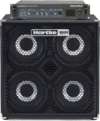
1000 watts HArtke bass boom
1577238445389.png

no treble --------
 
Actually --- Ive been running a Marshal Lead 15 SS head through a Hartke 1x12 cab ......and TBTH -- it friggin SLAYS for Chug -- rich deep metal (at bedroom levels - no it wont "cut through a mix or hold up VS Keith Moon) but for home "dicking about" its the cats knees.....or is it the bees pajamas.? -- damn lemme ask the wife........................
 
Ok, after the Xmas break I ordered all the hardware necessary for a Rangemaster build, most of which has arrived. I'm just waiting for the two 47uf electrolytic capacitors & a mono Switchcraft jack socket which will arrive tomorrow. So, I thought I'd get it all ready so that I can put it together quickly when they do arrive.
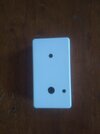
The enclosure is a white powder coated 125b. Here it is all drilled outIMG_20200104_074530.jpg
IMG_20200104_074552.jpg
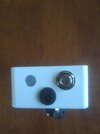
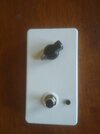
And here with the components that I do have fittedIMG_20200104_133438.jpg
IMG_20200104_133430.jpg
I mounted the indicator LED bezel next to the footswitch so that I could use the chicken head knob, because they look cool. Here's a gutshotIMG_20200104_133413.jpg
I'll be doing the small circuit "point to point" on perfboard. It's easy to use, simply insert component leads & wires through the board, twist together on the underside & solder. It also looks tidy & mounts easily in the enclosure using small adhesive backed standoffs.
So I'll wire it up as much as possible before the other components arrive tomorrow, then hopefully complete it tomorrow night. 'Til then, cheers
 
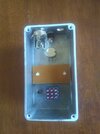
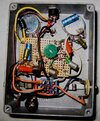
Ok, here's a gutshot of the finished pedalIMG_20200106_175000.jpg
The 2.2 meg pulldown resistors for the input & output caps (stop pops when switching) are mounted on the footswitch. As can be seen, it's a very simple circuit. Still, by the time I'd finished it it was too late to crank up a 50 Watter to try it, well, at home anyway. All voltages check out as they should. I'll give it a whirl through an amp tomorrow. Cheers
Edit:
I usually socket germanium transistors, but chose to solder this one in. The heat of soldering can cause damage to germanium devices, so the leads were heatsinked with a couple of small alligator clamps while I soldered them. Cheers
 
Last edited:
Damn, this thing KICKS A$$. I took it out & ran it through my recently built JTM50.
This pedal has quite a good bit more gain than my other treble boosters & it's tone is more focused, with a biting edge to its distortion that becomes more apparent up towards the acrobatic end of the fretboard. The increased gain of this pedal is really noticeable up there, where, as Mr Vox AC30 said, it really starts killing it.
I'm glad this thread gave me the inspiration to put this one together as it's an eye opener as to just how much of a difference a "really good" transistor makes in this circuit.
If anyone is interested in making one of these, I cannot recommend enough that you find a germanium transistor with a hfe (gain) figure in the high 90's & leakage current of no more than 20uA.
If anyone does have an original Rangemaster type Mullard transistor with these hfe & leakage current figures, I have an RS dogbone 0.005uf & 0.01uf cap that I could spare for your build. It wouldn't be worth wasting them on a lesser transistor, as these caps are also becoming scarce. Cheers
 
It's really interesting that the leakage current is vital, maybe it pushes a kind of positive feedback to the circuit that affect the parameters of the response of the pedal? I wonder if the mullard mustard caps of the same value would affect the sound. I have to rip apart my garage to find those cv7003's and if/when I locate a bunch I'll pass around some if anyone cares to build one. But I'm not sure where they are … yet! Ivan, yours appears the be from :cheers2:the third week/month of 72' and you've hit a homerun with that one …. Cheers
 
Ivan the Radio Spares dogbone capacitors nice touch.

On a side note 2002 I ordered a copy of my 1960 LPS from the Gibson Shop I put Jim Rolph pickups and wired 50's with Sprague bumble bee
capacitors from the 1950's nice clean sound first band practice of the year every thing fine second practice after an hour the notes are blooming
out of control what did my EF86 Mullard 1965 tube go bad no. I have my boost peddles set at 50% turned them down to 25% OK
All I can say is that Custom shop guitar sounds nothing like it did the bass notes are darker and the treble notes are brighter
and the note bloom is still happening with out boost what happened I guess the guitar opened up ???.

My tone bender build it's ugly but sounds good I used a trim pot on the money transistor AC127

Tone Bender 001.JPG
 
It's really interesting that the leakage current is vital, maybe it pushes a kind of positive feedback to the circuit that affect the parameters of the response of the pedal?

To understand why a transistor with the correct HFE & leakage current figures is needed for correct biasing we must first understand "leakage current".
Transistor leakage is the leakage current across the reverse biased Collector - Base junction. This current then crosses the Base - Emitter, which causes a current from Collector to Emitter "that is equal to the current times the HFE of the transistor".
I have put the part of the above that pertains to why both the HFE & leakage current are important for proper bias in inverted coma's.
So the leakage current plays a part in how the transistor biases. When we have much higher than 20uA leakage we need to adjust firstly the 68k base resistor, maybe also the 3k9 emitter resistor. Frequency response is determined by the high pass filter formed by the input cap & circuit input impedance. Input impedance is determined by the 470k & 68k resistors. So altering the value of the 68k resistor slightly alters the input impedance, & so slightly alters frequency response.
Edit: Looking further into it, when a germanium transistor is biased at cut-off, the collector-base leakage causes a positive feedback effect at the base. As the Rangemaster's transistor is biased near to cut-off, maybe you are onto something with the positive feedback thought.
Cheers
 
Last edited:
Back
Top