When I was in electronics school in the Air Force, we had a saying: "The bigger the blob, the better the job".
We were just joking...
Ebidis, you are relatively new here and to me, but I had almost 0 electronics experience before joining here and another forum.
I had need of some fixes to my '72 Marshall 50 watt JMP amp. I would blow fuses and or lose sound while playing. Totally dead sound despite amp still working. I wound up going to a local tech who had a good reputation. I got new tubes, new caps, and he called it good to go.
I basically took it as he knew what he was doing and with it playing, I took it home and eventually went to play it again. Sadly after a short period, it failed again. This time, he hooked up a tester in front of me and told me the OT was done. I told him I would buy the new Marstran one and have him install it. Save me the old one. Well, by the time I went to pick it up, I had totally loaded it up and got 5 minutes down the road and remembered I had forgotten to get the OEM tranny back. Called him, and he told me he does not save those things. At this, I lost all faith in his work and his honesty as on my first trip there, he had shown me his shop and boxes of parts I knew were not new parts. To quote Bryan Wallace at Marstran, the OEM trans was worth more dead, than His new one was brand new. Anyhow, even with the new one, my amp was still cutting out.
Upon explaining this on here, another member really encouraged me and prodded me with his statement of faith, that he believed in me and that I could fix it.
This began my postings for help from electronics experienced members as well as acquiring books, googling, and you tube videos. In short time, Ivan H, Sysco, DonP, Bastarddon, 67 plexi and some fellas from Marshall amps forum taught me a lot as we basically went over the amp to get a few wires returned to proper places, checked voltages on Trans, cap values, resistors etc. The amp should have been in full working order when I was finished. It would fire up and make sound every time I completed a repair and check, until the day I really thought I would give it a good go. Strummed a few chords and all of a sudden, the sound fizzed out to NADDA.
I was almost at a give up point then gave it one more shot and tried the chopstick test. As I learned online, one can safely test for flaws using a non conducive probe like a wooden chop stick. I sure got lucky and actually did get the amp to make sound and lose sound when I finally touched the probe to the pins/wires on the back of the OHMs selector switch. The final diagnosis was that the attached Ohms socket and the removable 2 pronged cap with the little window in it was losing good contact between the female ferrules and the male prongs. This caused the no load condition to be present, if that is how I understand what results when loss of a signal occurs at this selector.
Some experts stress that this selector should be replaced in order to prevent wiping out a tranny,. however I disassembled mine and gently squeezed the female tubes tighter on all the connections on both the Ohms selector and the Volts selector switches. This restored the operations of both to good snug fits, no loss of contact and for my use, I will not be plugging and unplugging the selectors 1000 times a year for speaker cab changes or anything to wear it out loose again. I set the pronged cap to my only needed setting, 16 ohm and forget about it.
Ebidis, Now that was my long winded story. But for those members I mentioned who helped me along the way, the knowledge you guys shared, has equipped me with the skills to repair additional amps. My upcoming fixes will be to remedy things like mouse chewed wires, a chewed coupling cap, to replace filter capacitors, and to undo a hard wired ohms selector switch to make it adjustable like the repaired one I mentioned above.
I know it likely sounds like riding a bike to you experienced Electronics guys, but every time I learn about Phase Inverters, Slope resistors, Diode vs Bridge rectifiers, tone stacks, Ohm's law, Resistor band calculations, etc, the more excited I get to put these all to use.
Thanks to all for adding to my learning of this invaluable treasure of knowledge.


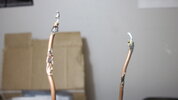
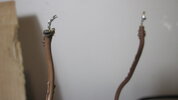
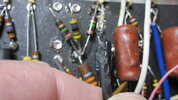
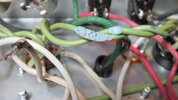
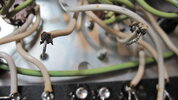
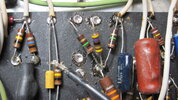
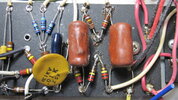
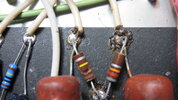
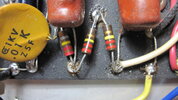




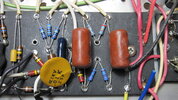
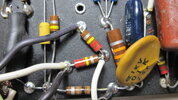
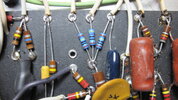
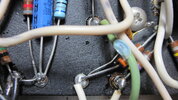

 load of melted wires...I have to take the output sockets apart, and take all the filament wires off.


