Transformer Swap

The output transformer has a big impact on how any tube amp sounds, with the laminate core size, type of steel it is made of, the way it is wound, whether it is wound on a plastic bobbin or paper former & if applicable, the thickness of paper between layers, along with whether there is interleaving of the primary & secondary or not (& more) all affecting how the transformer sounds. Transformer winding is kinda like "a black art". The new transformer may have better bandwidth than the original. Glad it's improved the tone of your amp & hope you get the squeal sorted. Cheers
 
Last edited:
The output transformer has a big impact on how any tube amp sounds, with the laminate core size, type of steel it is made of, the way it is wound, whether it is wound on a plastic bobbin or paper former & if applicable, the thickness of paper between layers, along with whether there is interleaving of the primary & secondary or not (& more) all affecting how the transformer sounds. Transformer winding is kinda like "a black art". The new transformer may have better bandwidth than the original. Glad it's improved the tone of your amp & hope you get the squeal sorted. Cheers
Thanks Ivan. The squeal is no more. It was the Zoom G5n digital multi effects unit causing the issue. I can now have master and channel volume on 10 with nothing more than your standard hum to be heard!
 
Thanks Ivan. The squeal is no more. It was the Zoom G5n digital multi effects unit causing the issue. I can now have master and channel volume on 10 with nothing more than your standard hum to be heard!
I'm glad it all seems to have worked out for the better. Hope you get to enjoy your OTS Mini even more now... :dood:
 
Thanks. So is V1, pin 1 always they right "Drain" in every amp?

BTW, I am going to take start a sticky for amp safety for this section. It seems like anyone looking here should remember these tips always!
"So is V1, pin 1 always they right "Drain" in every amp? "

No, most amps already have bleeder resistors.
When you turn the power off, the power supply discharges itself within a few seconds....so you don't need to use a discharge resistor at all most of the time.

A few amps however: do not have bleeder resistors.
So check your schematic and see if the power supply has them or not.
 
So I am thinking about upgrading my OTS Mini transformer to a Mercury Magnetics FDFD-OM

I am hoping to rid myself of the high squeal I get at 75% channel and master power, and in any event heard it is a nice upgrade. I love the tone at low volumes, and I am hoping this will help me love it at all volumes.

I noticed that Weber has the same transformer for a full$ 67 (38%) less. They say they just order it from Mercury. That means that Mercury is marking it up a LOT, since Weber must be making something.

Anyway, is this an easy swap? It just seems like 3 wires and the usual precautions when getting under the hood of an amp. Sound right?
"I am hoping to rid myself of the high squeal I get at 75% channel and master power..."

No, it's not going to get rid of the squeal. That's a separate problem which is not related to the transformers.

First of all:
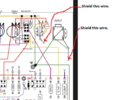
The input wire between the jack and the first preamp tube needs to be shielded wire.
Second: the wire between the first volume control (wiper) and the next preamp tube grid needs to be shielded wire.

inputshielding.png
 
Last edited:
No, it's not going to get rid of the squeal. That's a separate problem which is not related to the transformers.
RVA finally found the culprit pig for all the squealing. It was one of his pedals in the chain that did not want to play nice... Bad little piggy!

Nice to see you posting some amp knowledge here. Can you post a schematic that shows those bleeder resistors in the circuit, please?
 
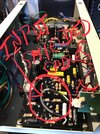
Some amps have bleeder resistors & some dont, & off the amps that do have them, they are not always intended as bleeder resistors. The only amp I have that has them is my 100 watt superlead clone, where they are actually intended as "balance resistors", to distribute the voltage evenly across the two series wired (screen grid supply's) filter capacitors (two 56k 2 watt resistors). They can be seen here across the filter caps just to the right of the board (large red resistors)IMG_20190819_130506.jpg
Bleeder resistors can be fitted to most any amp that does not have them. Cheers
 
Some amps have bleeder resistors & some dont, & off the amps that do have them, they are not always intended as bleeder resistors. The only amp I have that has them is my 100 watt superlead clone, where they are actually intended as "balance resistors", to distribute the voltage evenly across the two series wired (screen grid supply's) filter capacitors (two 56k 2 watt resistors). They can be seen here across the filter caps just to the right of the board (large red resistors)View attachment 31914
Bleeder resistors can be fitted to most any amp that does not have them. Cheers
Such nice work!! I am awed!
 
"I am hoping to rid myself of the high squeal I get at 75% channel and master power..."

No, it's not going to get rid of the squeal. That's a separate problem which is not related to the transformers.

First of all:
The input wire between the jack and the first preamp tube needs to be shielded wire.
Second: the wire between the first volume control (wiper) and the next preamp tube grid needs to be shielded wire.

View attachment 31896
Thank you!
 
"I am hoping to rid myself of the high squeal I get at 75% channel and master power..."

No, it's not going to get rid of the squeal. That's a separate problem which is not related to the transformers.

First of all:
The input wire between the jack and the first preamp tube needs to be shielded wire.
Second: the wire between the first volume control (wiper) and the next preamp tube grid needs to be shielded wire.

View attachment 31896

How would you recommend shielding the wire in question????
 
Last edited:
The output transformer has a big impact on how any tube amp sounds, with the laminate core size, type of steel it is made of, the way it is wound, whether it is wound on a plastic bobbin or paper former & if applicable, the thickness of paper between layers, along with whether there is interleaving of the primary & secondary or not (& more) all affecting how the transformer sounds. Transformer winding is kinda like "a black art". The new transformer may have better bandwidth than the original. Glad it's improved the tone of your amp & hope you get the squeal sorted. Cheers

It seems I've read somewhere that the sound of a tube amp is less a function of the tubes, and more a function of the output transformer.

What are your thoughts?
 
Smitty, I met with a really nice and smart, fellow Marylander, who sold me my Power tubes for my orange Marshall Superlead head. He had a long career as an owner of one or more car audio shops and was now in the tube acquisition and tube selling business.

When I acquired the Marshall SL, and it immediately was popping fuses, I deduced I had at least one bad/dangerous power tube, he tested them for me when I went to pick some new ones up that I bought from him. He also had quite a lot of experience building his own home stereo amps and had some definite opinions on tubes for them vs his summary of us Guitar amp tube guys.

He mentioned numerous times that the preamp section and preamp tubes were most responsible for the ultimate output of amps. And we tube amp guitar players who had our quest for the ultimate vintage power tubes were really not going to hear differences like one would in top high end audio speakers and audio amplifiers during playback of recorded music.

Once again, he stressed the preamp tubes as having the most effect. I really did not get into discussion of the HARD parts like transformers since we were in the mode of solving my new amp's malfunctions that were bad tube caused.
______________________________________________________________________________________________________________________________________

Now, I know I am no electronics expert, but from my quick read of Ivan's message regarding transformer construction and overall effect on how it colors the amp's sound, I am sure he is spot on. Ivan H stands for "HAS" the smarts when it comes to amp performance, construction, and repair in my book.
 
Last edited:
It seems I've read somewhere that the sound of a tube amp is less a function of the tubes, and more a function of the output transformer.

What are your thoughts?
Yes, in some amps more so than others. The famous tweed 4x10 bassman for example, whose circuit can be traced back to the pages of the RCA tube applications manual (& Marshall adaptation to the pages of the Radiotron Designers Handbook). A big part of the bassman sound quality is being imparted by that interleaved OT (IIRC the primary is wound in 4 sections with the secondary's 3 sections interleaved between them, so a 7 wind interleaving). Another example would be to compare say, a Hiwatt DR103's Partridge OT (which plays a big part in that big, authoritive tone) to a Marshall Superlead's Dagnall OT. Both OT's provide the output tubes with the same (1.7k) plate to plate load impedance, but if we were to take the Partridge OT out of the Hiwatt & transplant the Dagnall in, we'd find (at the very least) the "authoritive low end" noticeably reduced. The Partridge OT is simply a better mouse trap with better bandwidth. Other amp designs effectively make use of an undersized OT to give them their signature characteristics (like a tweed deluxe). So yes, while every component, from power transformer on through to the OT, have an effect on how an amp sounds, I would say the OT is one of the major players.
Damn, time flies. The boss is gunna love this (or I'll get done for speeding this morning). I'll get back on "tubes" during lunch. Cheers
 
Back
Top