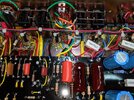
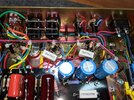
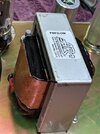
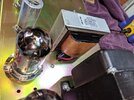
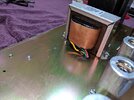
Transformer Swap

Spoke to mercury. They confirm brown is P1, but that it still may be out of phase for my amp. They said it is 50/50 shot, so hook it up and if it squeals and oscillates, just reverse them
In this case, if it squeals & oscillates it is because, with the primary leads reversed (V4 & V5), instead of the amp taking negative feedback around the power stage/PI, it will be taking positive feedback. Swapping the primary leads in this case will put things to normal. You will know if the primary leads are reversed RVA, as at any sort of volume the amp will howl like a banshee. If this happens, shut the amp down immediately & reverse the leads on pins 3 of the power tube sockets. Cheers
 
In this case, if it squeals & oscillates it is because, with the primary leads reversed (V4 & V5), instead of the amp taking negative feedback around the power stage/PI, it will be taking positive feedback. Swapping the primary leads in this case will put things to normal. You will know if the primary leads are reversed RVA, as at any sort of volume the amp will howl like a banshee. If this happens, shut the amp down immediately & reverse the leads on pins 3 of the power tube sockets. Cheers
It did that and does that. But what qualifies as "any sort of volume"? At present, and before, it squeals at 100% channel volume and 60% master volume on the clean channel. On the gain channel, it squeals at 60% and 60%. This is true even without guitar signal. The manufacturer (builder really), verified that this is to be expected.

I am a bit disheartened, but feel the swap was still an upgrade and a good experience.
 
Last edited:
Ok, so the issue comes from my pedal monstrosity. If I plug directly into the amp from the guitar, standing right in front of the amp, with master and channel volume at 100%, on the gain channel, I do not even get regular feedback!

When I am plugged into the pedal monstrosity, the squeal is deafening with my wireless pack off, but disappears as soon as I pull the cord from the input jack. All is well with the amp...but not with my pedal excesses.

Also, it was unfair to say that I was getting the squeal with "no guitar signal". By this I meant a cord in the input jack, but the wireless pack off. That is NOT a lack of input.
 
Ok, so the issue comes from my pedal monstrosity. If I plug directly into the amp from the guitar, standing right in front of the amp, with master and channel volume at 100%, on the gain channel, I do not even get regular feedback!

When I am plugged into the pedal monstrosity, the squeal is deafening with my wireless pack off, but disappears as soon as I pull the cord from the input jack. All is well with the amp...but not with my pedal excesses.

Also, it was unfair to say that I was getting the squeal with "no guitar signal". By this I meant a cord in the input jack, but the wireless pack off. That is NOT a lack of input.
What happens when you remove the wireless system completely out of the picture? Just the guitar > cable > effects (Start with one only, then work your way up) > cable > amp.
 
What happens when you remove the wireless system completely out of the picture? Just the guitar > cable > effects (Start with one only, then work your way up) > cable > amp.
I previously removed each pedal, one by one, with no luck. Then I bought the loop switcher.

I will try removing just the wireless. I never did that before. Thank you
 
Last edited:
so....Removing my Zoom G5n from the front loop COMPLETELY solved the issue. Now mind you, I did remove this before BUT when I did, I had not set up my other pedals in the loop switchers they are in now. At present, 80% of my other pedals were out of the picture. I will tinker with the rest, but the Zoom is getting retired.
 
Quick question: Why does the red wire - the center tap - go to a fuse/live leg? I would think a tap would go to ground.
The valves (tubes) need a high positive potential on the plates (anodes) so that the negatively charged electrons from the cathode will attract to them. This "high positive potential" is applied through the primary winding of the output transformer, the positive voltage being "fed in" through the center tap. Cheers
 
The valves (tubes) need a high positive potential on the plates (anodes) so that the negatively charged electrons from the cathode will attract to them. This "high positive potential" is applied through the primary winding of the output transformer, the positive voltage being "fed in" through the center tap. Cheers
Thank you!
 
Are you still able to notice any difference in tone, and or output, with the new and different OT?
There seems to be more low end generally. The pull bright is much more subtle, which is good in my opinion, because I thought it got unusably bright before. Also, I believe there is more volume at any given level, although I cannot say if it is louder at maximum due to the previous limitations. Generally speaking, I would describe it as more robust
 
Last edited:
Back
Top