Transformer Swap

I hope those resistors have a minimum power rating of 2 watts.


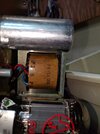
I learned from an article with this pic:
View attachment 30594


Here's mine:
View attachment 30595

One end is clipped to ground (anywhere on the chassis). The other end is clipped to pin 1 of V1. The whole circuit drains smoothly like this. Unless your are discharging a cap individually, you don't really need a power resistor in the jumper wire with this method. If pin 1 for some reason is a little tricky to get to, maybe by following the lead to its plate resistor, you can clip it right where the lead joins the resistor...:
View attachment 30596
Thanks. Looks like theyvare 1/4W. No good?

I was planning to do each cap individually. I assume pin one of V1 drains them all at once. Do you count pins going clockwise or counterclockwise from the open area with no pins, or something else?
 
Thanks. Looks like theyvare 1/4W. No good?

I was planning to do each cap individually. I assume pin one of V1 drains them all at once. Do you count pins going clockwise or counterclockwise from the open area with no pins, or something else?
Here you go Ray:

1241547A-920D-4F31-BD97-8B62AAE13A92.jpeg

Big resistors(wattage wise) are good for the draining tool...I use a 5watt ceramic...overkill, but very effective. I had mine on hand though...
 
Thanks. I ordered some 2W resistors.
(y)

I was planning to do each cap individually.
You can, but...

I assume pin one of V1 drains them all at once.
Yes. And keeping the jumper wire connected while you perform any work on the amp will keep the caps from recharging, unless the stringed connection between any of the caps is broken. Don't forget to remove the jumper wire before the amp is powered on again.

Do you count pins going clockwise or counterclockwise from the open area with no pins, or something else?
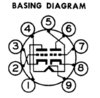
Clockwise. If you look closely at the tube sockets, the pin sections might be numbered.
 
Clockwise. If you look closely at the tube sockets, the pin sections might be numbered.
Thanks. So is V1, pin 1 always they right "Drain" in every amp?

BTW, I am going to take start a sticky for amp safety for this section. It seems like anyone looking here should remember these tips always!
 
Syco has given some good advice here, as always. Removing the AC plug from the wall socket is a "must". Just turning the wall switch off isn't enough as the switch can leak due to capacitance.
When it come time to do the swap there's a few things to note. Because of the way in which an output transformer works it must be wired in correctly, both primary & secondary. Hopefully the replacement has the same wiring color code as the original. If not, confirm the correct wiring with Mercury Magnetics. All AC carrying leads should be neatly twisted together for the length of their run to their termination points. This means the two "plate leads" should be twisted together. Also the "secondary" leads should be twisted together. Keep the "primary" leads & "secondary" leads as well seperated from each other as possible. If either of these have to cross any other leads, try to make them cross at 90 degrees, or as close to as possible. Hope this helps. Cheers
 
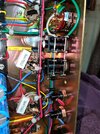
Can someone please verify what the P1, P2 and B markings mean? I am trace where they go, but I want to make sure I match the leafs to the new transformer properly.

Tx

IMG_20190912_234740-756x1008.jpg
 
Can someone please verify what the P1, P2 and B markings mean? I am trace where they go, but I want to make sure I match the leafs to the new transformer properly.

Tx

View attachment 31366
I think P1/Brown & P2/Blue are the OT's Primary wires. P1 goes to V5's pin 3. P2 goes V4's pin 3.

B/Red is the wire that gets connected to the B+ of the power supply after the rectifying diodes. Not sure where that would exactly be on your amp.
 
Last edited:
how did I miss this?
good luck Ray.

Match each wire on the existing one to where it goes in the chassis and on your layout diagrams.
example / typical as has been said - OT primary CT will go to B+ directly from last power filter cap, or through a fuse, etc.
Primary leads will goto power tubes anode pin 3 on the typical 8 pin amp power tubes.

That will identify each lead. Match the new OT leads to the functions identified.

As far as cap drain, I land across the + leg of each power filter cap but if you cant get them I have drained at the B+ where your OT center tap goes. Mine simply a clip lead with one clip to ground and the other clip has one leg of the resistor wrapped into the other clamp.
The other leg of the resistor is my probe. I think it is a 1w 68Ω I ordered by mistake at the very beginning of my tube amp journey.

the resistor on your drain tool just avoids sparking; the value is not important and at least a 1/2w will do just fine, bigger.
I suppose the in rush of current with no resistor could heat and melt the clip lead wire in theory.

That is my experience, but I am not expert; if something is off, please correct me.
I misspeak often, as @syscokid mentioned recently I posted "radial caps" instead of "axial caps", and I damn well know better.
I blame it on lack of sleep, lol!
 
Last edited:
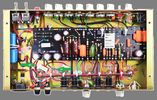
I'm trying to identify the wires by pictures supplied by Ceriatone. Brown is going to V5; Blue is going to V4... in this modified pic:
View attachment 31376

I hope your happy now, cuz I iz confused!

@RVA … Is this what your amp looks like inside?
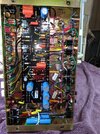
Thanks all. Sysco, here she is. It will be pin 3 on each socket, with the other going to the secondary fuse as per the schematic. I think the color codes will match on the new transformer, which just got here!

IMG_20190912_225727.jpg

IMG_20190913_072521.jpg
 
Spoke to mercury. They confirm brown is P1, but that it still may be out of phase for my amp. They said it is 50/50 shot, so hook it up and if it squeals and oscillates, just reverse them
 
Back
Top