Transformer Swap

RVA

Ambassador
So I am thinking about upgrading my OTS Mini transformer to a Mercury Magnetics FDFD-OM

I am hoping to rid myself of the high squeal I get at 75% channel and master power, and in any event heard it is a nice upgrade. I love the tone at low volumes, and I am hoping this will help me love it at all volumes.

I noticed that Weber has the same transformer for a full$ 67 (38%) less. They say they just order it from Mercury. That means that Mercury is marking it up a LOT, since Weber must be making something.

Anyway, is this an easy swap? It just seems like 3 wires and the usual precautions when getting under the hood of an amp. Sound right?
 
Last edited:
You seem to be pretty handy from what I've seen here at TTR. As long as you get the correct tranny I think you'll have no issues. Even if you do you'll figure it out and we'll say 'welcome to the club' ;)
Thanks! Tranny ordered, type confirmed with mercury and size confirmed with nik at ceriatone! I ordered from Weber and saved $ 50. Not sure why Mercury does that to themselves.
 
Last edited:
Just try to dot your i's and cross your t's and at least use a current limiter (light bulb thingy) and if possible a variac. DO NOT stick more than one hand into the amp at a time or you may have a shocking experience you won't be awake to remember. Make sure you discharge the caps, etc. You probably already know all this - BUT better safe than sorry and you can't repeat this general safety stuff too many times. Working on amps is very fun and addictive - but the voltage/current can and will cause you to take a permanent dirt nap if not careful ;)

Your a talented guy, man - look forward to hearing how well it's working/sounding...
 
Just try to dot your i's and cross your t's and at least use a current limiter (light bulb thingy) and if possible a variac. DO NOT stick more than one hand into the amp at a time or you may have a shocking experience you won't be awake to remember. Make sure you discharge the caps, etc. You probably already know all this - BUT better safe than sorry and you can't repeat this general safety stuff too many times. Working on amps is very fun and addictive - but the voltage/current can and will cause you to take a permanent dirt nap if not careful ;)

Your a talented guy, man - look forward to hearing how well it's working/sounding...
Thanks. I may circle back for some advice when I do the deed - complete with gut shots of course!!
 
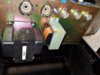
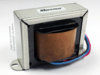
I may be being overly simplistic here, and Mercury will provide color codes, but is it possible that the blue/blue, red/red and brown/grey wires match up for these 2 compatible transformers. The top one is a gut shot from the Ceriatone and is stock. The bottom is the Mercury Magnetics FBFD-OM

IMG_20190409_192918.jpg

Horizontal A-Frame.jpg
 
Hopefully the new one is labeled primary and secondary. You can figure the circuit from there.
Yes, the new one will have color coded wires with instructions that ID them. If you folks can help me ID what the old wires are going to on the amp, I will be set.

I also emailed Nik at Ceriatone. Maybe he can tell me the ID of the existing wires
 
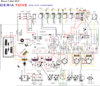
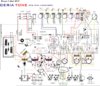
RVA, you got the OT connections right on the layout, now if only I knew how to draw those little circles like you did on the layout, I could show you the OT on the schematic (I'm "digitally challenged"). But I can "tell" you where it is. Its at the "lower right" of the schematic & to the extreme right. The primary winding's "center tap" is labelled "B1" & the secondary winding's 4, 8 & 16 ohm taps are labelled as such. Hope this helps. Cheers
 
Last edited:
RVA, you got the OT connections right on the layout, now if only I knew how to draw those little circles like you did on the layout, I could show you the OT on the schematic (I'm "digitally challenged"). But I can "tell" you where it is. Its at the "lower right" of the schematic & to the extreme right. The primary winding's "center tap" is labelled "B1" & the secondary winding's 4, 8 & 16 ohm taps are labelled as such. Hope this helps. Cheers
Thank you Ivan. I have been reading up. So the "CT" or center tap, will go to the fuse, the other 2 associated wires will go to pin 3 of each power socket and the 3 ohm selection wires will go to the appropriate pot lug of the ohm selector, right?

Can you clear up the terminology for me? Is the center tap also the "primary"? This diagram is calling the ohm tap wires the secondary, so what do you call the wires that go to pin 3 of the vb power socket - or are those the "primary"?

Tx
 
Yes, the primary's center tap gets connected to the fuse. This supplies the B+ HT (high tension) voltage to the power tube plates (aka anodes). I'm not sure of the exact correct terminology, but the plate leads are usually called just that, plate leads as they connect to the power tube plates. The "primary winding" is made up of the complete winding, starting at one plate lead & finishing at the other plate lead. The primary's center tap is exactly that, a lead that taps into the center (turns wise) of the primary winding.
The "secondary" winding is the speaker output winding, comprising the entire winding from the 16 ohm tap through to the "ground" lead, with the 4 & 8 ohm taps appropriately placed.
Yes, the secondary's 4, 8 & 16 ohm leads connect to the appropriate lugs of the impedance selector. The secondary's ground lead connects to a speaker out jack socket (ground lug).
To read up on this type of output transformer search "audio valve push pull output transformer". Hope this helps. Cheers
 
Yes, the primary's center tap gets connected to the fuse. This supplies the B+ HT (high tension) voltage to the power tube plates (aka anodes). I'm not sure of the exact correct terminology, but the plate leads are usually called just that, plate leads as they connect to the power tube plates. The "primary winding" is made up of the complete winding, starting at one plate lead & finishing at the other plate lead. The primary's center tap is exactly that, a lead that taps into the center (turns wise) of the primary winding.
The "secondary" winding is the speaker output winding, comprising the entire winding from the 16 ohm tap through to the "ground" lead, with the 4 & 8 ohm taps appropriately placed.
Yes, the secondary's 4, 8 & 16 ohm leads connect to the appropriate lugs of the impedance selector. The secondary's ground lead connects to a speaker out jack socket (ground lug).
To read up on this type of output transformer search "audio valve push pull output transformer". Hope this helps. Cheers
Thanks Ivan. As you are already familiar with my MO, please entertain my requests for an expanded explanation of the above after I have it in hand and I am getting to the install. Big problem is the website does not display all wires on the new transformer. Looking forward to seeing it in person
 
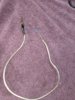
This is the first half of a cap discharge device. An alligator clip for securing to the chassis on one end, and 2 10k resistors in parallel in the middle in case one fails ( I got the idea from an Amazon review of a cap discharge device by a tech suggesting how it could be better). I am waiting for delivery of a probe for the other end

IMG_20190830_232847-756x1008.jpg
 
Last edited:
This is the first half of a cap discharge device. An alligator clip for securing to the chassis on one end, and 2 10k resistors in parallel in the middle in case one fails ( I got the idea from an Amazon review of a cap discharge device by a tech suggesting how it could be better). I am waiting for delivery of a probe for the other end

View attachment 30592
I hope those resistors have a minimum power rating of 2 watts.


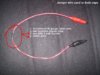
I learned from an article with this pic:
cap discharge kit (2).jpg


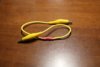
Here's mine:
IMG_1790.JPG

One end is clipped to ground (anywhere on the chassis). The other end is clipped to pin 1 of V1. The whole circuit drains smoothly like this. Unless your are discharging a cap individually, you don't really need a power resistor in the jumper wire with this method. If pin 1 for some reason is a little tricky to get to, maybe by following the lead to its plate resistor, you can clip it right where the lead joins the resistor...:
IMG_1791.JPG
 
I hope those resistors have a minimum power rating of 2 watts.


I learned from an article with this pic:
View attachment 30594


Here's mine:
View attachment 30595

One end is clipped to ground (anywhere on the chassis). The other end is clipped to pin 1 of V1. The whole circuit drains smoothly like this. Unless your are discharging a cap individually, you don't really need a power resistor in the jumper wire with this method. If pin 1 for some reason is a little tricky to get to, maybe by following the lead to its plate resistor, you can clip it right where the lead joins the resistor...:
View attachment 30596
Thanks. I ordered some 2W resistors.

I was planning to do each cap individually. I assume pin one of V1 drains them all at once. Do you count pins going clockwise or counterclockwise from the open area with no pins, or something else?
 
Last edited:
Back
Top