
You are using an out of date browser. It may not display this or other websites correctly.
You should upgrade or use an alternative browser.
You should upgrade or use an alternative browser.
Tools of the trade.
- Thread starter BGood
- Start date


gasket
Ambassador of the Guitarded
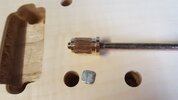
This isn't very imaginative (I'm new to working on guitars) but when putting a kit together I figured I'd have to be able to remove the things (don't know what called) driven into body that bridge is screwed into. I cut 4 pieces of gal steel to sit at bottom of each hole and found a bit of threaded rod to use as an extractor. The guitar is now undergoing an update and it worked just fine. Possible unnecessary but I didn't like the idea of extracting by screwing hard onto wood. Some may use a slide-hammer or a special tool but this works for me.

RVA
Ambassador
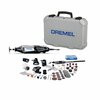
What you never knew you needed... a Dremel. Route with ease, polish metal parts wih the feld pad, get a drill press attachment, take scratches out if your stainless steel stove (yes I did), it does a whole lot for a whole little $$ and fits in any shop. Dremel...now available at your finer retailers.
RVA
Ambassador
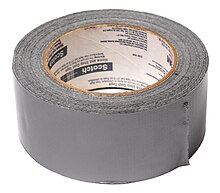
Snd if you are not as crafty as B.Good, you can buy a version of this rather cheap. $2.32 for a set of 2 at amazon. This is a must have item for fret work.Be it a tool for fixing your guitar, one you like, one you just bought, one you'd like to have or one you made yourself. We want to see them explained and in action.
Here's one I made from a sheet of roofing metal, for protecting the fretboard while polishing frets.

https://www.amazon.com/Fingerboard-...TF8&qid=1481707959&sr=1-2&keywords=fret+guard
RVA
Ambassador
Howard's feed-n-wax
Howard's restore-a-finish
They work miracles. They even make me look like I know what I am doing.
Howard's restore-a-finish
They work miracles. They even make me look like I know what I am doing.

RVA
Ambassador
I just picked one randomly, but if people are buying this to do fret work and they are troubled by rough spots on a flat protector, I wish them luck!!Got some bad reviews there. Rough edges and otherwise spotty quality


jtcnj
Ambassador of the Crossroad

I have bought from Philadelphia Luthiers supply fret protectors and crowning file - I usually only use the fret protectors when sanding 320, if I'm feeling fiesty I might go >400 or >800, after level and crowning.
I bought A2 humbucker magnets here too. I cant believe how good the stock Agile AL-2000 pick ups now sound with the A2 magnets over the stock ceramics.
They offer custom poker chips too! Under "toggle switch rings"
http://www.philadelphialuthiertools.com/
UAAC - Best price I found for fret rocker and notched straight edge (ones side 24.75 and other 25.5" scales)
http://uaac.us/luthier-tools
leveling Beam - Home Depot 3" marble floor threshold cut into around a 15" and an 8" piece.
Found rolls of 2 1/2" wide 180 sand paper at Harbor Freight as well, 3M or Loctite spray on glue to leveling beam
fret end dress file - made from old ignition points file by grinding one edge safe
mill file, sharpening stones for fret end tangs.
Hand Reamer - $3.75 I think at Harbor Freight for enlarging or smoothing existing holes for tuners, pots, etc.
Usual hand tool suspects of screw drivers, allen keys, wood blocks, cutters and pliers, small files, hammers and mallets, painters tape, soldering station, utility knives, clamps, etc. Router as needed.
I always try to buy a Dremel, but end up using what I have pretty much just fine which kind of defeats the "I need this tool argument". I almost bought a 3000 series kit around the Black Friday sales but didnt find a good enough deal to pounce on.
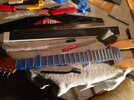
Older pic with blue tape and home made notched straight edge before I cut the leveling beam down, and recent pics of Tele neck transplant:
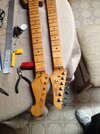
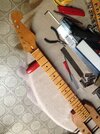
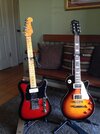
I bought A2 humbucker magnets here too. I cant believe how good the stock Agile AL-2000 pick ups now sound with the A2 magnets over the stock ceramics.
They offer custom poker chips too! Under "toggle switch rings"
http://www.philadelphialuthiertools.com/
UAAC - Best price I found for fret rocker and notched straight edge (ones side 24.75 and other 25.5" scales)
http://uaac.us/luthier-tools
leveling Beam - Home Depot 3" marble floor threshold cut into around a 15" and an 8" piece.
Found rolls of 2 1/2" wide 180 sand paper at Harbor Freight as well, 3M or Loctite spray on glue to leveling beam
fret end dress file - made from old ignition points file by grinding one edge safe
mill file, sharpening stones for fret end tangs.
Hand Reamer - $3.75 I think at Harbor Freight for enlarging or smoothing existing holes for tuners, pots, etc.
Usual hand tool suspects of screw drivers, allen keys, wood blocks, cutters and pliers, small files, hammers and mallets, painters tape, soldering station, utility knives, clamps, etc. Router as needed.
I always try to buy a Dremel, but end up using what I have pretty much just fine which kind of defeats the "I need this tool argument". I almost bought a 3000 series kit around the Black Friday sales but didnt find a good enough deal to pounce on.
Older pic with blue tape and home made notched straight edge before I cut the leveling beam down, and recent pics of Tele neck transplant:

DonP
Guest
Define "over time" also, that'd be a lot of little dots.
A year or a few. The last one I did involved about six dots.

jtcnj
Ambassador of the Crossroad
[QUOTE="Raiyn, post: 4098, member:
Two questions:
1. About $8. and no I cut it with a $2 masonry cut off wheel on a $20 harbor freight grinder; things I already had on hand.
It is some kind of fake marble but it is flat and stable.
2. I spray a little plain old spray adhesive on the leveling block / beam and stick a length of sandpaper to it.
https://www.lowes.com/pd/LOCTITE-Ge..._clickID=2f35a693-9e03-44af-ada6-20b829d5ad9f
I have the same strip on there for at least 2 fret level jobs.
The shorter one I used to ramp frets 17-21 down a little.
Two questions:
- How much did that threshold cost you? (did they cut it?)
- Why don't you do the masking tape & super glue trick?
1. About $8. and no I cut it with a $2 masonry cut off wheel on a $20 harbor freight grinder; things I already had on hand.
It is some kind of fake marble but it is flat and stable.
2. I spray a little plain old spray adhesive on the leveling block / beam and stick a length of sandpaper to it.
https://www.lowes.com/pd/LOCTITE-Ge..._clickID=2f35a693-9e03-44af-ada6-20b829d5ad9f
I have the same strip on there for at least 2 fret level jobs.
The shorter one I used to ramp frets 17-21 down a little.
DonP
Guest
Yeah..... Mine'd take quite a few more. I cut strips to follow the contours.
Not seeing anything about this on the ol' Googletron..... Wait & see I guess. Still gonna recommend it.
This comes from a lot of experience in satellites. Conductive tape for sealing the edges of metal boxes is a big thing, and a lot of research has gone into what does and doesn't work. The solution in the end was to always die cut a single large sheet to the right shape, then drape it on and seal it down. But this was for high frequencies that would leak out between solder blobs. For audio work that isn't an issue.
DonP
Guest
Too bad shield paint is garbage.
It is. But it is surprising how holey a shield can be and still do a good job. Pull apart some TV antenna coax cable, and you will find the inner, some cheap foamy plastic and half a dozen wispy strands of wire for a shield. Provided the location isn't really noisy, that is plenty good enough. It's all about wavelengths.

My favorite goodies are similar to many already listed.
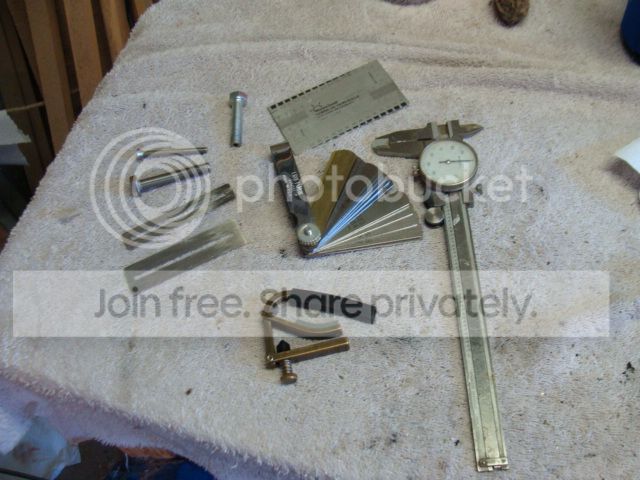
One of those metal credit card sized action & setup gauges is handy for slipping between the strings & headstock when filing nut slots.
Oh yeah, they're handy for checking action height too.
A set of automotive feeler gauges is good to have around too. They can be stacked as needed for just about any thickness.
A few different fully threaded screws for use as bushing pullers.
5/16 x 24 gets out Gibson tailpiece bushings.
10 - 32 pulls Gibson bridge bushings.
M8 x 1.25 takes care of the metric needs.
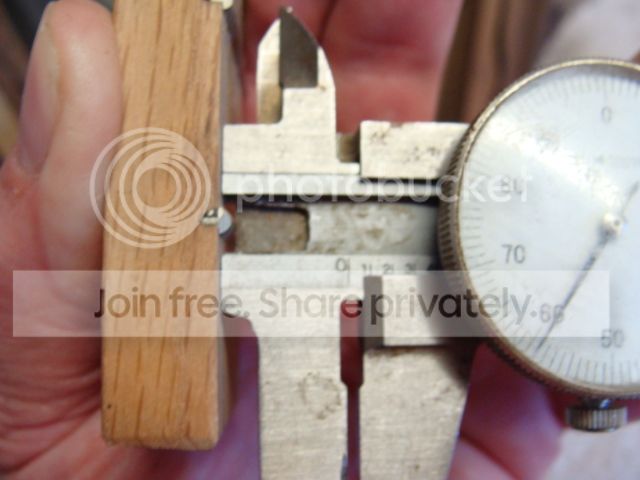
My calipers has been modded so I can get an accurate measurement of fret height.
A capo comes in handy too for keeping the strings from tangling, when pulling bridge pins to adjust saddle height on acoustics.
And don't forget my chain saw. I couldn't route anything without that...
One of those metal credit card sized action & setup gauges is handy for slipping between the strings & headstock when filing nut slots.
Oh yeah, they're handy for checking action height too.
A set of automotive feeler gauges is good to have around too. They can be stacked as needed for just about any thickness.
A few different fully threaded screws for use as bushing pullers.
5/16 x 24 gets out Gibson tailpiece bushings.
10 - 32 pulls Gibson bridge bushings.
M8 x 1.25 takes care of the metric needs.
My calipers has been modded so I can get an accurate measurement of fret height.
A capo comes in handy too for keeping the strings from tangling, when pulling bridge pins to adjust saddle height on acoustics.
And don't forget my chain saw. I couldn't route anything without that...