
You are using an out of date browser. It may not display this or other websites correctly.
You should upgrade or use an alternative browser.
You should upgrade or use an alternative browser.
Tonewood v Semi-Hollow
- Thread starter RVA
- Start date
-
- Tags
- semi-hollow tonewood


Col Mustard
Ambassador of Perseverance

Every time I see a Gibson with a maple neck I refuse to buy it - that won't have the Gibson sound!
Then, everytime I'm repeatedly tuning a Gibson, I wish they'd change that weak mahogany neck to a nice strong maple neck...
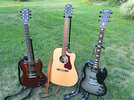
Here are my three Gibsons... The one on the left, I bought because I fell in love with it
instantly on a touch. When I tuned it in the store... when I strummed it, it rang like bells in my
heart and my MasterCard began to twitch inside my wallet. The one on the left is traditional
Gibson, a mahogany body, mahogany neck, rosewood fretboard. It's got the Gibson sound
as one would expect. It's the best guitar of any kind that I have ever played.
The other two, I bought online, unplayed, because I wanted the guitar I saw advertised at the
price I saw advertised, and I wanted it immediately. The J-45 in the middle has a maple neck.

It also has a spruce top, walnut back and sides, it has a walnut bridge, walnut fretboard, tusq nut...
I was NOT concerned about any pre-concieved notions about what a "Gibson sound" should be...
I wanted THAT guitar, made out of North American Tonewoods, because I wanted to incorporate
its tone, (what ever it might turn out to be) into my music.
It's amusing to me (an acoustic player) to read through pages and pages of tonewood bull

in reference to electric guitars. Wood is not like, magnetic. So I'm with Smitty.
I do believe that anything can affect the vibration of the steel string in the magnetic field,
but I don't believe that very many of these factors will be audible, or significant. Especially
at band volume, in a mix with drums, bass, keys, harmonicas, vocals and f/x.
But as an acoustic player, tonewood is everything. It's all we have to offer. That
is simply a fact. Cheap acoustic guitars don't sound good, compared to expensive acoustic
guitars made out of the world's best tonewoods. What we are amplifying is the vibration of
the steel string in the wood of the bridge, the bridge pins, the bridge plate and the top,
and the glue... and shaped by the wood of the back and sides, and also by the neck,
the bridge saddles, the nut and the tuners. On an acoustic guitar all those things matter.
All those things are crucial! On an acoustic guitar, Tonewood rocks!

On an electric guitar, not so much. To me, the factors that alter tone on an electric guitar
are the strings, the pick (or no pick), THE PICKUPS, the bridge saddles, the nut,
THE AMP and f/x and how loud the whole signal gets, and what it gets mixed with.
Those are really important factors for electric guitars. Even semi-hollow ones.
All this other stuff under discussion, like the wood of the body, the wood of the neck,
the presence or absence of a scarf joint, the varnish or paint,
the glued in or the bolt on neck, the presence or absence of bridge post studs...
these are all very minor considerations IMHO.
They may have an effect, but it's like the effect of butterfly
wings in a cyclone. Even for semi hollow ones. That's the way I look at it.
So I bought the 2012 Gibson SG Special at the right of the photo above on a hunch.
I had never heard of a Gibson SG with a maple neck. So I was intrigued.
I owned two Fender guitars at that time, both with maple necks, both with awesome tone.
I wasn't prejudiced.
I never had my attention called to the Gibson Mini Humbuckers before. So I was curious
about them, and figured I could use their tone in my music. I wasn't concerned about
whether they might sound like some other guitar or not. I want to sound like me.
To hell with pre conceived notions about what a guitar ought to sound like.
I wanted that Silverburst SG with the maple neck and the mini hums, because I wanted to
sound like whatever that guitar sounded like.
It was a good choice. I've owned that guitar since 2013, and never regretted a thing.
It's tone is unique IMHO, which is why I value it. I've got 'the Gibson tone" covered by the
faded brown SG at left. But here's something to chew on. To me, the silver burst SG with all
the innovations (including baked maple fretboard) has a very Gibson tone, unique, but very
Gibson. It's got a great growl in the low end, firm and present midrange, clear and jangly highs
and I love the sound of it. Crisp cleans, lots of drive, it's got everything I wanted.
Now this thread is concerned with Semi-Hollow body guitars as well as tone wood.
I'll conclude by saying that I don't know why the Semi-Hollow electric guitar sounds so cool
I just have to admit that it does. Any Jazz guitarist will nod and look wise, even if they refrain
from comment in this thread.
In some ways, it's good to let life retain SOME mystery. That's what I think.


BFT Gibson
Ambassador of Originality
Certain p90's allow me to listen to the local radio station & have talked through them before.

Not sure that would be the continuous loop commented on. Interesting concept though. You perform the experiments and let us know your findings. No offense, but we won’t be behind you.so........if I stinker while playing a hollow guitar seated-- the audience could hear it AMPLIFIED??????
I may have discovered a new Genre ........................
Col Mustard
Ambassador of Perseverance
who ever holds the mic ought to light and hold a match at the same time...


Col Mustard
Ambassador of Perseverance
Puts a whole different concept to tone wood.
yah, you betcha... puts a whole diff'rnt concept to "G.A.S." as well...

So I'm with Smitty. I do believe that anything can affect the vibration of the steel string in the magnetic field,
but I don't believe that very many of these factors will be audible, or significant. Especially
at band volume, in a mix with drums, bass, keys, harmonicas, vocals and f/x.
But as an acoustic player, tonewood is everything.
Thanks for the kind words, Colonel!
So, yeah...that's pretty much my position. On the one hand, at an academic, theoretical, "gee-whiz" level, I tend to think changing the physical properties of a key component of the system (and the very substrate - the body and neck - is a pretty key component!) likely has some effect on how the strings vibrate. But, to what degree those effects actually translate to something we can hear is pretty much a case-by-case, person-by-person situation. Shoot, you can have areas of varying density and hardness in a single tree.
So, as I said, I get a kick out of the discussion, but it's just sport. I don't really care when it comes to actually buying an electric guitar. I care FAR more about where the confounded pickup switch is located!
But, I do love your comments about acoustics. I don't play acoustic often, but when I do, there is a satisfying sense of connection with something "real" - that experience of hearing a great sound without the need of electricity. There is no need to transduce string vibrations to electricity and then transduce back to physical vibrations via a speaker.
The sound of the acoustic is more direct. It is generated and enhanced by the very materials from which the instrument is made, which makes it satisfying at almost a primeval level.
Col Mustard
Ambassador of Perseverance
Heaven forbid you play a really nice Martin in a stadium and need to put a pickup in the sound hole. Might as well get a $100 acoustic from GC. You won't be able to hear the difference anyway.
Sorry, but that's just nonsense. Almost every pro player who uses an acoustic onstage plugs it in.
Including me.
And there have been lots of advances in the amplification of the tone of acoustic guitars in recent times.
That comment might have been true in the eighties, but it's way obsolete now.

Having toured extensively in my long and checkered career in acoustic venues, and having been saddled with a music partner
who believed what you say above, AND whose mind was closed on the subject... I believe I can be considered
an expert on the subject. People might argue with that. But I'm not boasting.
I'll grant this: When my partner David's guitar (at right) was properly miked by a sound man who knew how to do it
AND who knew how to mix it in the venue where ever we were... it sounded great. But most of the sound men
we encountered on the road did NOT know how to properly mic an acoustic guitar, or how to mix the signal.
So he was always having problems: either his signal disappeared when he moved, or it was too strong and
caused feedback. IMHO this stymied the excellent tone of his lovely old Martin D-35. (that's a Rainsong 12
in the photo above.
He would NEVER listen to me on this subject, so I shut up and let him struggle. It was a constant struggle
for him.
I have to say that my plugged in rig was more effective. I had almost no problems using the onboard systems
I had selected (The Fishman Elipse Blend system combining an internal mic with the piezo under saddle p'up)
AND the more modern L.R. Baggs Lyric internal mic system (which was even better than the Fishman Elipse)
AND most recently the L. R. Baggs Element under saddle pickup in my 2018 Gibson J-45 AG. That's simple
to use, creates no problems, sounds great and lets the acoustic tone ring and sustain, and let me use a
pedal board. No distortion, no bass roll-off, no quack, no tinny highs.

My plugged in tone was excellent, I could run two guitars through the same pedal board with no problems,
I could add reverb or chorus to my tone as needed. I could tune while cut out of the system, and I could silence
my acoustic(s) while I played bass or electric. No problems, plenty of headroom, plenty of presence.
I could plug in, tune up, stomp the tuner to feed the signal to the sound man and get a tone I recognized very
quickly. I'd tell the sound man, "There's my signal. Get a level on me and then work with David. Get his signal
as loud as you can without feedback, and then you can bring mine to a mix with him."
That's priceless. And it is very usable. Sound men get a signal they can mix very quickly, I've got control over
highs mids and lows... I've got my starting points marked on the pedals with paint, and can quickly check before
I do anything, and I can tweak them easily if necessary. It was only rarely necessary. Many times audience members
would come up after a show or during intermission to ask me how I was getting my tone. Sometimes they would
photograph my paddle board. If my tone sucked, they would never do that.
I've had this discussion before, as maybe you can tell. There's plenty of people who still say the same thing,
but (to me) it's like they haven't been listening to anything for a couple of decades. A closed mind is nothing to
be proud of.
I'm sorry if I sound snarky here, I don't mean to. But that statement pushes my buttons, as maybe
you can tell.
Last edited:

eSGEe
Ferengi Ambassador of Trade
Acoustics.............uhm.....someplace........I have one in a case--- old Japanese Epiphone -- its very nice as I recall.....I forgot to pull it out this past Christmas ----
Man I cant believe Christmas has come and gone--- its almost Feb?!?!?! --- will be 2021 beofre a get a good grasp on 2019........ugh
Man I cant believe Christmas has come and gone--- its almost Feb?!?!?! --- will be 2021 beofre a get a good grasp on 2019........ugh