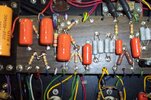
Thinking About A Variable Negative Feedback

ChasFred

Ambassador of Smooth Operations
Country flag
Ok this is what I am thinking about.
On my "68 Princeton Reverb thinking about adding a pot in series with the Negative Feedback Resistor.

The '65 PRRI uses a 2.7K feedback resistor, and is a cleaner sound as compared to the '68 PRRI which uses a 5.7K feedback resistor.
My thought is to put a 2.7K potentiometer in series with a 2.7K resistor. Then I would be able to control when the amp begins to break up.

Steps:

1 Replace existing resistor with a 2.7K with one lead free
2 Install 2.7K pot on back panel.
3 Wire pot so that the feedback from the output runs to pin 3
4 Wire pot pin 1 to the free end of the 2.7k resistor
5 Wire pin 2 (wiper) to pin 3

I know we have members with a lot more experience and insight to this than myself.
Please give me your thoughts and suggestions.
 
Last edited:
I have similar on my 5F1, I believe I saw it in an Uncle Doug (RIP Rusty) episode on Youtube.
I halved the resistor value to allow for range to include more cleaner / more feedback included in the sweep of the pot.

I wired mine so turning the pot "up" -clockwise -ADDS NFB, (reduces resistor value) opposite of gain.
But thats just how I perceived the way it should function.

I metered the whole thing before soldering it in to determine that the pot at 11:00 is at / close to the stock value of (WAG) 22kΩ.
I do use it, especially cranked with humbuckers I typically add a bit more NFB.

EDIT: I had some of this bass ackward initially.
 
Last edited:
I have similar on my 5F1, I believe I saw it in an Uncle Doug (RIP Rusty) episode on Youtube.
I halved the resistor value to allow for range to include more cleaner / more feedback included in the sweep of the pot.

I wired mine so turning the pot "up" -clockwise -ADDS NFB, (reduces resistor value) opposite of gain.
But thats just how I perceived the way it should function.

I metered the whole thing before soldering it in to determine that the pot at 11:00 is at / close to the stock value of (WAG) 22kΩ.
I do use it, especially cranked with humbuckers I typically add a bit more NFB.

EDIT: I had some of this bass ackward initially.

I am sure I will wire it backwards also. I mean that's the only way I know to do things.
Got to do it 2-3X before it is just right.
 
Ok this is what I am thinking about.
On my "68 Princeton Reverb thinking about adding a pot in series with the Negative Feedback Resistor.

The '65 PRRI uses a 2.7K feedback resistor, and is a cleaner sound as compared to the '68 PRRI which uses a 5.7K feedback resistor.
My thought is to put a 2.7K potentiometer in series with a 2.7K resistor. Then I would be able to control when the amp begins to break up.

Steps:

1 Replace existing resistor with a 2.7K with one lead free
2 Install 2.7K pot on back panel.
3 Wire pot so that the feedback from the output runs to pin 3
4 Wire pot pin 1 to the free end of the 2.7k resistor
5 Wire pin 2 (wiper) to pin 3

I know we have members with a lot more experience and insight to this than myself.
Please give me your thoughts and suggestions.

It is more noticeable to disconnect the feedback entirely with a switch.
Adjusting the feedback may make a scratching sound when the pot is turned.
But adjusting it (VS disconnecting it) won't make a lot of difference in the final sound.

A Dumble is a bit different than a stock Princeton...but try disconnecting the feedback and listen to see what it sounds like.

In a Dumble I think he tries to adjust it down to like 91 ohms, in which case it draws current. Anyway I'm not suggesting you try this...
 
Last edited:
I tried variable NFB on my 2204/Caswell #39 type amp. Given that an often overlooked part of the Caswell mod is the 27k NFB series resistor (as in the 100 supertrem) while the 2204 uses 100K off the 8 ohm tap. So I did the calculations using the 8 ohm tap, small value series resistor (can't remember value) & 100k Linear pot. At minimum pot rotation it equalled roughly 27k/16 ohm tap (which is a lot of NFB), at maximum pot rotation a little over 100k/8 ohm tap. This has a "very" noticeable effect on power amp's feel & response, tight & clean at minimum through to standard 2204's looser & dirtier at maximum.
In the end I took it back out as (aside from experimenting with) I never really used it (maybe should have made the two NFB components part of the footswitching process).

If your going to do it, I would suggest going from 2k7 through to about 10k or more (experiment to find values), which will give it more range, ie, from more NFB than its currently taking through to a reasonable amount less NFB than it is currently taking. Hope it works out well for you. Cheers
Edit:
And yes, you could also encorporated switchable "no NFB". I beg to differ on the "won't make a lot of difference in the final sound" if you choose the right values. Cheers
2nd Edit:
Don't be afraid to use a LOT larger value pot (I used 100k). Just a standard pot will be fine as the NFB component is "voltage" feedback, not current feedback. Cheers
 
Last edited:
I'm wondering what one of these '68 PRRI's, or any PR's, would sound like with no NFB... :hmmm:


Not to hard to find out. Just put a jumper around the resistor.
I may pull mine apart this weekend, if I do I will try and let you know.
 
Not to hard to find out. Just put a jumper around the resistor.
I may pull mine apart this weekend, if I do I will try and let you know.
I might try this too. My Allen Amp's Sweet Spot is based on a Blackface Princeton Reverb.
 
Not to hard to find out. Just put a jumper around the resistor.
I may pull mine apart this weekend, if I do I will try and let you know.
No no no, this is not right. To accomplish "no negative feedback" you need to break the NFB circuit somewhere between the OT secondary (where the feedback is taken off from) & the point at which the feedback is applied to the PI.
To "bridge" (aka shunt) the resistor with a jumper will mean you are applying 100% of the voltage component of the output as negative feedback.
Lift one end of the NFB series resistor to see how your amp fairs without NFB. Cheers
 
No no no, this is not right. To accomplish "no negative feedback" you need to break the NFB circuit somewhere between the OT secondary (where the feedback is taken off from) & the point at which the feedback is applied to the PI.
To "bridge" (aka shunt) the resistor with a jumper will mean you are applying 100% of the voltage component of the output as negative feedback.
Lift one end of the NFB series resistor to see how your amp fairs without NFB. Cheers

Thank you sir, you just saved me from one of those rewire experiments.
So now instead of doing this 2-3X, it is just 1-2X.
Good eye my friend.
 
Hopefully I posted before our buddy Sysco tried it, not that I think it would do damage (the heavy current being taken care of by the speaker/s), but it is a LOT of negative feedback (I imagine output would be greatly reduced, among other things). Glad to be of help. Cheers
 
I'm wondering what one of these '68 PRRI's, or any PR's, would sound like with no NFB... :hmmm:

From a sustain standpoint no NFB is better,
but there is more noise and more low frequency ringing potential without the NFB. The feedback is more of a damper against low frequency resonances.

This was bound to become a problem with larger output transformers like a bassman, that have extended low frequency response.
But a Princeton doesn't have that extended low frequency in either the OT or the speaker....

IMHO I would change the Princeton phase inverter first. The stock phase inverter is more stinker than crunch.
 
Thank you sir, you just saved me from one of those rewire experiments.
So now instead of doing this 2-3X, it is just 1-2X.
Good eye my friend.
You take the resistor out, you don't jumper the resistor.
It doesn't hurt anything.
What you have is the same amplifier without the added feedback.

The amp was designed that way, the feedback was added last.
The feedback is stuck in there to make it conservative. Makes it a little less wild.

Mesa does the same thing, it's called "extreme mode." They just put a switch in there to shut off the NFB.

It depends how you like to play. I like it without the feedback because the sustain and harmonics increases.
Other players find the sustain too difficult to control.

However in the Princeton I would do more changes besides that.
 
Back
Top