
You are using an out of date browser. It may not display this or other websites correctly.
You should upgrade or use an alternative browser.
You should upgrade or use an alternative browser.
The Muse I Adorn
- Thread starter RVA
- Start date

Session 5
Ambassador of Strings & Wings

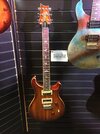
Was down at the shop yesterday test playing a guitar the PRS Se Cssr. Its a good playing guitar had double Humbuckers. They are made in Korea the Quality is very good. Pickups gave great tones, had a three way switch with volume and tone knob. They have a bit of weight to them, but the axe was balanced. I have a friend who likes them, thought I would try one out. They have had it sitting in the shop for roughly a couple of years now, was $900 down to $799. I am surprised nobody has taken it, They call it red in colour its a deep red very nice finish and nice wood grain. I will keep watch on it. I haven't notice much action on site here about PRS they make some nice axes.
OP

RVA
Ambassador
AgreedI haven't notice much action on site here about PRS they make some nice axes.

BlackSG91
Ambassador of Anarchy
Holy sheep
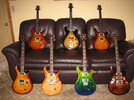
 e...you're a guitar hoarder like me Ray...that is sure one nice looking collection of axes you are sporting there!
;>)/

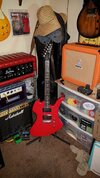


I haven’t seen a coiled guitar cord in like forever
Like, capacitance is a groovy thing, Man...

Tony M.
Ambassador
The coiled cord causes the electrons to whip themselves into a frenzy as they race down the spiral.
By the time they reach the amplifier they are dizzy and disoriented so they scatter and increase the
harmonic content of the notes and chords. You get a much bigger splatter of sound that way.

By the time they reach the amplifier they are dizzy and disoriented so they scatter and increase the
harmonic content of the notes and chords. You get a much bigger splatter of sound that way.
The coiled cord causes the electrons to whip themselves into a frenzy as they race down the spiral.
By the time they reach the amplifier they are dizzy and disoriented so they scatter and increase the
harmonic content of the notes and chords. You get a much bigger splatter of sound that way.
There are quite a few old coiled cords up at Mom's. Every one of them has higher capacitance than a straight cord because of their longer signal path. Some of the old relics have Gibson embossed on the threaded sleeves.

syscokid
Ambassador of War & Peace
Especially with an overly bright signal chain or amp.Like, capacitance is a groovy thing, Man...
Very well said...The coiled cord causes the electrons to whip themselves into a frenzy as they race down the spiral.
By the time they reach the amplifier they are dizzy and disoriented so they scatter and increase the
harmonic content of the notes and chords. You get a much bigger splatter of sound that way.

Especially with an overly bright signal chain or amp.
Very well said...
My normal, everyday practice cable is 50 feet long.
Geez, Man...I was just looking at my rig this morning....
DSL40C with a 50' cable from the guitar into a magic switching A/B box, patched into Boss CS-3, then patched into a NS-2 then a 7' dual path/dual shielded cable into the front of the amp...a 10' dual/path/dual shielded cable from effects loop into Boss FV30L, patched into Boss DD-3, then another 10 footer back into the amp - then on the 12 string side - 20' brown tweed cable (all six string cables are black) into Marshall DSL40C into magic switching A/B box, then another 20' tweed into the Marshall Valvestate VS265.
The magic switching A/B is the only device I don't currently have, but it's laid out with tape to check the cable and patch lengths.
I have almost as many cords as @Dave Sloven!!!
Last edited:
The coiled cord causes the electrons to whip themselves into a frenzy as they race down the spiral.
By the time they reach the amplifier they are dizzy and disoriented so they scatter and increase the
harmonic content of the notes and chords. You get a much bigger splatter of sound that way.
Street Tacos also produce a splatter of sound and particulate matter.

eSGEe
Ferengi Ambassador of Trade
Sure....why not ......The coiled cord causes the electrons to whip themselves into a frenzy as they race down the spiral.
By the time they reach the amplifier they are dizzy and disoriented so they scatter and increase the
harmonic content of the notes and chords. You get a much bigger splatter of sound that way.


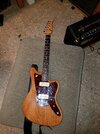
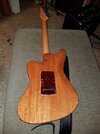
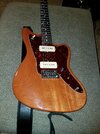
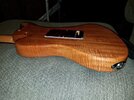
Session 5
Ambassador of Strings & Wings
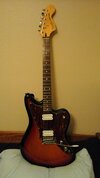
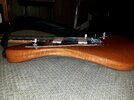
Tonight I'm playing... my '07 Squier Jagmaster. 24" scale, Duncan Designed humbuckers with push/pull coil splitting.
View attachment 11925
Nice guitar!
OP
RVA
Ambassador
Somewhere around 3/64 on the high E and 1/16 (or a touch lower) on the low E with minimal relief, if the guitar will allow. If it won't, it is off to the bench!!.What kind of action you use on your axes RVA.