Sorgenkind

bea

AmBASSador of the F Clef
Country flag
(engl: problem child).

This one will describe a decade old history of a mistreated archtop. It is actually a thread, but so intensive that i think it is better posted here.

It is about an old thinline archtop. A real archtop just with narrow rims. Teardrop holes, black rose sunburst, lots of perloid. Very narrow neck.

The guitar has a history. It must have been made in the early 60s as a prototype or by a student. Never finished, i saw it without hardware in the factory, when i brought my student guitar for a correction. I must have been 16 at that time. Although it was a simple and relatively low budget guitar, it would have been a beauty if it had been finished. A year later in the school orchestra my fellow at the same stand came up with it. And he did "gibsonize" it: modify the headstock to open book and with the Gibson logo, increase the pickup holes to mount humbuckers. He gave her golden '71 T-tops with Gibson Logo and increased the small holes for pots and switches to something irregular.

Unfortunately he cut through the bass bars in order to mount the neck pickup. So the guitar lost itst stability.

A few years later i bought it for him to the price of the pickups and the case. He sold it because of the stability problems. I played it for a few years as well and then decided to go for a real archtop without all those problems and annoyances. Mostly the neck (lacking a trussrod) was not straight anymore.

When the archtop was there, i decided to try to repair and to modify it: straighten the neck and try to compensate for the broken bass bars. I also did a neck reset - i wanted a neck angle closer to that of an ES335. A good opportunity because the neck became loose by the heat and humidity of the neck straightening process. I also gave her a new tailpiece, a new bridge and new plates for the electric parts, all from maple.

And thats the result - many years after my then little children had their fingers on the pickup frames too often:
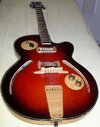
Front.jpg

In the meantime i spent a lot of time and effort to stabilize the top which was sunken in at the damaged bassbar. With very limited success.

So a few years ago i did some major work to make it playable again....
 
Hey Wave we really need a GIANT "drooling" smilie now that bea is here cause.....well......I am gonna need to use it!!!!!
 
I think some of You might know what will follow. I would like to give a few more details and a bit more background here than is meaningful in a SG community (the primary project thread will be located in the german speaking www.gitarrebassbau.de).
 
Maybe its time to add a few pictures of how it went on. Here the gibsonized headstock which i had already cutted as short as possible because the guitar has been too large for it s case, which seemed to be the major cause of the bent neck. You also see the extremely narrow string spacing. Normal string spacing can be achieved by reducing the No. of strings to 5. That finally happened, but mainly as an aftershot to reduce load on the top.

file.php


An old German archtop labeled as Gibson is a bit ridiculous in my eyes. I wanted to get rid of it and tried to reconstruct the old shape, which was the common lyre-shape decorated with MOP. Possibly like this one, but there were variations according to the brand they were made for:

hoyer-01.jpg


Here the headstock with the decoration removed and a sketch of the old shape as far as i could recover it:

file.php


Some new headstock veneer:

file.php


I ended up with a different style which was typical of another maker. Still strung as a 6-string.

file.php
 
This is a really cool thread.

I really like what you've done with that guitar.

Very nice, Bea!
 
Just let me continue with the story...

The holes in the body had to be filled somehow:

file.php


And then i decided to convert it into a 5-string. The body was still too weak for the tension of 6 strings, and the width of the fingerboard gave ideal spacing for just 5 strings. Which meant i needed a new nut in the old style. Luckily i managed to get one from a dealer specialized in German vintage guitars.

file.php


Of course i also needed a custom bridge:

file.php


It played fine and sounded really cool. BTW the tuning was quintic: CGDAE
After a while of happiness i saw that. That was last November.

file.php


OMG

AAAARRRGGGHHH!
 
You got it? The top is sinking in again :-(

Which means:

a) hang it on the wall as a decoration.
b) throw it away.
c) take it apart and rebuild it.

Guess what my choice was.
 
I agree with RVA...

Please, I hope you picked take it apart and rebuild it.

The suspense is killing me!
 
I hope You are aware that the repair will be massive... please expect that even an amateur might spend the same time to build an archtop (well, not quite, my 1st and up to now only build took about 200 hours...)

As i had already spent lots of hours to repair the structural weakness through the holes in the body, the only chance was to open the body and do a full restauration.

Main tasks: fill the pickup holes, replace the tone bars by new ones and do a neck reset. And repair all the traces and cracks of the previous repair attempts. And everything i might detect in addition to what i know already.

BTW: i am living in a one room appartment and can only use a vice clamped to an old table (which over the has intensely been used during guitar making and other woodworking attempts).
So let's start....

... and remove the outer binding. It turned out that the inner pert is entirely part of the bottom and thus can stay. Be careful in the hope to be able to reuse it.

file.php


Use an old fish knive to carefully open the glue joint. Warming up was difficult, no, actually dangerous: the binding is made of celluloid which might start to burn if it is heated above some 60° C. Furthermore, the guitar was build with PVA glue. The celluloid was probably attached using Acetone.

file.php


The upper end block needed "special" treatment. You'll soon see why...

file.php
 
Next chapter: the box is open.

The old bass bars: very high and pretty short. And You see two of the holes.

file.php


The endblock and the extension i set into the body in order to stabilze it. Partly worked.

You also see the damaged ends of the bass bars and my attempts to stabilize the thing through the two holes. Later on i noticed that the two holes with that very narrow distance made up for the biggest part of the weakness, especially because the plywood was broken there. You also see the filling in the head block. I set that piece of wood in during a neck reset. Those wooden blocks look ugly. The most important part of that job, adapting the blocks to the shape of top and bottom were carried out carefully. The y did their job as well as it was possible because of the other problems.

file.php


And also the old bass bars - after marking their position. You see that i also started to repair the first of the broken edges of the top.

file.php
 
Next chapter: the box is open.

The old bass bars: very high and pretty short. And You see two of the holes.

file.php


The endblock and the extension i set into the body in order to stabilze it. Partly worked.

You also see the damaged ends of the bass bars and my attempts to stabilize the thing through the two holes. Later on i noticed that the two holes with that very narrow distance made up for the biggest part of the weakness, especially because the plywood was broken there. You also see the filling in the head block. I set that piece of wood in during a neck reset. Those wooden blocks look ugly. The most important part of that job, adapting the blocks to the shape of top and bottom were carried out carefully. The y did their job as well as it was possible because of the other problems.

file.php


And also the old bass bars - after marking their position. You see that i also started to repair the first of the broken edges of the top.

file.php
No pics.
 
Mhmm, and in the previous posts? (i did nothing different, just inserted image links into the same forum....)
 
During the night hours that server - located in Germany or Switzerland - seems to be down for short time, at least occasionally.
 
Maybe it is time for the next chapter: closing the holes.
The main difficulty is that it is impossible to do that without visible traces hiding all those scars. So if You can't hide it emphasise it. Hopefully intelligently.

FIrst the pickup holes.
I decided do open up the old holes a bit, make the borders even, fill the breakouts, and round the edges. Fillings of wood will be used - i had a test piece of apple wood for a fingerboard available which was treated with oil and did not look pretty. Ideal to cut the fills from. They will be designed to mimic pseudo pickups. Elevated and stained black. Apple is really easy to stain and also easy to form with a knife.

file.php


Adapted to the inner surface

file.php


Fixing a knothhole in the inner layer of the plywood

file.php


From the outside:

file.php
 
Back
Top