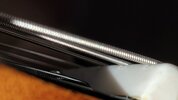
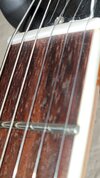
Slotting Gibson Les Paul Nuts:

Tonight, I cut a nut for my main Les Paul from a Corian blank I had laying around.

Using my Stewie-Mac fret saws, and following the headstock angle,, I slotted the nut straight, keeping first fret height to my preferred setting of .020" unfretted.

Using .009, .011, .016, .026, .036, .046 strings, I profiled the slots as follows:

E = .051"
A= .041"
D= .034"
G= .024"
B= .015"
E= .013"

Once I had the shape of the slot, I then added a rounded bottom with my selection of welding tip cleaners.

Then I shaped the nut profile in such a way that I created a 'fall away' on the tuning key side, so the lateral bend in the D and G strings is actually taking place in mid air.

Will post pics in the morning...
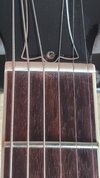
 
I intentionally made the d and g slots a little wider...plus, I added the "fall away" at the back of the nut. Note the perfectly rounded floor profiles and not a square-cut that will wear deeper over time...

20210520_074550.jpg

And here you can see how slot depth is about 1/2 of the string's diameter:
20210520_074113.jpg
 
Last edited:
String height at the nut slots: Due to my heavy handed and semi-sloppy playing techniques, a personal preference is to have the height extremely close to just above the height of the first fret.

Fretting a string between the 2nd and 3rd frets, I'll look and feel for a string gap over the 1st fret of just less than .01 for the E, A, & D strings; and down to less than .005 for the G, B, & the high E strings. This goes along with my prefered small amount of neck relief too.
 
I can't get multiquote to work for some reason, probably because I don't know what I'm doing, lol. Anyway, the reason I asked was because I just had 3 of my guitars set up by a "pro" because I didn't have the tools to work the nut slots and I wanted it done right and I wanted the fret levels checked, but like always I am disappointed and once again I see that I'll have to learn to do it myself. That's how I got into working on my own guitars in the first place, I've never had a good set up from a so called Tech or luthier in 30 + years. I don't know where the good ones are, but I've never found one.

So the nuts are slotted slightly different on each one of the guitars I had set up and I don't think any of them are right, that's when I ordered the files and now I'm ready to fine tune them.

One of the nuts is cut too low so I'll be redoing it, the others are set at .020" at the low E, but one of them steps down to .013" at the high E, the other is .020" for all the strings. I personally think the one that steps down from .020" to .013" feels the best, but the low side still feels a little high to me so that's when I posted the question yesterday. I guess I'm going to have to experiment until I learn what feels best to me.

Thanks for your replies and sorry for the hijack. :cheers:
 
Last edited:
You can shim the nut temporarily with a strip, or layered strips, of business card, etc. if you go too low.
I have sanded too much off the bottom of a new nut fit twice - check the overall height with the strings under tension.

I'm going to redo it also because one of the slots spacing is slightly off and I don't like that.
 
String height at the nut slots: Due to my heavy handed and semi-sloppy playing techniques, a personal preference is to have the height extremely close to just above the height of the first fret.

Fretting a string between the 2nd and 3rd frets, I'll look and feel for a string gap over the 1st fret of just less than .01 for the E, A, & D strings; and down to less than .005 for the G, B, & the high E strings. This goes along with my prefered small amount of neck relief too.

If I'm lower than .020" at the first fret, I can't get under it to bend it in the first three frets...
 
Wow, this method of slotting a fall away into the nut gives rock solid tuning stability.

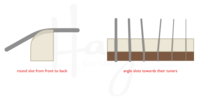
I don't angle my slots like this:

Nut+-+How+I+make+a+Nut+-+Cutting+Bone+Nut+(Part+2)+Slot+Direction.png

Instead, I cut the slot straight and let the string move laterally in the fall-away section...
 
Back
Top