Amp Mad Scientist
Ambassador of Heresy

The PI coupling caps are not what most people would suspect.I kind of stalled - thanks for the specifics and staying with me on this.
I will swap those PI coupling caps out this weekend if I have them on hand - I think I do.
The resistance between each pin 3 and the center tap (B+) has always been 19.4-19.5Ω for both, with the tubes in, power off.
I will check it with tubes out; it should be the same I would think.
But those little buggers can sneak up on you.
The purpose is to block PI high voltage from leaking into the output bias voltage.
But just a little leakage can cause a big headache...
And sometimes that leakage is intermittent not constant....sometimes leaks, then it stops, then it starts again.
It can drive you nutty. Of course this doesn't happen in all amps and it's hard to catch it when it happens.
Tubes out.
Standby on operate position.
Set meter for DC volts...
Now put red meter probe on one lead of the PI coupling cap.
Black probe on the other lead of the same PI coupling cap.
Now read the entire DC voltage, ACROSS the PI coupling cap.
It's a higher voltage than the highest B+ voltage anywhere in the amplifier....
and typically much higher than the cap is rated. No wonder it leaks.
Now you start to see why I use 630V caps for the PI coupling.
The blasted things are almost always underrated, from the factory.


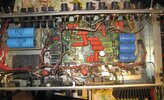
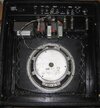
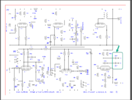

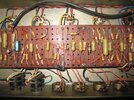
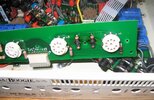
 pulling the board out.