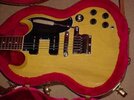
Short vibrola on Epiphone '61 SG Special.

Alex_SG

Ambassador of Trippy Rock
Country flag
Australia
After a couple of YEARS thinking about it, I finally decided to mount a short vibrola on my Epiphone '61 Special SG.
I haven't played my old G400 "EpiKrieger" for a long time, so instead of buying a short vibrola, I decided to modify the long one on my G400.
I put the original stop tail on the G400, including the original studs, and took the long Allparts vibrola off.
I cut off the frame that holds the plate on with a Dremel cut off wheel, and smoothed it down flat.
You can see where the frame has been cut off, but I think it looks pretty good, and it sounds awesome!
Without further ado, here it is:
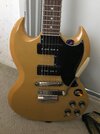
image.jpeg

I think it's quite a neat install. Going against my better judgement, I didn't actually measure anything, just eyeballed photos of early 60s SGs on the 'net, and voila. It lines up, looks cool and sounds great.
 
Last edited:
Thanks! I had been in two minds as to whether I should do it or not, but I had been thinking about it for a couple of years. Finally I thought "F**k it" and started cutting the frame off.
I only did it an hour or so ago, and I really like it. Don't know why I left it so long...

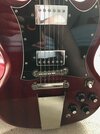
I saw this picture, and knew I was making the right decision...
image.jpeg
I'm planning on keeping this little '61 SG, so I'm not too worried about drilling the 3 holes required...
 
Last edited:
Well done, good result.
I sure understand why you held back for a couple of years. Screwing non standard holes into such a nice guitar would be beyond me :unsure:
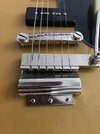
Got a side on shot?
 
Yes sir! Side on picture and one from below.
I nearly talked myself out of it (again) today, but I'm actually glad I did it...
If you look closely at the second pic, you can see where i slipped with my dremel and nicked the side of the plate, but it's not that visible.
All in all, I'm happy with the job...

image2.JPG
Side on view.

image1.JPG
Bottom view.

I got one of those Stewart MacDonald guitar tech screwdriver kits a while back, and it has "screw starter" bits that you can screw into the body without using a drill. If you don't use too much pressure, the holes turn out perfectly and are already threaded for the screws you're using.
 
Last edited:
Not seen this system in the flesh.
So it works by flexing the bottom (male) bracket but the metal has enough memory to return to the tuned position?
 
Close enough... The main body of the system is made of spring steel, so when it flexes (when you move the arm) it returns back to where it was.
 
So simple.
I have an engineering background and could design something much more complicated that would word almost as well. :p

That's the beauty of the Maestro-type vibrolas...just a curved piece of spring steel and a string anchor. I love mine. They work very nicely.
 
only thing i ever noticed about having a Vibrola on a wrap around style bridge is the tailpiece wants to rock around a little when using the Vibrola.on the TOM bridges they are stationary on studs so it dont rock around.
 
but hey theres thousands of guitars out there with Vibrolas on guitars with the wrap around bridges so what the hell do i know
 
So what does one do when there are holes left where one has removed the vibrola from one guitar and transplanted it onto another?

Why, you bolt the frame and cover plate back on, of course, a'la Derek Trucks!

image.jpeg

Not perfect, but better than having 6 holes visible!
 
Blasphemy! Burn 'm at the stake! Get a rope! Find a tree and hang ' em high!o_O
Just kiddin..... Actually my old Gibson '64 SG Special had one of those things on it when I brought it in '64. And yes, the bridge moved around and it made me nuts so I pulled it. Those three holes never bothered me a bit and it was the only guitar I ever regretted selling after nearly 50 years of owning it. :cry:
Little brother, if it feels right. It looks right. And if YOU believe it's right. Then it IS right! Nice piece of work !(y)
 
Funny enough, it seems to keep in tune really well.
After playing it for a while yesterday, I re-tuned it, and left it for about 18 hours at full string tension.
I just finished playing it about an hour ago, and it's still almost in perfect tune.
The bridge does move a tiny bit, but I have a fairly light touch when I play, and definitely when using a tremolo, so it's really a non-issue for me.
And yeah, I really do like it. I actually had to drill the center hole myself - The Allparts long vibrola only has 2 holes in that part of the frame. I wasn't sure if I really needed the third hole, but for the sake of looks (I guess it was vanity!) I decided to drill it.
Thanks for your kind words big brother!
 
A trick you can use is to take some copper shim material (a bit thicker than foil) and wrap a narrow strip on the bridge screws under the heads. This will bite into the bridge slots when reassembled and also into the posts. Often one strip is enough to keep the bridge stationary and does nothing to dampen tone. Just slack the strings and slip the U shaped shims into the bridge slots and ease it forward into the posts. Tune up and let it take a set for a bit. Then see if the bridge stays put. If not a bit more shim. Make sure you have shim material that wraps around both sides of the slot. Some super minute intonation change may, and that's minute now, occur. But will not be noticeable except to the most discerning ear. When changing strings go gentle and you won't disturbe the shims in place.
The above is an old T Worm shop trick that used to cost $20 USD. Hey, they were paying for the knowledge and shim cutting and positioning. But this one's a freebie!! HA!:dance:
 
Good tip, thanks brother!
(Now I gotta find where I can get some of this magic copper shim stuff!!!) ;)
 
If need be you can strip some solid copper wire and twist it into a rope-like looking bit. Then hammer it into shape with a small hammer and a flat piece of iron or an anvil part that many bench vices have. This has been used a lot in my old line of work. Copper is best forged cold so you're good without any heat like with iron. Also, copper won't rust like iron or steel and conforms to the shape inside the bridge post pockets.
 
Back
Top