OP

Mr Grumpy
Ambassador of Comings and Goings

By the way, how is the Vibrola holding up? Does it hold the tuning well? Have you done anything to the nut to make tuning stability better, or was ist well cut to begin with?
The vibrola is perfect, keeps tune well; I rarely use it, but the guitar goes straight back into tune after I do.
I had a good go at the nut - I used strings to cut the nut because I didn't have files, an 11 to cut the highE, a 16 to cut the B, a 26 to cut the G, a 36 to cut the D, a 46 to cut the A, and a good wiggling 46 to widen the lowE. Gibsons clearly have problems with the D and G (especially the G), so I rounded the angle a bit at the nut coming from the tuning pegs - seems to have worked well.
People seem to have different ideas of how strings should sit at the nut, and when the guitar came the strings were sitting on the nut, maybe halfway in (if that), but I like the strings to be in the nut, in a smooth space with a bit of room and with a bit of angle going towards the tuning pegs. Gibson seems to cut the nut slots straight which produces more string binding at the nut, imho.
I'm very happy with tuning stability now; the work on the nut along with the locking bridge studs (the locking faber studs really keep the bridge straight and rigid) has worked perfectly. These two areas are kinda vital for a Gibson, and I reckon a lot of owners should consider upgrades in this area (I'm sure most posters on here do already).
Do you reckon the nylon saddles in your DT SG help? The vibrola certainly helps to improve a Gibson wraparound - without the vibrola, the Specials could probably do with a heavier locking bridge like the one Sysco put on his Special. I'm not sure that the standard lightening wraparound is stable enough - it'll be interesting to see what bridge solution SG John goes for with his 2019 SG Special; he certainly knows his SGs!
Before:
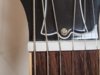
^ you can see a couple of things: 1) the highE is kinda going over a little mountain at the nut, strange (the A has a similar problem and thus binds at the first corner before dropping down into the nut as the string leaves the nut); 2) the D/G do have a bit of angle, the slots aren't absolutely straight, but especially the G is being caught on the corner which makes the string bind at the nut.
After:
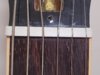
^ pretty ugly effort on my part, but the strings can move smoothly through the slots which is what I was after...
Last edited: