Questions About Marshall MG102GFX:

Inspector #20

Ambassador of Tone
Fallen Star
Country flag
I have a 1999 Marshall MG50 that I've used for years as both a practice, keyboard and backup amp. I played through it at our live performance Saturday night and it worked famously.

I'd really wanted a Valvestate Bi-Chorus 8200 Head or 8280 Bi-Chorus 2x12, but after looking at several - and rummaging through all the E-Bay and Reverb ads - all of them are either physically damaged (which concerned me for health of the guts) or they have some squeal, intermittent volume drop or some other anomaly that scared me.

Since I'm not even a novice amp tech, I felt that maybe I should look into something newer.

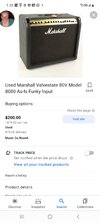
The MG102GFX really caught my eye because it has all the features/dimensions I'm looking for. These amps are hard to find.

I saw something interesting in the specs that I wanted to ask about.

It's a 2x12 with a single speaker output cable that reads 4 ohm minimum load.

The specs claim the speakers are 4 ohm.

What are your thoughts as to what's inside the closed cabinet????
 
I saw something interesting in the specs that I wanted to ask about.

It's a 2x12 with a single speaker output cable that reads 4 ohm minimum load.

The specs claim the speakers are 4 ohm.

What are your thoughts as to what's inside the closed cabinet????

The MGs are solid-state, hence will accept a wider range of speaker loads.

The 4 ohm minimum means just that - minimum. You could go higher, to a limit.

Two 4 ohm speakers in parallel would be 2 ohms. Two 4 ohm speakers in series would be 8 ohms.

I have seen amplifiers that will accept a 2 ohm load, but they are higher-powered PA amps.

My thinking is that the two, built-in 4 ohm speakers are wired in series so that the internal speaker connection “sees” 8 ohms.
 
The MGs are solid-state, hence will accept a wider range of speaker loads.

The 4 ohm minimum means just that - minimum. You could go higher, to a limit.

Two 4 ohm speakers in parallel would be 2 ohms. Two 4 ohm speakers in series would be 8 ohms.

I have seen amplifiers that will accept a 2 ohm load, but they are higher-powered PA amps.

My thinking is that the two, built-in 4 ohm speakers are wired in series so that the internal speaker connection “sees” 8 ohms.

Thank you @smitty_p. That makes sense to me now.

Would my 16ohm cabinet, wired for 8 ohms total load, be less efficient than two 4 ohms wired for 8 ohms???
 
Thank you @smitty_p. That makes sense to me now.

Would my 16ohm cabinet, wired for 8 ohms total load, be less efficient than two 4 ohms wired for 8 ohms???

I’m not sure what you mean by “efficiency”. Efficiency is a rating of the speaker, itself. A more efficient speaker will be louder for a given input level than a less efficient speaker. But, for guitar amps, sound quality is a more important factor. Some very efficient PA speakers may not actually sound too great for a guitar amp.

The wiring scheme won’t add to the efficiency. It’s just what you’ve got to do to give the amp the load it is looking for.
 
I’m not sure what you mean by “efficiency”. Efficiency is a rating of the speaker, itself. A more efficient speaker will be louder for a given input level than a less efficient speaker. But, for guitar amps, sound quality is a more important factor. Some very efficient PA speakers may not actually sound too great for a guitar amp.

The wiring scheme won’t add to the efficiency. It’s just what you’ve got to do to give the amp the load it is looking for.

Ok!!!!

I didn't understand that, so I appreciate the clarification!!!!

If I go with the head version (MG100HFX) then I will likely use (2) Celestion 250watt, 8 ohm Copperbacks (101 db spl) wired to it's own jack, so each output of the head has it's own speaker. The clean headroom of the Copperback is phenomenal.

It does not impart any 'spiked' areas to your tone, like people so often choose a speaker to 'color' their amp's tone. I want a 'colorless' speaker that allows me to exploit my multiple EQ's.

Additionally, speaker breakup is very inefficient and it is like nails on a chalkboard to me. I want headroom and loundness without "flub" which allows me to run huge levels of bass with enough mid and presence to offset it.

My ideal rig has been described (to me by others) like two amps running at once - a bass amp with a very tight, focused, lower mid that hits you when you are in front of it, coupled with a chain-saw esque upper mid range that swirls through the mix like like a sonic overtone.
 
Last edited:
This MojoTone article I just stumbled across is cool....

Guitarists are frequently chatting about how swapping speakers in any given amp or cab can quickly change up your tone, and for many years the topic trended toward the way in which more-efficient speakers can make an underpowered amp louder. That’s certainly true; changing a speaker with a 95 dB rating for one with a 100 dB rating can sound like you’re suddenly using a much more powerful amp.

It's worth considering, though, that you can get a lot of tone-tweaker mileage out of going the other way, and that seeking out less efficient, less sensitive speakers might actually achieve the results you’re looking for. Put simply, a speaker’s efficiency (also expressed as sensitivity) determines how much volume it will put out for any given input. Which simply means that less efficient speakers are not as loud as those with higher efficiency ratings, given the same wattage pumped into them from the same amp. (Note that ,for the sake of consistency, a speaker’s “sensitivity” or “efficiency” rating indicates the decibel level the speaker will achieve when measured at one meter from the cone with a signal input of one watt, a figure generally listed as “1 watt/1 meter” or “1W/1M”.)


speaker-efficiency-image-2.jpg


There’s definitely an enhanced awareness of stage volume these days, and a general move toward acquiring great tone at suitable volume levels. The old-school method of “decibels be damned”—using a huge amp that only sounds its best when you get it cranked up way too loud for the gig, and blowing everyone’s hearing to shreds in the process—is pretty widely frowned upon. Instead, guitarists who want the cranked-up sound without the oppressive volume levels are searching high and low for effective ways of getting there, and dialing in your tone via carefully considered speaker efficiency is one way of getting there.

With this in mind, let’s consider that, as well as using a more efficient speaker to make a small amp louder, you can use a less efficient speaker to make a great but too-loud amp less loud. In essence, you make your speaker choice work something like an attenuator. The trick is, you still want good all-round tone, and choosing a speaker according to its sensitivity rating can limit you somewhat in that respect. Of course, swapping in a new speaker is always a little bit of a crap-shoot anyway if you don’t have the privilege of trying it with your own amp before buying it. But by reading the reviews, checking out the speakers your guitar-playing pals and band mates are using, and always keeping an eye peeled for the well-regarded speakers that carry slightly lower specs for efficiency, you can at least narrow down your selection.

Many vintage Jensen speakers typically have lower sensitivity ratings, and many reproductions, including some of the new ones in the Italian-made Jensen Vintage Reissue series, follow suit. The reissue alnico P12R and P12Q are both rated at 95 dB, which is fairly inefficient by today’s standards, and their ceramic counterparts the C12R and C12Q are even lower, at 93.8 dB and 94.6 dB respectively (consider these against the 98.4 dB rating of the P12N and C12N). Also, the new Jensen Jet Tornado neodymium-magnet speaker has a good all-purpose tone with plenty of warmth and roundness, and rates at 97.3 dB, while handling 100 watts of power. The Indiana-based speaker manufacture Weber Speakers also makes a number of good reproductions of vintage US-made speakers, and although they don’t publish their sensitivity figures, I know many of them fall in line with the lower ratings of the originals.


speaker-efiiciency-image-3.jpg


Celestion is perhaps best known for two great-sounding, classic high-efficiency speakers, the Alnico Blue and G12H-30, both rated at 100 dB, as are newer additions to the lineup such as the Alnico Cream and Gold. If you like that tone you might just have to make do with a loud amp. But the British company does have a range of great, if different, sounding drivers with lower ratings.

The legendary G12M Greenback comes in at 98 dB in the Chinese-made Classic Series and a mellower (and more authentic) 96 dB in the English-made Heritage Series (similarly, Mojotone’s own Greenback-inspired BV-25M comes in at a comfortable 97 dB). It’s a fantastic rock lead and rhythm speaker and an undeniable classic, although it doesn’t have the firm lows or snappy high-end twang that some players also need in a guitar driver, and it handles only 25 watts. The Heritage G12-65, however, offers much of the Greenback’s sweet midrange grind, but has a fuller bass response, clear, sweet highs, and handles 65 watts with an efficiency rating of 97 dB (original examples from the early ’80s are also often readily available on the used market, frequently offered up by players breaking up the big old 4x12 cabs the came in).

Note that the big American speaker maker Eminence makes some excellent sounding units these days, in their Legend, Patriot, and Red Coat series, although they are usually aiming for higher sensitivity specs than the speakers I have focused on so far. I do find, however, that some of them don’t sound quite as loud as their three-figure ratings might imply. The great Red Fang alnico speaker is spec’d at a whopping 103 dB, for example, but it sounded no louder than other 98-100 dB speakers I tested it against, so something like their 98.8 dB Legend 1218 or 99 dB Texas Heat might not be quite as blasting as you would expect.

In addition, Eminence released the FDM (Flux Density Modulation) series a few years back which includes the Maverick and the Reignmaker, both of which have adjustable voice-coils to allow the user to dial in their efficiency from 91.5 – 100 dB. The difference between the higher and lower of those figures represents a far more significant volume reduction than it might appear on paper.


speaker-efficiency-image-4-rev1.jpg


Explore the speaker market—there are a ton of options out there these days—and pay close attention to write-ups, reviews, and sound samples that exhibit each make and model’s sonic characteristics, while also paying close attention to their efficiency ratings.

Overall, you still need to select your speaker with tonal considerations at the top of your list. But if the driver sounds right to you and also drops your output down just a little, ideally allowing you to play right in the sweet spot without the sound guy and your band mates constantly shouting at you to turn it down, that’s a double bonus in my book.
 
Ok!!!!

I didn't understand that, so I appreciate the clarification!!!!

If I go with the head version (MG100HFX) then I will likely use (2) Celestion 250watt, 8 ohm Copperbacks (101 db spl) wired to it's own jack, so each output of the head has it's own speaker.

Cool!

I’ll give you another case-in-point to scratch your brain:

4x12 cabinets use a combination of series and parallel wiring. The cab will have four 8 ohm speakers. Two speakers will be wired in series to produce a speaker pair that presents a 16 ohm load. This will be done for the other two speakers, as well. Then, those two pairs will be wired in parallel to bring the load back down to 8 ohms. The amplifier only sees the resultant 8 ohm load.
 
Cool!

I’ll give you another case-in-point to scratch your brain:

4x12 cabinets use a combination of series and parallel wiring. The cab will have four 8 ohm speakers. Two speakers will be wired in series to produce a speaker pair that presents a 16 ohm load. This will be done for the other two speakers, as well. Then, those two pairs will be wired in parallel to bring the load back down to 8 ohms. The amplifier only sees the resultant 8 ohm load.

No reduction in speaker spl with the different wiring combinations????
 
I recall seeing Rob Zombie's guitarist Riggs using a wall of Marshall MG100RCD's back around 1999/2000. Marshall even had a cartoon poster of him with that backline...
 
No reduction in speaker spl with the different wiring combinations????

The SPL ( sound pressure level) capability of a speaker won’t be affected by the wiring scheme. What is affected is that the output of the amplifier is distributed among multiple speakers, rather than just one. This is important in that an amplifier can exceed a speaker’s ability. Spreading the output level among multiple speakers allows you to take advantage of the full output capability of the amp.

Are you really asking if a wiring scheme can affect the tone? If so, I’ve never read about this happening.
 
The SPL ( sound pressure level) capability of a speaker won’t be affected by the wiring scheme. What is affected is that the output of the amplifier is distributed among multiple speakers, rather than just one. This is important in that an amplifier can exceed a speaker’s ability. Spreading the output level among multiple speakers allows you to take advantage of the full output capability of the amp.

Are you really asking if a wiring scheme can affect the tone? If so, I’ve never read about this happening.
That's what I was looking to confirm.

Yes, I was under the impression that the wiring scheme affected tone. I thought I read that somewhere????
 
Spreading the output level among multiple speakers allows you to take advantage of the full output capability of the amp.
Then, on my 2x12 cabinet with (2) 8 ohm speakers and a head designed with two separate outputs, is there any reason why I couldn't just wire each 8ohm speaker with it's own dedicated jack, rather than run only one speaker output cable to a common jack, running two speakers???

I'm sorry to ask so many questions, but I'm making serious purchase decisions this week and I want to make sure I'm on the right track!!!!
 
That's what I was looking to confirm.

Yes, I was under the impression that the wiring scheme affected tone. I thought I read that somewhere????

I would be interested to see that, if you could find it. Implementing series and/or parallel wiring to achieve the correct speaker load to the amp is really a very basic and industry-standard practice employed everywhere from guitar cabinets to in-room AV installations.

I‘m not saying categorically such a tone issue may not exist; it’s always possible someone has done some research and analysis! But, I’ve never read anything to that point.
 
Then, on my 2x12 cabinet with (2) 8 ohm speakers and a head designed with two separate outputs, is there any reason why I couldn't just wire each 8ohm speaker with it's own dedicated jack, rather than run only one speaker output cable to a common jack, running two speakers???

I'm sorry to ask so many questions, but I'm making serious purchase decisions this week and I want to make sure I'm on the right track!!!!

Okay, there are some “IFs” here.

IF, the amplifier has two speaker output jacks, and IF each of your two speakers is within the specified impedance rating of those jacks, then, yes, you could directly run each speaker independently to each jack.

In fact, that’s an interesting idea! But, just be sure the speaker matches (or isn‘t rated below, as the case may be) the specified load impedance for that output. Double-check your manual to be sure there isn’t some other connection caveat or requirement.
 
This MojoTone article I just stumbled across is cool....

Guitarists are frequently chatting about how swapping speakers in any given amp or cab can quickly change up your tone, and for many years the topic trended toward the way in which more-efficient speakers can make an underpowered amp louder. That’s certainly true; changing a speaker with a 95 dB rating for one with a 100 dB rating can sound like you’re suddenly using a much more powerful amp.

It's worth considering, though, that you can get a lot of tone-tweaker mileage out of going the other way, and that seeking out less efficient, less sensitive speakers might actually achieve the results you’re looking for. Put simply, a speaker’s efficiency (also expressed as sensitivity) determines how much volume it will put out for any given input. Which simply means that less efficient speakers are not as loud as those with higher efficiency ratings, given the same wattage pumped into them from the same amp. (Note that ,for the sake of consistency, a speaker’s “sensitivity” or “efficiency” rating indicates the decibel level the speaker will achieve when measured at one meter from the cone with a signal input of one watt, a figure generally listed as “1 watt/1 meter” or “1W/1M”.)


speaker-efficiency-image-2.jpg


There’s definitely an enhanced awareness of stage volume these days, and a general move toward acquiring great tone at suitable volume levels. The old-school method of “decibels be damned”—using a huge amp that only sounds its best when you get it cranked up way too loud for the gig, and blowing everyone’s hearing to shreds in the process—is pretty widely frowned upon. Instead, guitarists who want the cranked-up sound without the oppressive volume levels are searching high and low for effective ways of getting there, and dialing in your tone via carefully considered speaker efficiency is one way of getting there.

With this in mind, let’s consider that, as well as using a more efficient speaker to make a small amp louder, you can use a less efficient speaker to make a great but too-loud amp less loud. In essence, you make your speaker choice work something like an attenuator. The trick is, you still want good all-round tone, and choosing a speaker according to its sensitivity rating can limit you somewhat in that respect. Of course, swapping in a new speaker is always a little bit of a crap-shoot anyway if you don’t have the privilege of trying it with your own amp before buying it. But by reading the reviews, checking out the speakers your guitar-playing pals and band mates are using, and always keeping an eye peeled for the well-regarded speakers that carry slightly lower specs for efficiency, you can at least narrow down your selection.

Many vintage Jensen speakers typically have lower sensitivity ratings, and many reproductions, including some of the new ones in the Italian-made Jensen Vintage Reissue series, follow suit. The reissue alnico P12R and P12Q are both rated at 95 dB, which is fairly inefficient by today’s standards, and their ceramic counterparts the C12R and C12Q are even lower, at 93.8 dB and 94.6 dB respectively (consider these against the 98.4 dB rating of the P12N and C12N). Also, the new Jensen Jet Tornado neodymium-magnet speaker has a good all-purpose tone with plenty of warmth and roundness, and rates at 97.3 dB, while handling 100 watts of power. The Indiana-based speaker manufacture Weber Speakers also makes a number of good reproductions of vintage US-made speakers, and although they don’t publish their sensitivity figures, I know many of them fall in line with the lower ratings of the originals.


speaker-efiiciency-image-3.jpg


Celestion is perhaps best known for two great-sounding, classic high-efficiency speakers, the Alnico Blue and G12H-30, both rated at 100 dB, as are newer additions to the lineup such as the Alnico Cream and Gold. If you like that tone you might just have to make do with a loud amp. But the British company does have a range of great, if different, sounding drivers with lower ratings.

The legendary G12M Greenback comes in at 98 dB in the Chinese-made Classic Series and a mellower (and more authentic) 96 dB in the English-made Heritage Series (similarly, Mojotone’s own Greenback-inspired BV-25M comes in at a comfortable 97 dB). It’s a fantastic rock lead and rhythm speaker and an undeniable classic, although it doesn’t have the firm lows or snappy high-end twang that some players also need in a guitar driver, and it handles only 25 watts. The Heritage G12-65, however, offers much of the Greenback’s sweet midrange grind, but has a fuller bass response, clear, sweet highs, and handles 65 watts with an efficiency rating of 97 dB (original examples from the early ’80s are also often readily available on the used market, frequently offered up by players breaking up the big old 4x12 cabs the came in).

Note that the big American speaker maker Eminence makes some excellent sounding units these days, in their Legend, Patriot, and Red Coat series, although they are usually aiming for higher sensitivity specs than the speakers I have focused on so far. I do find, however, that some of them don’t sound quite as loud as their three-figure ratings might imply. The great Red Fang alnico speaker is spec’d at a whopping 103 dB, for example, but it sounded no louder than other 98-100 dB speakers I tested it against, so something like their 98.8 dB Legend 1218 or 99 dB Texas Heat might not be quite as blasting as you would expect.

In addition, Eminence released the FDM (Flux Density Modulation) series a few years back which includes the Maverick and the Reignmaker, both of which have adjustable voice-coils to allow the user to dial in their efficiency from 91.5 – 100 dB. The difference between the higher and lower of those figures represents a far more significant volume reduction than it might appear on paper.


speaker-efficiency-image-4-rev1.jpg


Explore the speaker market—there are a ton of options out there these days—and pay close attention to write-ups, reviews, and sound samples that exhibit each make and model’s sonic characteristics, while also paying close attention to their efficiency ratings.

Overall, you still need to select your speaker with tonal considerations at the top of your list. But if the driver sounds right to you and also drops your output down just a little, ideally allowing you to play right in the sweet spot without the sound guy and your band mates constantly shouting at you to turn it down, that’s a double bonus in my book.

This is a really good article. I was on the road earlier but was planning on writing another response with many of these same points when I was able.

By the way, I second the article’s praise of Eminence. I’ve been really pleased with the Redcoat I’m using for my Rivera amp.
 
Okay, there are some “IFs” here.

IF, the amplifier has two speaker output jacks, and IF each of your two speakers is within the specified impedance rating of those jacks, then, yes, you could directly run each speaker independently to each jack.

In fact, that’s an interesting idea! But, just be sure the speaker matches (or isn‘t rated below, as the case may be) the specified load impedance for that output. Double-check your manual to be sure there isn’t some other connection caveat or requirement.

Paging @Amp Mad Scientist !!!!!
 
This is a really good article. I was on the road earlier but was planning on writing another response with many of these same points when I was able.

By the way, I second the article’s praise of Eminence. I’ve been really pleased with the Redcoat I’m using for my Rivera amp.

No complaints with Eminence.
 
Back
Top